The AI Awareness Framework™: How Brands Move From Invisible to Trusted in AI Answers
February 12, 2026 – Proprietary Research. A five-stage framework for LLM and chatbot discovery, recommendation, and brand risk.
Imagine a buyer typing this into an AI chatbot:
- “Best payroll provider for a 20-person company?”
- “What is a good alternative to My Brand X?”
- “Which companies offer this in California?”
And you don’t appear in any of the answers.
You know you do great work, so of course your brand is the right answer… and yet the model never says your name.
Not because it hates you. Not because it is broken. Because your entity authority isn’t what it needs to be.
Traditional SEO is all about getting a page to rank. SEO for AI is all about building your brand / company / product or service up to be the most trustworthy and reliable reference for the models and chatbots to quote.
| The new uncomfortable truth
In AI discovery, being known is not the same as being named. And being named is not the same as being trusted. |
Why this matters right now
LLMs have quietly become a front door for buying decisions. People are skipping the ten blue links and asking for a short list, a comparison, or a recommendation. When that happens, the model becomes the first filter between you and the customer.
People don’t even click anymore.
If the model does not surface you, you are not just losing traffic. You are missing consideration – the moment where the customer is actively selecting a shortlist.
How Large Language Models Actually Work (And Why That Changes Brand Strategy)
Before we talk about awareness, recognition, or recommendation, we need to address something more fundamental:
How do these models actually decide what to say when you ask them something?
Because if you misunderstand that, you will misdiagnose your visibility problem.
1. The Core: Predictive Language, Not a Search Engine
Large language models (LLMs) like OpenAI’s ChatGPT, Anthropic’s Claude, and Google’s Gemini are not databases.
They are not lookup tables.
They are not “Google with a chat box.”
At their core, they are statistical prediction systems trained on massive amounts of public text. Their job is simple:
Given everything seen so far in the conversation, predict the next most probable word.
That’s it.
But here’s the important part:
Because they’ve seen patterns across millions (or billions) of documents, they build an internal map of relationships:
-
Brand ↔ Category
-
Brand ↔ Use case
-
Brand ↔ Competitor
-
Brand ↔ Sentiment
-
Brand ↔ Geography
If your brand consistently appears next to “best payroll software for small business,” the model learns that association. It becomes part of the knowledge graph of your entity.
If it rarely appears in that context, it doesn’t.
2. The Model Has “Core Knowledge” (Its Frozen Memory)
I like to think of LLM’s and chatbots as high-school grads. Every LLM has a certain amount of knowledge it learns, and then one day the training stops and that is the cutoff date for that model(that’s what the difference is between ChatGPT 3.5, or 4, or 5, or 5.1, 5.2…). That means:
-
It was trained on a snapshot of the internet up to a certain date.
-
It internalized patterns up to a certain point.
-
That internal representation becomes its core knowledge.
Think about it this way. That high school grad has learned as much science, history, and math it’s ever going to learn.
This core knowledge determines:
-
Whether it recognizes your brand when asked directly. (in it’s training data, you are there)
-
What category it places you in. (it knows how to associate you with your industry)
-
What competitors it associates with you. (who to compare and contrast you with)
-
Whether it views you as niche, emerging, or dominant. (based on what the internet says about you)
If you are missing or weak in that internal core knowledge, no amount of prompting will reliably fix it.
This is the foundation of the Recognition (Entity Score) in the AI Awareness Framework™.
Recognition lives inside the model’s frozen knowledge, and you can’t change it when it’s set.
3. Search-Grounded Answers: When the Model Reaches Outside Itself
Because of this training cutoff, some models now supplement their internal knowledge with live retrieval (also called RAG – or Retrieval Augmented Generation).
For example:
-
ChatGPT (with browsing enabled)
-
Gemini
-
Perplexity
So what this means is like any good high school grad, if it doesn’t know the answer to something you’ve asked, it can go out to the internet look it up, and tell you the answer in it’s own words.
In these cases, the system can:
-
Generate a hypothesis answer.
-
Query the web.
-
Pull in relevant documents.
-
Synthesize a response grounded in fresh sources.
This changes the game, but not in the way most brands assume.
Search grounding does not replace core knowledge.
Instead, it layers on top of it.
If your brand:
-
Is not well defined,
-
Is inconsistently named,
-
Or lacks strong public signals,
The model may still:
-
Skip you.
-
Misinterpret you.
-
Or prefer more statistically dominant brands.
Search improves freshness.
It does not automatically create authority.
The study behind the AI Awareness Framework (what we measured)
The AI Awareness Framework™ was created out of the LLMtel.com Study that was completed in January of 2026.
The Study Data
The Entities:
We randomly selected 1000 entities that were input into the LLMtel.com AI Visibility checking tool, within a date range of 2025-08-18 to 2025-12-04.
Each entity had a unique report, with questions generated either by the user, or the LLMtel system, or a combination of both.
What do the LLMtel.com reports show?
LLMtel then went out to the internet and checked 2 things:
- Do the models recognize the brand? (Recognition Score)
- Yes / No – score out of 17. Each model that recognizes the entity gets one point per model.
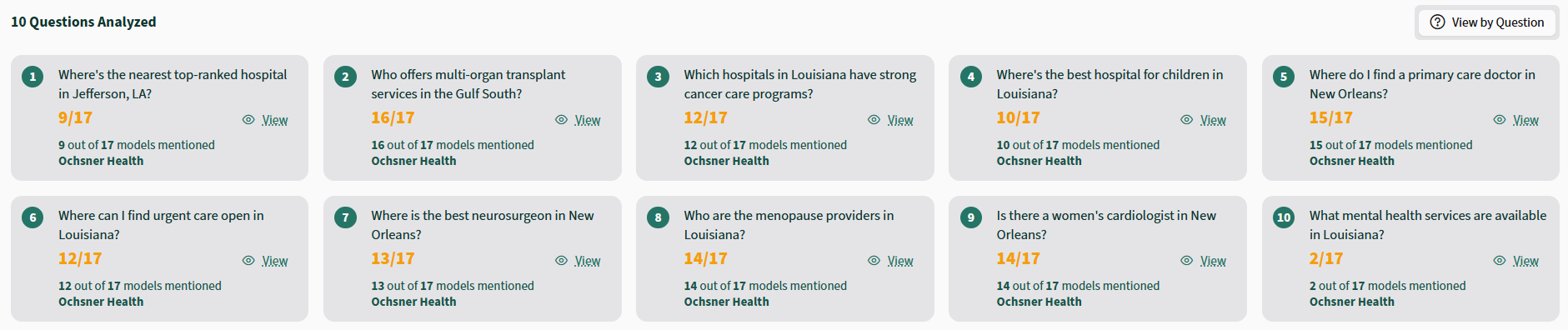
- Does the brand get mentioned in the answers to the prompts the user entered into the system? (Mention Score)
- Each question has a score out of 17. Each model that recognizes the entity in the answer gets one point per model.
Example of brand recognition score:

Example of search grounded mention scores:
The Models and Chatbots
For each entity, we checked 17 different models and chatbots for both Recognition and Mentions. This is the list of models checked for each entity:
- GPT-4o with Web Search
- Gemini 2.5 Series with Web Search
- Perplexity Sonar with Web Search
- GPT-4.1
- GPT-4o
- GPT-4o (model used in ChatGPT)
- GPT-5 Chat
- GPT-5 mini
- o3
- Gemini 2.5 Series
- Claude 4.5
- Grok 4
- DeepSeek Chat 3.2
- GPT OSS 120B
- Meta: Llama 3.3
- Meta: Llama 4 Scout & Maveric
- Qwen3 32B
The Data Set Details:
- 1000 LLMtel reports
- 17 models
- 1,000 entities
- 5,070 prompts
- 86,190 answers
This is enough scale to show stable, repeatable patterns.
| Two behaviors drive everything
Recognition: “Do you know this entity when asked directly?” (Entity Recognition Score) Mentions: “Do you mention this entity in answers to related questions?” (Question Mentions Score) Recognition is brand memory. Mentions are brand speech. |
Known vs named: the grid that exposes the problem
So what did the results show?
Interestingly, sometimes an entity is known in the Core Knowledge of the model, and not shown in the search results for the questions entered.
Sometimes it’s not known in the Core Knowledge, but gets discovered in search in the answer to a question.
And in the best cases, that entity is known in both the Core Knowledge and recommended in the search grounded answers to the questions.
What we found was when you plot recognition (known) against mentions (named), brands fall into repeatable buckets. In the 1,000-entity study, a surprisingly large group was recognized but never mentioned at all.
Enter the AI Awareness Framework™
The AI Awareness Framework™: five stages of how LLMs treat brands:

The 5 AI Awareness Stages (and what they really mean)
Stage 1 – Invisible
The AI doesn’t know we exist. Not recognized and never named.
How you fall in this bucket:
- Chatbots and LLMs do not recognize the brand (Recognition Score of 0).
- The brand never appears in answers, even when it logically should (Mention Score of 0).
Business meaning:
- You sit outside the AI market. No awareness, no consideration – only missed opportunity. You are invisible in both Core Knowledge and AI Search.
Stage 2 – Ignored

AI recognizes us, but stays quiet. Known by AI, but never mentioned.
How you fall in this bucket:
- If asked directly, AI systems understand who you are (Recognition Score of 1 or greater).
- But they do not bring you up in answers to relevant questions (Mention Score of 0).
Business meaning:
- You have awareness without consideration. You live in the model’s memory, not its recommendations.
Stage 3 – Misaligned
AI mentions us, but not reliably. Named, but not reliably known.
How you fall into this bucket:
- Chatbots and LLMs do not recognize the brand (Recognition Score of 0).
- Your name appears in answers (Mention Score of 1 or greater).
- But models don’t reliably recognize or understand the entity.
Business meaning:
- You have attention without understanding. This stage introduces brand risk: incorrect details, wrong associations, or misattribution.
Stage 4 – Aligned

AI knows us and uses us correctly. Recognized and named in relevant answers.
How you fall into this bucket:
- Models recognize the brand accurately (Recognition Score of 1 or greater).
- They name it in relevant answers when it fits the question (Mention Score of 1 or greater).
- Brand identity is stable and unambiguous.
Business meaning:
- You are firmly in the consideration set. This is the AI version of being in the coversation for real customer problems.
Stage 5 – Trusted
AI knows us, trusts us, and recommends us. Recognized and recommended.
Behavior:
- Models consistently recognize the brand (Recognition Score of 1 or greater).
- They recommend it, often as a top or default option (Mention Score of 1 or greater).
- The brand appears across varied question types, not just narrow queries.
Business meaning:
- You are a preferred choice inside the AI ecosystem. Visibility -> credibility -> recommendation.
How is this different from Aligned? You are often the first mention on the list, or the first answer cited, or the first mention.
What was the actual distribution?
LLMtel Study – 1000 reports: Known vs Named outcomes (study counts).
- There were 36 entities that were Invisible.
- There were 319 entities that were Ignored
- There were 28 entities that were Misaligned.
- There were 617 entities that were Aligned and Trusted (recognized and recommended).
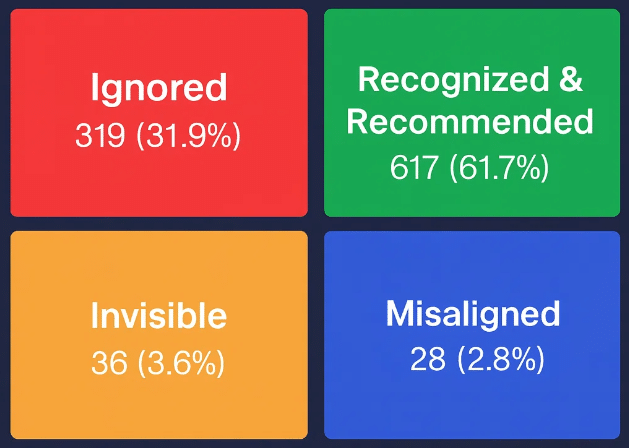
For ease of use, we combined Aligned and Trusted as recognized and recommened into the top right quadrant because the order of results the LLM’s present entities to is different from user to user, so we grouped them all as recognized and recommended.
With grouping Aligned and Trusted results together, 617 (61.7%) of brands are doing well in AI search from a visibility perspective. However that also means that more than a third of companies, 383 (38.3%) to be exact, have some work to do.
That ‘Ignored’ bucket is the silent killer. You can be ‘in the model’s memory’ and still be absent in buying moments.
How to use the AI Awareness Framework (a practical workflow)
OK, this is great, but what do you do with this?
- Run a recognition test using LLMtel.com: ask multiple models to identify your brand directly (Entity Recognition Score).
- Run an activation test: ask recommendation and use-case questions in your category and track whether you get named (Question Mentions Score).
- Classify your current stage and decide your next strategic move (moves by stage outlined below).
- Repeat the report on a schedule because models update and your position can drift.
| Two paths you should remember
Growth path: Invisible -> Ignored -> Aligned -> Trusted Risk path: Invisible -> Misaligned -> brand confusion (or damage) |
Strategic moves by stage (the short playbook)
Use these as your default operating moves:
Stage 1 -> Stage 2 (Invisible to Ignored)
What to do?
Fix basic entity identity (consistent naming, clear category definition, structured metadata, technical SEO).
Stage 2 -> Stage 4 (Ignored to Aligned)
What to do?
Strengthen ties between your brand and the questions customers ask. Publish content that links brand + category + use cases.
Stage 3 -> Stage 4 (Misaligned -> Aligned)
What to do?
Clean up ambiguous names and variants. Use structured profiles and schema markup. Anchor the correct entity across the public web.
Stage 4 -> Stage 5 (Aligned to Trusted)
What to do?
Build credibility: reviews, case studies, coverage, analyst reports. Become the safe default answer for your category.
Stage 5 (Trusted)
What to do?
Keep doing what you’re doing – and monitor for drift.
What to track (simple metrics that don’t lie)
You do not need 50 dashboards. You need two scores and a few sanity checks.
- Recognition rate (Entity Recognition Score): how many models recognize you when asked directly.
- Mention/recommendation rate (Question Mention Score): how often you get named when the question is about the problem you solve.
- Naming variance: how many different strings your brand appears as (fragmentation creates invisibility).
- Accuracy notes: when you are mentioned, are the facts right (misalignment risk)?
The bottom line
In an AI-first world, your job is not just to make the model know you. Your job is to make it confident enough to say your name at the exact moment a buyer asks for help.
| If you only remember one sentence
Recognition is table stakes. Recommendation is the advantage. |
Next step: read the stage articles and run your first diagnosis on your brand (and your top competitors).
Related Articles
AI Awareness Framework Stage 1: Invisible
AI Awareness Framework Stage 2: Ignored
AI Awareness Framework Stage 3: Misaligned
AI Awareness Framework Stage 4: Aligned
AI Awareness Framework Stage 5: Trusted
About The Author