AIO Is the Operating System: Build an AI Visibility Program That Doesn’t Drift
SEO, AEO, and GEO are tactics. AIO is what happens when you stop treating tactics like a personality and start treating them like an operating system.
In other words: AIO is how you prevent your brand from being ignored, or misrepresented, at scale.
See Also: SEO vs AEO vs GEO vs AIO: The 2026 Field Guide
AIO in one line
AI Optimization (AIO) is the coordinated system for how your brand and content show up across AI-driven surfaces—search, assistants, summaries, citations, and conversations.
The AIO stack (simple version)
- Message: one positioning statement, one set of canonical facts.
- Assets: pages and content that express those facts (site + profiles).
- Distribution: where those assets get repeated and validated (PR, partners, reviews).
- Monitoring: how you track accuracy, visibility, and gaps over time.
Step 1: Create your “canonical facts” doc (your Brand Factbook)
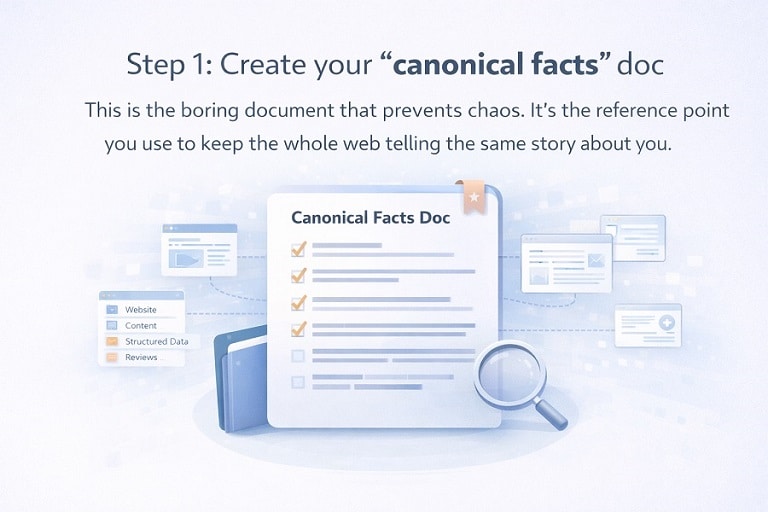
This is the boring document that prevents chaos. It’s the reference point you use to keep the whole web telling the same story about you.
- Company/brand name (exact spelling), category, and short description.
- Primary offerings (product/service names) and who they’re for.
- Core differentiators (3–5), stated in plain language.
- Proof points (customer counts, results, credentials) with sources.
- Founder/leadership bios and preferred headshots/links.
- Policies for sensitive claims (health, finance, legal, guarantees).
See Also: Off-site authority guide
Step 2: Make your website the source of truth
If your own site is inconsistent, everything downstream becomes a game of telephone.
- Create (or refresh) an About page that states your canonical facts clearly.
- Create dedicated pages for each core offering (don’t hide everything in one services page).
- Publish author bio pages and show credentials where relevant.
- Add FAQ blocks for common questions (AEO win) and cite key claims (GEO win).
Step 3: Align your off-site footprint
Pick the 10–20 places most likely to be referenced: major social profiles, directories, industry associations, key partners, and review sites.
- Update descriptions to match your canonical facts (verbatim where possible).
- Standardize your logo, name, and category selections.
- Make sure your leadership bios match your site (titles and dates especially).
- Publish a press kit page so third parties can copy accurate info.
Step 4: Build a monitoring loop (so you don’t drift)
AIO isn’t “set it and forget it.” It’s “measure it or it mutates.”
- Monthly: run a set of “AI queries” for your category and log results (who gets cited, what claims repeat).
- Monthly: spot-check brand accuracy (does the system describe you correctly?).
- Quarterly: refresh your citable assets (benchmarks, stats, case studies).
- Quarterly: run a footprint audit (profiles, listings, key third-party pages).
What to measure (so AIO doesn’t become vibes)
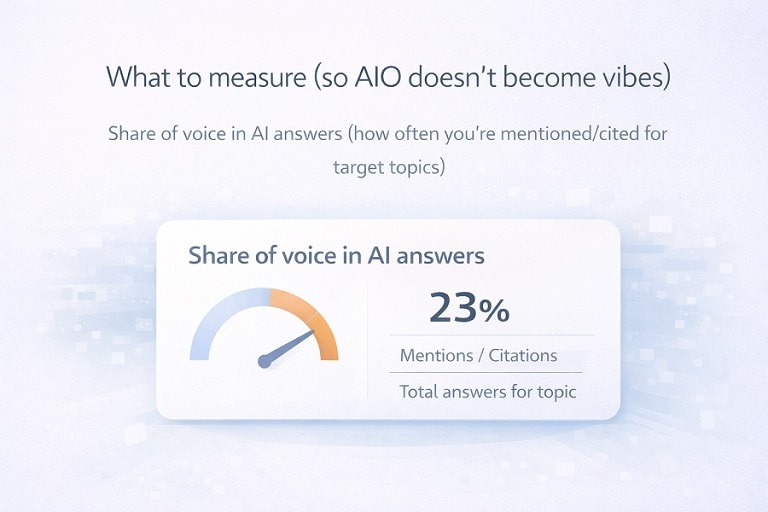
- Share of voice in AI answers (how often you’re mentioned/cited for target topics).
- Brand accuracy score (how many key facts are correct/incorrect across surfaces).
- Assisted conversions (users who saw you in AI surfaces and converted later).
- Coverage depth (how many distinct topics you’re consistently associated with).
See Also: GEO for Marketers: Write Content AI Can Cite
AIO checklist
- ✅ Canonical facts doc exists and is kept current
- ✅ Website expresses those facts clearly (and is indexable)
- ✅ Key profiles/listings repeat the same positioning
- ✅ AEO answer blocks exist on priority pages
- ✅ GEO citation handles exist (stats, sources, definitions)
- ✅ Monitoring loop runs monthly with logged outcomes
Common mistakes
- Calling everything “AIO” without defining the scoreboard you’re using.
- Letting marketing, sales, and listings describe the company in three different ways.
- Measuring only rankings while ignoring mentions, citations, and accuracy.
- Treating AI visibility like a one-time campaign instead of a system.
FAQ:
Do I need special tools for AIO?
Not at first. Start with a spreadsheet, a monthly query list, and a consistent process. Tools help later, but process comes first.
Is AIO the same as LLMO / GEO / AEO?
AIO is the umbrella and the operating system. GEO and AEO are parts of the content layer inside it.
How do I stop AI from getting my brand facts wrong?
You reduce contradictions, publish canonical facts in obvious places, and earn third‑party validation that repeats the same story.
About The Author