The CORE Knowledge Framework: The 3 Layers of Truth That Decide If You Get Found in AI Search
A practical guide for building Content, Ontology, Representation, and a consistent Entity so Google and AI models can understand and trust your brand.
If you only remember one thing:
Your website is not the only “truth” AI uses. If you want to get found in AI search, you have to build truth in layers and keep your entity consistent across all of them.
People still browse websites. But the way people discover websites is changing fast. In AI search, the “answer” often shows up before the click. So the real question is no longer just “How do I rank?” it is: “How do I get understood?”
That is why I started teaching this as a simple mental model: three layers of truth. And to make it stick, I gave it a name: the CORE Knowledge Framework.
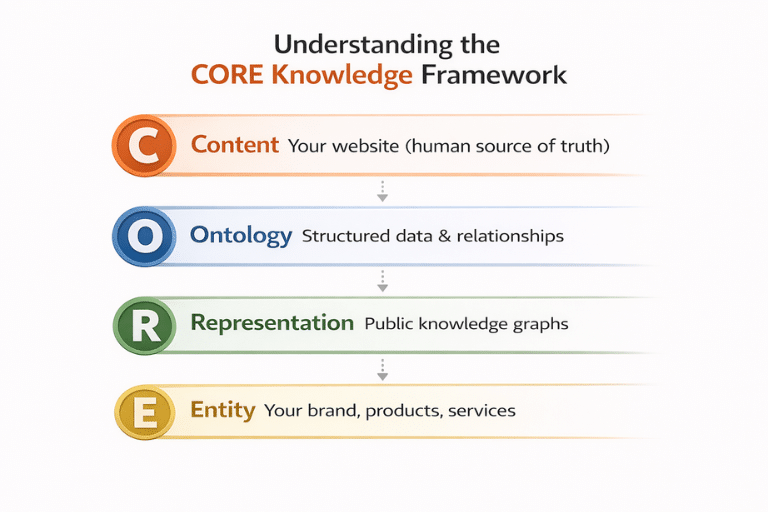
What is the CORE Knowledge Framework?
CORE is an acronym that maps cleanly to the three layers you need to get right if you want to show up in Google, Gemini, ChatGPT, Claude, and everywhere else AI answers appear.
Here is the simple version:
- C – Content (Layer 1): your human source of truth. A great website built for people.
- O – Ontology (Layer 2): your structured data and on-site knowledge graph. Machine-readable truth.
- R – Representation (Layer 3): how Google and AI systems represent you in public knowledge graphs.
- E – Entity (Through-line): the consistent identity that must run through all three layers.
If you are wondering why this matters, it is because AI systems do not just “read pages.” They extract facts, connect relationships, and build an internal model of who you are. If your facts are missing or inconsistent, the model fills in the blanks and sometimes it fills them in wrong.
Why AI search feels different (and why your old playbook is not enough)
Traditional SEO trained an entire generation of marketers to think in pages and keywords. AI search forces you to think in entities and relationships.
- A search engine can rank a page even if it barely understands your business.
- An AI system needs to understand your business well enough to summarize it.
- Summaries require confidence and confidence comes from consistent facts across multiple sources.
This is why you can publish great content and still be invisible in AI answers. Or worse: you show up, but the model describes you incorrectly.

The 3 layers of truth (overview)
- Layer 1 – Content: The story and proof humans need to trust you.
- Layer 2 – Ontology: The structure machines need to classify you and relate you to other entities.
- Layer 3 – Representation: The “public” version of you that appears in knowledge panels, AI answers, and citations.
Now let us break them down using CORE.

C – Content (Layer 1): Your human source of truth
Your website is your canonical source (your source of truth). It is where your truth originates. And yes it still matters because people still want proof: case studies, testimonials, credentials, pricing logic, process, and credibility.
What “Content” means in CORE
- Built for people first: clear UX, clarity of message, trust, narrative.
- Authoritative content, not just pages: your best explanation of who you help and how.
- Consistent language: the same terms for the same things (services, locations, offers).
Layer 1 checklist (simple but powerful)
- Homepage: In 5 seconds, can a stranger tell what you do, who it is for, and why you are different?
- About page: Real story, real leadership, real credentials, real location(s).
- Service pages: One page per core service with outcomes, process, and proof.
- Proof: Case studies, testimonials, logos, metrics, before/after examples.
- Contact: Make it easy to take the next step (forms, calendar, phone, email).
- No fluff: If a sentence does not clarify, persuade, or prove, cut it.
Layer 1 earns human trust. But Layer 1 alone does not earn machine confidence.
O – Ontology (Layer 2): Structured data and your on-site knowledge graph
This is the layer most companies are missing. They build for humans and assume the machines will “figure it out.” Sometimes they do. Often they do not. Ontology is how you stop guessing and start being clear.
Ontology in plain English
An ontology is a formal map of entities, attributes, and relationships. In CORE, that means you are explicitly defining things like:
- Your organization (what it is, what it does)
- Your leadership (who leads it)
- Your services/products (what you offer)
- Your locations (where you operate)
- Your profiles (the same entity across the web)
- How all of those pieces relate to each other
You build this layer using structured data (schema markup), internal linking, and factual consistency across your site. Think of it as “machine-readable truth.”
A concrete example
Imagine a digital agency. Here are facts that matter to machines:
- The agency is a “Digital Marketing Agency” (category/type).
- It has offices in Toronto and New York (locations).
- It offers AI search optimization (service).
- It is led by specific people (leadership).
Those facts can be written in normal copy for humans. But machines need the structured version too so they can connect, compare, and retrieve it reliably.
What to implement on your site (the practical list)
- Organization / LocalBusiness schema: your official identity.
- Person schema: founders, leadership, key experts.
- Service schema: your core offers (and who they are for).
- Location schema: each office or service area (consistent address/phone).
- WebSite + WebPage + Breadcrumb schema: clarity for navigation and structure.
- Article schema: for blog posts and guides.
- FAQ schema (where it makes sense): answers machines can quote verbatim.
Layer 2 is where you remove the “marketing fluff” and give machines clean facts and relationships.
R – Representation (Layer 3): The public knowledge graph about you
This is the layer you do not control directly. Google and AI systems build it based on signals from everywhere: your website, your profiles, directories, reviews, mentions, and more.
Representation in CORE
- How Google, ChatGPT, and other systems model you.
- The external interpretation of your entity graph.
- Not controlled directly, but influenced.
If your public signals are messy, your representation will be messy. And AI models avoid messy.
What feeds your public representation (examples)
- LinkedIn company page and leadership profiles
- Google Business Profile (if you serve locally or have offices)
- Industry directories and association listings
- Review platforms and third-party testimonials
- Press mentions, podcasts, guest posts, citations in “top companies” lists
- Consistent Name/Address/Phone (NAP) across the web
Representation checklist (quick wins)
- Claim and update your major profiles: LinkedIn, Google Business Profile, YouTube, X, Facebook (as relevant).
- Standardize your brand name everywhere (pick one spelling and stick to it).
- Standardize your address and phone everywhere (especially if you have multiple locations).
- Add your website link and make sure it matches the canonical domain you want indexed.
- Collect legitimate third-party reviews (they increase confidence).
- Get cited by other sites in your industry (directories, partnerships, guest contributions).
One underrated piece: your competitors and “people also search for” cluster. AI does not just learn you. It learns your neighborhood. So the more consistently you show up in the right places, the more reliably you get grouped correctly.
E – Entity: The through-line across all three layers
Entity is the glue that makes CORE intentional instead of arbitrary. Your brand, your people, your products, your services… they must be the same entity everywhere.
What “entity consistency” looks like
- Same name (no “Acme” vs “Acme Inc.” vs “Acme Agency” unless those are real entities).
- Same leadership names and titles.
- Same locations and contact points.
- Same service naming (avoid swapping labels every quarter).
- SameAs links that connect your official profiles back to you.
If your entity is fragmented, AI will either ignore you or hallucinate the missing pieces.

How to implement CORE (a practical 30-day plan)
You do not need a six-month brand relaunch. You need a focused build.
Week 1 – Clarify your entity and fix Layer 1 (Content)
- Create your Brand Factbook: one page with your official name, leadership, locations, services, and official profiles.
- Update your homepage and About page for clarity (humans first).
- Ensure every core service has a dedicated page.
Week 2 – Build Layer 2 (Ontology)
- Add Organization/LocalBusiness schema and connect your official profiles with sameAs.
- Add Person schema for leadership and experts.
- Add Service schema (or at least clear service definitions + internal linking).
- Fix internal linking so relationships are obvious (service -> case study -> about -> contact).
Week 3 – Clean Layer 3 inputs (Representation)
- Audit your top profiles and directories for inconsistent business info (name, address, phone, website).
- Update/claim what you can and request edits where needed.
- Start collecting third-party reviews in the places your customers already trust.
Week 4 – Validate and iterate
- Test how AI describes you: ask “Who is [Brand]?”, “Where are they located?”, “What do they do?”, “Who runs it?”
- Look for inconsistencies and go fix the source (site, schema, profiles).
- Publish one truly authoritative piece of content that reinforces your core entity and services.
How to tell if it is working
- Your brand is described consistently across Google and AI tools.
- AI answers cite you (or at least align with your positioning).
- Your knowledge panel/entity panel becomes more accurate over time.
- You start showing up for the right prompts, not random ones.
Common mistakes to avoid
- Mistaking more content for more truth (volume does not equal clarity).
- Adding schema markup while your site copy still contradicts it.
- Ignoring third-party profiles and directories (Representation layer).
- Changing your service names constantly (you are breaking the entity graph).
- Trying to “game” AI instead of building confidence through consistency.
Frequently asked questions
Do I need schema markup to show up in AI answers?
Schema is not magic, but it is one of the cleanest ways to give machines unambiguous facts. If you want to reduce confusion, it is worth doing.
What is the difference between a knowledge graph and schema?
Schema is the structured format you publish. A knowledge graph is the connected model that search engines and AI systems build from many signals (including your schema, content, and third-party sources).
Is Layer 3 (Representation) something I can control?
Not directly. But you can influence it by keeping your business information consistent and by earning credible third-party mentions and reviews.
What if I have multiple locations?
Treat each location as a first-class entity: dedicated page, consistent address/phone, and location schema. Then connect each location back to the main organization.
How long does it take to see results?
Some fixes show up quickly (like profile consistency). Knowledge graph changes can take longer because systems need to recrawl and reconcile signals. The goal is not instant, the goal is durable.
What should I do first if I am overwhelmed?
Start with your entity facts and create a Brand Factbook. This is a single source of truth that AI can’t misquote. If you cannot write down your stable facts in one page, the machines cannot either.
Final thought
In AI search, you are not just publishing pages. You are teaching machines who you are. CORE is how you do that without turning your marketing into a science project.
Build your Content. Publish your Ontology. Shape your Representation. Protect your Entity.
About The Author