If you are trying to get cited in AI answers, you are not just doing SEO. You are doing trust engineering.
Because the AI answer is built from what the broader web says about you, not what your homepage claims.
What off-site signals are (and why they matter now)?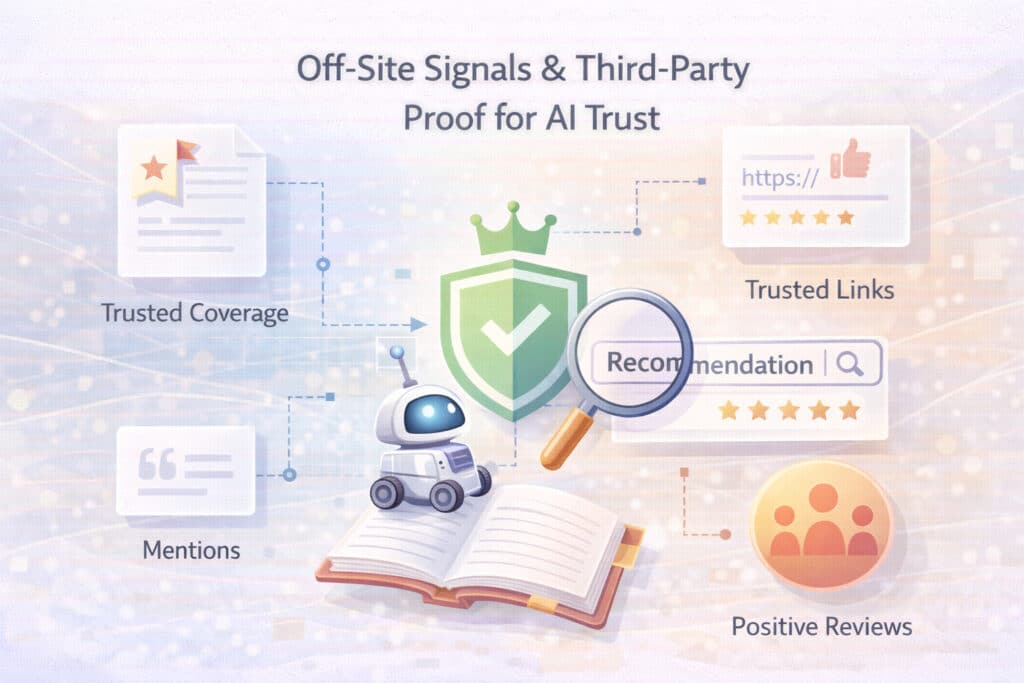
Off-site signals are any credible, third-party indications that your brand, your leaders, or your ideas are real, reliable, and recognized. Think: earned media mentions, expert recommendations, awards, reviews, association listings, conference speaker pages, partner pages, and citations of your research.
Historically, off-site mattered because it influenced links, brand search, and reputation. In the AI era, off-site matters because it increases the odds that retrieval systems pull you in as a source and that a model feels safe citing you.
On-site is testimony. Off-site is corroboration.
Your site is where you describe who you are and what you do. Off-site is where the internet votes on whether it believes you.
When the web agrees on your story, you get stronger entity signals: a clearer ‘who’, ‘what’, and ‘why’ that algorithms can confidently summarize.
Google’s trust model is not subtle about reputation
Google’s Search Quality Evaluator Guidelines explicitly instruct evaluators to look for reputation information from sources that are not written by the company itself. The guidelines call out high-quality news and informational articles as useful reputation sources and recommend looking for expert references and other credible information about the site.
Whether or not you care about how raters score pages, the underlying idea is the same for AI: independent proof reduces uncertainty.
E-E-A-T is not a tagline. It is a paper trail.
Google’s Search Central guidance frames E-E-A-T as a set of concepts that help systems prioritize helpful, reliable content. It also emphasizes that trust is the most important aspect, and recommends making it clear who created content (bylines and author information) when readers would expect it.
See Also: Earned Authority for AI: PR, Co-Citations and GE
Why AI systems reward off-site proof?
In practice, generative answers tend to privilege sources that look verifiable: publications, documentation, research, and widely referenced explainers. If your brand is not present in that ecosystem, you are asking the model to take a risk by citing you.
Research on Generative Engine Optimization (GEO) found that including citations, quotations, and statistics can significantly boost a source’s visibility in generative responses. The lesson for PR and comms is obvious: sources that already behave like sources get treated like sources.
AI trust is earned off-site, then reinforced on-site
You want the loop to look like this:
- Off-site: credible mentions and references appear across the web (earned media, expert quotes, conference pages).
- On-site: your site backs those claims with proof (case studies, methodology, author bios, clear positioning).
- Off-site again: more people cite your assets because they are easy to reference, and the cycle compounds.
See Also: Co‑Citation Strategy (Safe and Credible)
The off-site signals that actually move the needle
Not every mention is equal. Focus on signals that are both credible and durable.
1) Earned media that contains a quotable or citeable artifact
A throwaway mention helps. A mention that includes a statistic, a framework, or a strong quote helps more because it gives the internet something to repeat.
2) Linkable assets that create third-party references
Original research, benchmark reports, tools, and templates get referenced because they save other writers time. They are the easiest path to natural citations.
3) Third-party profiles that confirm you exist
Conference speaker pages. Association directories. Partner pages. Awards listings. Reviews. These are not glamorous, but they are verification points.
4) Thought leadership published where trust already exists
A guest post in a respected industry publication can be more valuable than 20 blog posts on your own site, because it comes with built-in credibility.
See Also: As Seen In + Press Kit: Build an AI‑Ready Proof Hub
A simple 30-day plan to build off-site proof
Week 1: Clean up the story
- Write a canonical one-sentence descriptor for your company (category, ICP, outcome, differentiator).
- Create or refresh a press kit and leadership bios so journalists can copy the correct language.
- Define 3 to 5 proof points you want repeated (numbers, awards, outcomes, benchmarks).
Week 2: Build the citeable asset
- Pick one narrow benchmark question that your ICP actually asks.
- Publish a short ‘key findings’ page with charts and a clear methodology section.
- Package 5 to 10 quotable takeaways for PR outreach.
Weeks 3 and 4: Earn mentions in the right places
- Pitch the benchmark to 10 to 20 relevant outlets and newsletters.
- Book 2 to 4 podcasts or webinars where a leader can discuss the findings.
- Secure 3 to 5 partner or community placements (associations, event pages, directories).
The goal is not volume. The goal is a credible footprint that a model can triangulate.
References
[1] Google. Search Quality Evaluator Guidelines (PDF). Updated September 11, 2025.
[2] Google Search Central. Creating helpful, reliable, people-first content. Last updated December 10, 2025.
[3] GEO: Generative Engine Optimization. arXiv:2311.09735 (PDF). 2023. https://arxiv.org/pdf/2311.09735
About The Author