What is Entity Authority – the TL;DR
- Entity authority is the machine’s confidence that your brand is a distinct, correctly described “thing” (an entity), not a fuzzy keyword.
- AI systems prefer entities they can verify: consistent facts, stable identifiers, and multiple corroborating sources.
- If your brand facts are inconsistent across the web, AI will average them, merge you with look-alikes, or guess.
- The fix is operational: a canonical facts sheet, verified third-party references, and structured “identity links” (for example, sameAs and platform entity IDs).
1) From keywords to entities: what changed?

Search and AI systems increasingly model the world as entities (people, companies, places, products) and relationships between them, not just strings of text. Google popularized this shift when it launched the Knowledge Graph, “things, not strings” to better understand what users mean and what the web is describing.
Modern AI assistants inherit the same constraint: they can generate fluent language, but when the underlying “thing” is unclear, the answer becomes unstable. The model fills gaps by sampling what sounds plausible. That’s how brands end up with the wrong founding year, the wrong headquarters, or the wrong category.
2) A plain-English definition of entity authority
Entity authority is clarity. It is the probability a machine can reliably resolve your brand to one entity, distinguish it from similar entities, and retrieve a consistent set of facts about it.
Entity authority has three parts:
- Identity: Can the system uniquely identify you? (Name, website, profiles, IDs.)
- Consistency: Are your facts the same everywhere? (Founding date, leadership, location, product, positioning.)
- Corroboration: Do independent sources confirm the same story? (Earned media, trusted directories, public databases.)
Think of it like a background check. If your résumé conflicts with your LinkedIn, and your LinkedIn conflicts with your company bio, you might still be real, but the confidence level drops.
3) How machines decide what’s “verifiable”?
Machines don’t “trust” the way humans do. They approximate trust using signals like repetition, agreement across sources, and the presence of stable identifiers. Structured data helps because it turns brand facts into machine-readable statements.
- Consistency across owned properties (your site, press kit, social bios).
- Consistency across major third-party profiles (LinkedIn, directories, data providers).
- Clear entity identifiers (canonical URLs, platform IDs, and, when appropriate, Wikidata QIDs).
- Machine-readable markup (Organization schema, including url and sameAs where appropriate).
- Evidence of independent coverage (for high-trust references like Wikipedia).
Google states that it uses structured data it finds on the web to understand the content of pages and to gather information about the web and the world. That’s not the whole story, but it’s an important lever you can control.
4) Why AI gets your company wrong (common failure modes)?
Failure mode A: Entity collisions (name look-alikes)
If your brand name collides with other companies (or products, or people), machines need stronger identifiers to disambiguate you. Without those anchors, you get merged.
Failure mode B: Fact drift (your own site contradicts itself)
- Different founding years across pages
- Multiple versions of the company name (Inc. vs. LLC vs. brand name)
- Old executive bios still ranking
- Outdated address in the footer or schema markup
Failure mode C: Third-party contradictions
AI systems triangulate. If one data provider says you’re based in Austin, another says Dallas, and your website says “remote,” the system has no stable answer, so it picks one, averages, or guesses.
Failure mode D: Hallucination-by-necessity
When the system can’t verify a detail, it may still produce a confident-sounding answer. OpenAI has published research explaining that standard training and evaluation can reward guessing instead of acknowledging uncertainty, which contributes to hallucinations.
5) The Entity Authority Triangle (a simple operating model)
If you’re a PR/Comms or Marketing leader, the fastest way to make this actionable is to treat entity authority like a three-legged stool.
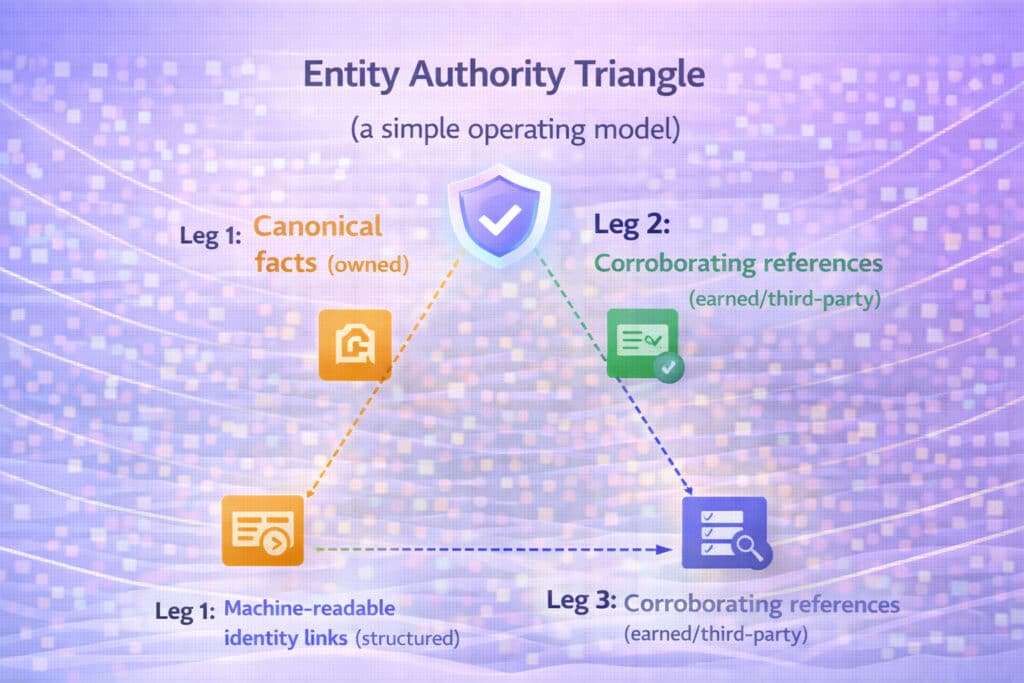
Leg 1: Canonical facts (owned)
- A Brand Factbook with approved, version-controlled facts and descriptions.
- A single canonical About page and a single canonical Press/Media Kit page.
- A published corrections page for high-risk facts (optional, but powerful).
Leg 2: Corroborating references (earned/third-party)
- Claim and correct high-impact profiles (LinkedIn, major directories, regulated registries).
- Build independent coverage (press, podcasts, analyst reports) that repeats your canonical facts.
- Resolve duplicates and stale listings.
Leg 3: Machine-readable identity links (structured)
- Organization schema that includes url, logo, and other stable facts where appropriate.
- sameAs links only to identity-confirming pages (official profiles, Wikidata/Wikipedia when legitimate).
- A stable @id for your organization on your site (for example, https://example.com/#organization).
6) Quick audit: your entity authority scorecard
Use this checklist to spot the top gaps fast:
| Check | Owner | Status | Notes |
| Your canonical name is used consistently across your site (title tag, header, footer). | Marketing/Web | ☐ | |
| Founding year, HQ, and primary description match across About, Press kit, and schema markup. | Marketing/Web | ☐ | |
| LinkedIn company page matches your canonical facts. | PR/Comms | ☐ | |
| Top 3–5 industry directories match your canonical facts. | PR/Comms | ☐ | |
| Organization schema is present, valid, and not misleading. | Web/SEO | ☐ | |
| sameAs links only to true identity anchors (not random mentions). | Web/SEO | ☐ | |
| You can explain “who we are” in one sentence without changing it per channel. | Marketing | ☐ |
7) What success looks like
- AI answers about your brand converge (same founding year, same HQ, same category, same offer).
- Entity panels/knowledge experiences show fewer errors and fewer “blended” details from other brands.
- Citations and references point to your intended sources (press kit, About page, trusted third-party profiles).
- New coverage reinforces the same canonical story instead of inventing new variants.
8) Next steps
- Build your Brand Factbook (canonical data) and appoint an owner.
- Implement Organization structured data with a stable @id and carefully chosen sameAs links.
- Claim and correct your top third-party profiles (start with LinkedIn + your top directories).
- Decide whether Wikidata/Wikipedia is appropriate based on evidence of independent coverage and conflict-of-interest constraints.
- Set up a recurring “wrong AI answer” log so fixes become a workflow, not a fire drill.
References
Google Blog. “Introducing the Knowledge Graph: things, not strings.”. Accessed January 11, 2026.
Google Search Central. “Introduction to structured data markup in Google Search.” Accessed January 11, 2026.
Google Search Central. “Organization structured data.” Accessed January 11, 2026.
Google Search Central. “General structured data guidelines.” Accessed January 11, 2026.
Schema.org. “sameAs property. Accessed January 11, 2026.
About The Author