Small business content marketing should help potential customers understand a problem, compare their options and feel confident about choosing your company. It should not become a weekly struggle to publish something simply because a content calendar says a new post is due.
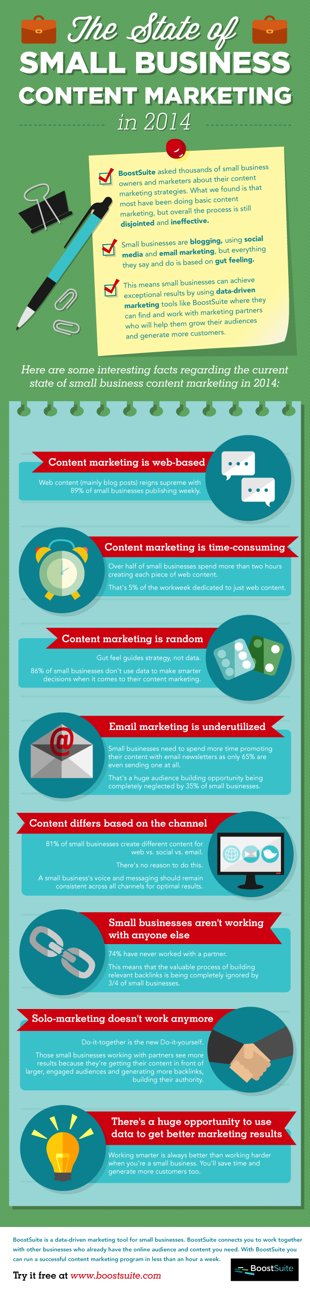
The original 2014 infographic on this page revealed a familiar problem. Small businesses were creating blog posts, social updates and emails, but many were working without a clear strategy or reliable performance data.
The tools have changed since then, especially with the growth of AI and new search experiences. The central challenge, however, remains the same: small businesses need to create the right content, for the right people, with a clear business purpose.
What Has Changed Since the 2014 Content Marketing Survey?
The historical infographic reported that 89% of surveyed small businesses published web content weekly, while 86% did not use data to guide their decisions. Those figures should now be viewed as a snapshot of content marketing in 2014 rather than current benchmarks.
Publishing is easier today. A small business can use AI tools, design platforms, scheduling software and reusable templates to create content faster than before. The real difficulty is producing something that feels useful and different when customers already have more information than they can reasonably consume.
Recent Content Marketing Institute research shows that 59% of surveyed B2B marketers described their marketing as at least somewhat effective. However, creating content that leads to action, working with limited resources and measuring performance remained their three most common challenges. The research included micro and small companies as well as larger organisations.
This is the modern content marketing conundrum: producing more has become easier, but producing content people remember, trust and act on is still difficult.
Start With One Clear Business Goal
A content strategy becomes confusing when every article is expected to increase traffic, build awareness, generate leads, improve rankings, grow an email list and make immediate sales.
Choose the main purpose before choosing the topic.
| Business goal | Useful content | Practical measurement |
| Increase awareness | Educational articles, videos and original research | Relevant impressions and new visitors |
| Generate enquiries | Service guides, comparisons and case studies | Qualified form submissions and calls |
| Support sales | Buying guides, product demonstrations and FAQs | Assisted conversions and sales |
| Build customer loyalty | Tutorials, newsletters and support content | Returning visitors and repeat purchases |
| Establish expertise | Commentary, research and expert explanations | Mentions, citations and quality backlinks |
The goal determines what you create and how you judge it. A detailed educational guide may attract visitors who are not ready to buy today, while a service comparison page may reach fewer people but generate stronger enquiries.
Content Marketing Institute’s 2026 research found that 61% of marketers with a strategy reported improved effectiveness. Strategy refinement was the most frequently cited reason for that improvement, ahead of implementing new technology.
The Periodic Table of Content Marketing can help you think about the different elements involved without treating every channel or format as equally important.
Build Topics Around Real Customer Questions
Small businesses often begin by asking, “What should we post this week?” A better question is, “What does a customer need to know before taking the next step?”
Useful ideas can come from:
- Questions asked during sales calls
- Common objections
- Customer service emails
- Search queries in Google Search Console
- Comments and messages on social media
- Reviews of your business and competitors
- Questions appearing in relevant communities
- Problems customers experience after making a purchase
A local accountant may repeatedly hear questions about allowable expenses. A repair company may receive enquiries about whether a damaged item can be fixed. A software provider may notice that prospective customers struggle to compare subscription plans.
Each repeated question can become a focused page that helps the visitor and reduces the amount of explanation required from the team.
The strongest topics usually sit close to the business’s real expertise. Google recommends creating content primarily for people and using SEO to make that useful information easier to discover, rather than producing pages mainly to manipulate rankings.
Following clear steps for content marketing success can prevent the blog from becoming a collection of unrelated posts with no connection to the customer journey.
Create Content That Is Worth the Reader’s Time
Good content does not need to be unusually long. It needs to answer the question properly.
A useful small-business article should normally:
- Explain the issue clearly
- Give a direct answer near the beginning
- Include practical steps or examples
- Address likely follow-up questions
- Support factual claims with dependable sources
- Connect the topic to a realistic next action
- Avoid unnecessary repetition
Do not add several paragraphs simply to reach a preferred word count. A 900-word guide that solves the problem can provide more value than a 2,000-word article filled with broad explanations.
Original experience can make a page more useful. A contractor can explain common mistakes seen during real projects. A consultant can share the factors that affect cost. A retailer can describe how customers should compare materials, sizes or product features.
Google’s guidance encourages publishers to make it clear who created the content, how it was produced and why it exists. These signals help readers assess whether the page is trustworthy and genuinely designed to help them.
Practical blog post improvements and content hacks can make older pages more useful without turning every update into a complete rewrite.
Use AI Without Losing the Human Voice
AI can help a small team organise research, develop outlines, summarise internal notes and create variations for different channels. It can save time, but it should not replace subject knowledge or editorial judgement.
HubSpot’s 2026 marketing report states that 80% of surveyed marketers use AI for content creation and 75% use it for media production. The report also stresses the growing importance of trust, a clear brand point of view and human-led marketing as automated content becomes more common.
Content Marketing Institute similarly found that 95% of surveyed B2B marketers used AI-powered applications. Despite this widespread use, teams still struggled with conversion, differentiation and measurement. (Content Marketing Institute)
That is why AI-generated drafts should be reviewed carefully. Check:
- Whether the facts are accurate
- Whether the examples fit the business
- Whether the writing sounds natural
- Whether claims are supported
- Whether the article adds anything new
- Whether the advice is safe and realistic
- Whether the page answers the intended question
AI can improve efficiency, but the final content should still reflect the company’s customers, experience and point of view.
Turn One Strong Idea Into Several Useful Formats
Small businesses rarely have the time to create completely new material for every channel. A better approach is to develop one useful core resource and adapt it thoughtfully.
For example, one detailed article could become:
- A short email explaining the main lesson
- A social media carousel
- A two-minute video
- A downloadable checklist
- A series of brief posts
- A sales-team reference document
- Several answers for related FAQs
Repurposing does not mean copying the same text everywhere. Each version should suit the way people use that channel.
A newsletter should feel personal and focused. A social post needs a clear opening. A video should show the important point early. The full article can provide the depth that shorter formats cannot.
Email remains particularly valuable because it gives the business a direct way to reach people who have chosen to hear from it. The signs of an effective email marketing approach include relevant messages, clear expectations and a reason for subscribers to remain interested.
Consistent distribution gives a strong piece of content more opportunities to reach the right person without forcing the business to publish something new every day.
Connect Content With SEO, AEO and AI Discovery
Traditional SEO remains important, but people now discover information through more than a list of blue links. They may encounter a business in featured snippets, local results, video platforms, AI-generated answers or recommendations from other websites.
Content should therefore be easy for both people and machines to understand.
Use a clear page title, one descriptive main heading and subheadings that match real questions. Define important terms naturally, identify relevant people and organisations, and provide evidence for claims.
Direct answers can improve AEO, especially when they appear near the relevant question. However, the answer should lead naturally into a fuller explanation rather than repeating the same sentence several times.
GEO also depends on credibility beyond the business’s own website. Original research, expert commentary, accurate facts and mentions from trusted sources can make the brand easier to reference. A business should monitor not only rankings but also where its ideas, products or people are being cited.
The guide to monitoring AI discovery and citations explains how businesses can begin evaluating visibility across newer search experiences.
Measure Results Without Building a Complicated Dashboard
Small businesses do not need dozens of reports. They need a small set of measurements connected to the goal of each page.
Content Marketing Institute found that 33% of surveyed B2B marketers considered measuring content effectiveness one of their main challenges. It also found that effective teams commonly credited content relevance, team capabilities, customer understanding, measurement and channel selection for stronger performance.
A simple review can include:
Search visibility: Are relevant impressions and clicks growing?
Engagement: Are people reading, saving, watching or returning?
Lead quality: Are the right visitors submitting forms or calling?
Sales contribution: Does content assist enquiries, purchases or renewals?
Efficiency: Can useful content be produced and updated without overwhelming the team?
Look at performance over several months rather than judging an article after a few days. Some pages attract attention quickly, while others build visibility as they earn links, gain history and begin ranking for more specific searches.
Use the process in seven steps to improve digital marketing to turn reporting into clear actions instead of collecting numbers that no one uses.
Update Good Content Before Publishing More
An older page is not automatically a bad page. It may need updated facts, stronger examples, a clearer introduction or better internal links.
Review existing content before adding more URLs to the website.
Look for pages that:
- Receive impressions but few clicks
- Rank just outside the strongest positions
- Contain outdated statistics
- Cover the same subject as another page
- Attract traffic but generate no useful action
- Have lost traffic over time
- No longer match the company’s services
Combine overlapping pages where appropriate. This can reduce keyword cannibalization and create one stronger resource instead of several thin articles competing for the same search intent.
Do not change publication dates without making meaningful improvements. Update the content because the subject has changed or the page can genuinely become more useful.
The principles in Freshness Without Flailing can help you decide when to refresh, consolidate or leave a successful page alone.
Frequently Asked Questions About Small Business Content Marketing
What is small business content marketing?
Small business content marketing is the creation and distribution of useful information that helps a defined audience understand problems, evaluate solutions and build trust in a company.
Does content marketing work for small businesses?
It can work when content supports a clear business goal and addresses real customer needs. Publishing without a strategy, promotion plan or measurement process is less likely to produce meaningful results.
How often should a small business publish content?
There is no universal publishing frequency. A realistic schedule that maintains quality is more useful than frequent low-value posts. Some businesses may publish weekly, while others may produce one substantial resource each month.
What content should a small business create first?
Begin with questions customers ask before purchasing. Service explanations, pricing factors, comparisons, how-to guides and FAQs often provide a practical starting point.
How can a small business measure content marketing?
Track metrics that match the page’s purpose. These may include search visibility, qualified enquiries, assisted sales, email subscriptions, returning visitors and customer-support savings.
Should small businesses use AI for content creation?
AI can support research, planning and editing, but every page should be checked for accuracy, originality and relevance. The final content should still reflect real expertise and the business’s natural voice.
How does content marketing support SEO?
Useful content can help a website answer relevant searches, earn internal and external links, demonstrate expertise and guide visitors toward related services. It should support SEO without being written only for search engines.
Build a Smaller but Stronger Content Program
Small business content marketing does not require a large publishing team or a new article every day.
Start with customer questions. Choose one clear goal, create the most useful answer you can and distribute it through the channels your audience already uses.
Then measure what happens. Improve pages that show potential, combine content that overlaps and stop spending time on formats that do not support the business.
The 2014 infographic showed that small companies were already creating plenty of content. The opportunity in 2026 is not simply to create more. It is to make every useful piece work harder.
Source: www.yahoo.com
About The Author