Most advice on “power words” treats every platform the same way, as if the word that gets a blog post shared is the same word that gets a post retweeted or a Facebook update passed around. It is not. Each platform has its own sharing behavior, its own audience expectations, and its own reasons people hit share instead of scrolling past.
This is a reference guide broken down by platform, not a generic list of persuasive words. If you want the psychology behind why power words work at all, our guide to crafting compelling headlines covers that in depth. This piece is about the specific, platform-tested word choices themselves.
Why Word Choice by Platform Actually Matters
A blog headline has one job: earn a click from someone scanning a search result or a feed. A tweet or X post has a different job: earn a retweet from someone who has already read it and is deciding whether it is worth passing to their own audience. A Facebook post has yet another job: it needs to trigger one of a small number of specific emotional responses, because Facebook sharing behavior is driven far more by emotional resonance than by curiosity alone.
Treating all three the same way is why so much content gets decent impressions but poor share rates. The word doing the heavy lifting in a headline is not necessarily the word that gets that same piece of content passed along once someone has actually read it.
Words That Get Blog Post Headlines Shared
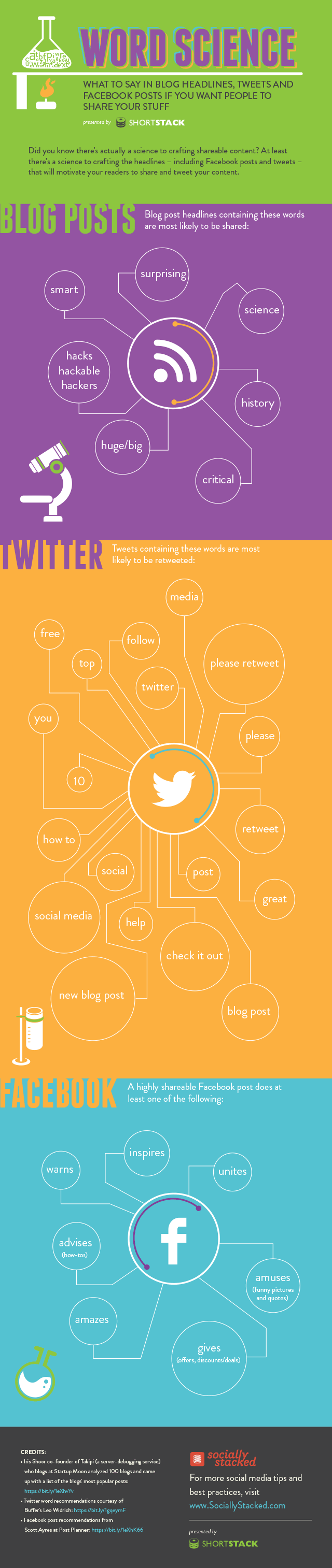
Analysis of high-performing blog posts consistently shows certain words showing up disproportionately often in headlines that earn above-average shares. These words tend to work because they promise something specific: unexpected value, credibility, or a shortcut.
- Smart — signals the content will make the reader look sharper for having read it
- Surprising — promises the content will overturn an assumption, which is inherently more shareable than confirming one
- Science or research-backed — borrows credibility from data rather than opinion
- Hacks / hackable — promises a shortcut or workaround, though this word has become oversaturated in some industries and should be used selectively
- Huge / big — signals scale or stakes, useful for industry news or major shifts
- History — works well for retrospective or “how we got here” content
- Critical — signals urgency and importance, useful for time-sensitive or risk-related topics
The common thread across all of these is specificity. “Smart tips” outperforms “helpful tips” because “smart” implies the reader gains something the average reader does not have.
Words That Get Posts Retweeted or Shared on X
X and similar short-form platforms reward a different kind of language, largely because the audience is deciding whether to share within seconds, not after finishing a full article. Words that explicitly reference the sharing action itself, along with words tied to timeliness and utility, consistently perform well:
- Free — one of the most consistently high-performing words across nearly every short-form platform
- Follow and retweet — direct calls to action outperform implied ones on this platform specifically, which is somewhat counter to headline-writing conventions elsewhere
- How to — signals immediate, actionable utility
- 10 or other specific numbers — numbered lists consistently outperform vague quantity claims like “several” or “many”
- New (as in “new post”) — timeliness cues perform well on a platform built around real-time content
- Check it out — an informal, low-friction call to action that performs better than more formal alternatives on this specific platform
- Social or social media — meta-relevant content about the platform itself tends to get shared by people in that space
The direct-ask words on this list (“please retweet,” “follow,” “retweet”) are a notable departure from blog headline conventions, where directly asking for a share generally reads as desperate. On X specifically, the norms are different, and a direct ask does not carry the same penalty.
What Makes a Facebook Post Shareable
Facebook sharing behavior is less about specific trigger words and more about which of a handful of emotional or functional categories a post falls into. A highly shareable Facebook post typically does at least one of the following:
- Inspires — content that makes the reader feel motivated or moved
- Warns — content that helps the reader protect themselves or people they care about
- Advises — practical how-to content people want to pass along to someone who needs it
- Amuses — humor, particularly relatable humor, remains one of the most reliable share triggers on this platform
- Amazes — content built around surprising facts or unexpected outcomes
- Gives — offers, discounts, and deals, which people share both for their own benefit and because sharing a good deal reflects well on the sharer
Unlike the blog and X word lists above, this is less about specific vocabulary and more about the underlying function the post serves. A post can use none of the specific words above and still perform well on Facebook as long as it clearly falls into one of these categories.
How to Use This Without Sounding Formulaic
The risk with any word list is that it starts showing up in every headline until it stops working, both because audiences develop banner blindness to overused words and because it can start to read as manipulative rather than genuinely useful. A few guardrails:
Use platform-specific words only where they fit the actual content. Forcing “surprising” into a headline for content that is not actually surprising erodes trust quickly and increases bounce rate, since the content fails to deliver on the headline’s promise.
Rotate vocabulary across a content calendar rather than defaulting to the same two or three words repeatedly. If every post uses “hacks,” the word stops signaling anything specific to a returning reader.
Match the word to the platform, not just the topic. The same piece of content might need a “critical” framing for its blog headline, a “free” or “how to” framing for its X post, and an “advises” framing for its Facebook share, even though it is the same underlying content.
For a deeper look at emotional triggers and persuasive language more broadly, our roundup of high-impact copywriting words and our guide to going viral both go further into the psychology behind why these words work.
Turning Word Choice Into a Repeatable System
Individual word choices only move the needle if they are part of a broader, consistent content and distribution strategy. A well-chosen headline on a piece of content that never gets properly distributed will not perform, no matter how well-optimized the wording is. This is where paid social media promotion often makes the difference between content that quietly exists and content that actually reaches the audience it was written for, and where strong search engine optimization ensures that well-worded blog headlines are also structured to rank in the first place.
Frequently Asked Questions
Do these words work the same way across every industry?
Not exactly. Words like “hacks” perform well in tech and marketing content but can feel out of place in more formal industries like legal or healthcare, where “critical,” “research-backed,” or “advises” tend to perform better.
Should I use these words in every headline?
No. Overusing the same words trains your audience to tune them out and can make content feel formulaic. Use them selectively, where they genuinely match the content’s value.
Is this the same as clickbait?
Not if the content delivers on what the word promises. Clickbait fails because the headline overpromises and the content underdelivers. These words work specifically because the underlying content backs up the claim.
Which platform is hardest to write shareable content for?
Facebook tends to be the least formulaic, since it depends more on the underlying emotional category the content falls into rather than specific wording, which makes it harder to reduce to a simple checklist.
How do I know if my headlines are actually working?
Track share rate and click-through rate separately, not just total traffic. A headline can drive clicks without driving shares, and a strategy built only around clicks will miss content that quietly builds long-term brand trust through shares.
Want Headlines and Distribution Working Together?
Word choice is only one piece of getting content seen and shared. If you want a strategy that connects strong content with the right distribution channel, get your free growth plan or schedule a quick chat with our team.
Source: http://www.sociallystacked.com/
About The Author