You may have heard people talking about SEO for AI, AI search optimization, or getting your business found in tools like ChatGPT and Google’s AI-powered search results.
It can sound complicated.
There are algorithms, search engines, large language models, crawlers, citations, structured data, authority signals, and a growing list of acronyms.
So let’s forget all of that for a few minutes.
Instead, imagine you are in 5th grade.
Your teacher has just given the class an assignment.
Suddenly, SEO for AI becomes much easier to understand.
First, What Is SEO?
Imagine your school has a gigantic library.
There are thousands of books inside it.
Some books are about dinosaurs. Some are about space. Some teach you how to bake cookies. Others explain the history of your country.
Now imagine you wrote a really good book about sharks.
The problem is that simply writing the book does not guarantee anyone will find it.
If your book has:
- no title
- no label
- no clear chapters
- no description
- it is sitting in the wrong section of the library
the librarian may have a difficult time finding it when someone asks:
“Do you have a good book about sharks?”
Traditional SEO helps solve that problem.
SEO, or search engine optimization, is basically the process of making your website easier for search engines to discover, understand, and show to the right people.
Your website is the book.
Google is one of the librarians.
SEO helps the librarian understand:
“This book is about sharks, and it might be useful to someone looking for information about sharks.”
Now Imagine the Librarian Starts Answering Questions
This is where AI search changes things.
Previously, someone might walk into the library and ask:
“What do sharks eat?”
The librarian could point toward the shark section and say:
“You can find the answer in one of those books.”
That is similar to traditional search.
You search for something, and Google gives you a list of websites that might contain the answer.
But now imagine the librarian does something different.
Instead of simply pointing you toward the books, the librarian reads information from several trustworthy books and answers:
“Different sharks eat different things. Some eat fish and squid, while larger species may eat seals and other marine animals.”
Then the librarian tells you which books helped provide that information.
That is much closer to how AI-powered search works.
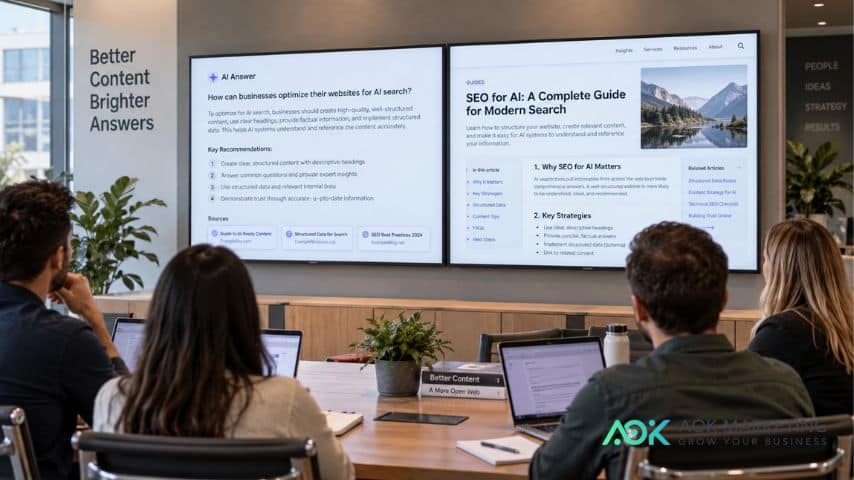
AI tools can take information from multiple sources, organize it, and give the user a direct answer.
ChatGPT search, for example, can provide answers with links and citations to web sources. OpenAI also states that public websites can potentially appear in ChatGPT search results when their content is accessible to its search crawler.
Google has also integrated generative AI into Search through features such as AI Overviews and AI Mode. Google says its existing SEO best practices remain relevant for appearing in these generative AI experiences.
That means businesses have a new challenge.
It is no longer only:
“How do I get my website to rank?”
It is also:
“How do I make my website useful enough for an AI system to understand, reference, or recommend?”
That is the basic idea behind SEO for AI.
Think of Your Website Like a School Report
Now imagine two students have been asked to write a report about volcanoes.
Student A writes:
Volcanoes are really interesting. They are very hot and can erupt. Lots of people like learning about volcanoes.
Student B writes:
A volcano is an opening in the Earth’s crust where molten rock, gases, and ash can escape. There are several types of volcanoes, including shield volcanoes, stratovolcanoes, and cinder cones.
Student B then organizes the report into sections:
- What is a volcano?
- Why do volcanoes erupt?
- What are the different types?
- Where are volcanoes found?
- What happens during an eruption?
Which report would be easier for a teacher to understand and use?
Probably Student B’s.
The same idea applies to online content.
AI systems benefit from content that clearly explains what something is, answers related questions, provides useful context, and organizes information logically.
You do not need to write like a robot.
You need to make your information easy to understand.
Rule #1: Answer the Question
Imagine asking your teacher:
“What is photosynthesis?”
And your teacher responds:
“Before we talk about photosynthesis, it is important to understand that nature is incredibly complex and has fascinated scientists for hundreds of years…”
Ten minutes later, you still do not know what photosynthesis is.
That would be frustrating.
Web content often does the same thing.
A person searches:
“How much does SEO cost?”
But the article spends 800 words talking about the history of digital marketing before giving an answer.
For AI search, clear answers are especially valuable.
If someone asks a question, answer it.
Then add the explanation.
For example:
What is SEO for AI?
SEO for AI is the practice of making online content easier for AI-powered search tools to discover, understand, and potentially reference when answering users’ questions.
Simple.
Then you can explain the details.
Rule #2: Make Your Homework Actually Useful
Imagine your teacher asks everyone to write about the solar system.
You copy the same information that twenty other students already wrote.
Technically, you completed the assignment.
But you did not add very much.
Now imagine another student includes:
- a diagram they created
- an interview with a science teacher
- a comparison of planet sizes
- an original classroom experiment
- answers to questions nobody else covered
Which project would be more useful?
The second one.
The same concept applies to websites.
Publishing another generic article that repeats what hundreds of other websites already say may not give search engines or AI systems much reason to pay attention.
Google’s recent guidance for generative AI search specifically encourages publishers to create useful, original, non-commodity content rather than relying on content that simply repeats information already available elsewhere.
Businesses can add value through things like:
- original research
- first-hand experience
- customer questions
- case studies
- expert commentary
- proprietary data
- real examples
- detailed comparisons
- photographs
- demonstrations
- industry-specific insights
In other words:
Do not just repeat the textbook. Add something to it.
Rule #3: Show Your Work
Remember when your math teacher told you:
“Don’t just write the answer. Show your work.”
There is a good reason for that.
It helps the teacher understand where your answer came from.
Web content works in a similar way.
If your website says:
“Most customers prefer Product A.”
A reader may wonder:
According to whom?
But if you say:
“In our survey of 500 customers, 67% said they preferred Product A.”
That statement becomes much more useful.
When appropriate, support your content with:
- research
- statistics
- reputable sources
- expert quotes
- case studies
- real examples
- your own data
This helps human readers evaluate your information, and it makes your content more informative for search systems as well.
Rule #4: Organize Your Backpack
Imagine your school backpack.
Inside it are:
- three notebooks
- two pencils
- yesterday’s sandwich
- a ruler
- seven worksheets
- a water bottle
- one mysterious sock
Everything is thrown together.
You know your math homework is somewhere inside.
Finding it is the problem.
Some websites look exactly like that.
Everything technically exists, but the information is difficult to navigate.
Good website organization helps both people and machines understand how information connects.
For example, an SEO agency might have:
Main topic: SEO
Then supporting pages about:
- Local SEO
- Technical SEO
- SEO Content
- Keyword Research
- Google Search Console
- Link Building
- AI Search Optimization
Each page covers a specific topic, while internal links help show how the subjects are connected.
Think of it as organizing your school binder into clearly labeled sections.
The easier the information is to navigate, the easier it is to understand.
Rule #5: Use Good Headings
Headings are like chapter titles in a textbook.
Imagine opening your science book and every chapter was simply called:
Chapter
You would have no idea what anything was about.
Useful headings tell both readers and search systems what a section contains.
Instead of:
More Information
Try:
How Does AI Search Find Information?
Instead of:
Things to Consider
Try:
5 Ways to Make Your Content Easier for AI to Understand
Clear beats clever.
Rule #6: Become the Kid Who Actually Knows the Subject
Imagine someone in your class talks about dinosaurs every single day.
They read dinosaur books.
They visit museums.
They know the difference between a Tyrannosaurus rex and a Triceratops.
Whenever someone has a dinosaur question, everyone thinks:
“Ask Alex. Alex knows dinosaurs.”
Websites can develop a similar reputation around particular subjects.
If your company sells cybersecurity software, for example, it makes sense to consistently publish detailed, useful information about cybersecurity.
If one day you publish about cybersecurity, the next day you publish about pizza recipes, and the following week you write about lawn care, it becomes much harder to understand what your website specializes in.
Strong websites tend to build depth around the subjects that actually relate to their expertise.
The goal is not to write about everything.
The goal is to become genuinely useful within the topics that matter to your business.
Rule #7: Make Sure the Librarian Is Allowed to Read Your Book
There is also a technical side to AI SEO.
Imagine writing the best science book in the world and then locking it inside a cabinet.
The librarian cannot recommend something they cannot access.
Search engines use automated systems called crawlers to discover and read webpages.
Website owners can control whether certain crawlers are allowed to access their content.
For example, OpenAI says website owners who want their content to be eligible for inclusion in ChatGPT search summaries and snippets should make sure they are not blocking OAI-SearchBot.
Google similarly requires pages to be accessible for crawling and indexing if publishers want them to appear in Google Search.
This is where technical SEO still matters.
A fantastic article will not help much if search systems cannot properly access it.
Rule #8: Give Machines Helpful Labels
Remember our library?
Libraries use labels to keep books organized.
Websites can provide extra labels too.
One example is structured data.
Structured data is code that gives search engines additional information about what something on a webpage represents.
For example, it can help identify:
- an organization
- a product
- an article
- an author
- a recipe
- an event
- other types of information.
Google explains that structured data helps it understand the content of webpages and may allow pages to appear in additional search features.
You do not necessarily need to understand the code yourself.
Your developer or SEO team can handle that part.
Just remember the library analogy:
Structured data is like putting better labels on your books.
Does AI SEO Mean Regular SEO Is Dead?
No.
Think about it this way.
Before your teacher can use your report to answer a question, they first need to:
- Find your report.
- Read your report.
- Understand your report.
- Decide whether the information is useful.
Traditional SEO still helps with the first few steps.
Good technical foundations, useful content, clear site structure, crawlability, internal links, relevant pages, and trustworthy information still matter.
Google explicitly says that standard SEO best practices continue to apply to its generative AI search features.
AI search does not mean throwing out everything we know about SEO.
It expands what good SEO needs to accomplish.
So What Is Different About SEO for AI?
Traditional search often encourages the user to visit a website to find an answer.
AI search may give the user an answer first and then provide sources they can explore.
That changes the opportunity.
Businesses should think beyond:
“How can we rank #1 for this keyword?”
They should also ask:
“Are we providing the kind of information an AI system could confidently use to answer this question?”
That might mean creating:
- clearer definitions
- better comparisons
- original research
- useful statistics
- detailed FAQs
- first-hand case studies
- expert explanations
- stronger topic coverage
Can You Guarantee That ChatGPT Will Mention Your Business?
No.
There is no magic button that guarantees an AI system will recommend a particular company.
There is also no secret paragraph you can add to your website that forces an AI tool to cite you.
Search systems use many signals and can select different sources depending on the question, context, available information, and system being used.
What businesses can control is the quality and accessibility of the information they publish.
You can make your website:
- easier to crawl
- easier to understand
- more useful
- more specific
- more trustworthy
- more valuable than generic competing content
That gives search engines and AI systems something worth discovering.
AI SEO in One School-Day Example
Imagine you own a company that sells custom office furniture.
Someone asks an AI assistant:
“What kind of office desk is best for a small home office?”
Your website has an article titled:
How to Choose a Desk for a Small Home Office
Inside the article you clearly explain:
- recommended desk dimensions
- different desk styles
- how much space each requires
- storage options
- standing vs. sitting desks
- common mistakes
- actual examples
- measurements from desks your company sells
You also include original photos and advice from your furniture designers.
Compare that with a competing article that simply says:
“Choose a desk that fits your space and budget.”
Both articles technically answer the question.
But one gives far more useful information to work with.
That is the mindset businesses should adopt for AI search.
The 5th-Grader’s Checklist for AI SEO
Before publishing something, pretend your teacher is grading it.
Ask:
Did I answer the question?
Do not hide the answer.
Did I explain it clearly?
Avoid unnecessary jargon.
Did I add something useful?
Do not simply rewrite what everyone else already says.
Did I show where my information came from?
Use evidence when appropriate.
Did I organize everything properly?
Use headings, sections, internal links, and sensible site structure.
Does my website actually know this subject?
Build depth around your real expertise.
Can search systems access the page?
Make sure technical SEO is not blocking them.
If the answer to all seven is yes, you are already thinking about AI SEO in a much smarter way.
The Simplest Definition of SEO for AI
If you remember only one thing from this article, remember this:
Traditional SEO helps search engines find your website.
SEO for AI also helps AI systems understand your information well enough to potentially use it when answering someone’s question.
The best strategy is not to trick AI.
It is to become a better source.
Create information people genuinely want.
Answer questions clearly.
Share things your business actually knows.
Show your expertise.
Organize your website properly.
And make sure search engines and AI systems can access it.
Because whether the reader is a person, Google, ChatGPT, or a very curious 5th grader, good information is still good information.
About The Author