Artificial intelligence has quickly become one of the most useful tools available to marketers, writers, and business owners. It can reduce the time spent on repetitive tasks, help teams work through creative blocks, and make it easier to produce content across multiple channels.
However, using AI effectively involves more than entering a topic and publishing whatever it produces.
The best results come from treating AI as a creative partner rather than a replacement for strategy or expertise. Your business still supplies the audience knowledge, original insights, brand perspective, and final editorial judgment. AI helps you organize and express those elements more efficiently.
If you are exploring practical ways to use AI for content creation, the following five applications can help you save time while producing content that remains useful, accurate, and recognizably yours.

1. Generate and Develop Content Ideas
Creating a consistent flow of relevant topics is one of the biggest challenges in content marketing. Teams often run out of ideas because they begin with a broad instruction such as “write about our industry.” AI can make brainstorming faster, but it works best when it is given meaningful business context.
Instead of asking for a list of generic blog topics, provide details about:
- Your products or services
- Your ideal customers
- Common questions from sales calls
- Problems customers want to solve
- Topics already covered on your website
- Seasonal campaigns or business priorities
- The stage of the customer journey you want to support
For example, a digital marketing agency could ask AI to group questions from recent discovery calls into topics for business owners at the awareness, consideration, and decision stages. This would produce a more useful content plan than simply requesting “ten digital marketing blog ideas.”
AI can also help you approach familiar subjects from new angles. Ask it to identify common misconceptions, compare opposing perspectives, suggest beginner and advanced versions of a topic, or develop ideas for specific industries.
How to improve AI-generated ideas
Do not select a topic based only on how interesting it sounds. Validate each idea against real information, including keyword research, website analytics, customer feedback, competitor gaps, and your company’s goals.
The strongest content ideas usually sit at the intersection of three things:
- Your audience cares about the subject.
- Your business has something credible to contribute.
- The topic supports a measurable marketing or business objective.
AI can expand the possibilities, while your team decides which opportunities deserve attention.
2. Build Better Content Briefs and Outlines
AI can turn a promising idea into a structured plan before drafting begins. This is particularly helpful for agencies or internal marketing teams working with several writers, clients, or subject-matter experts.
A clear content brief keeps an article focused and reduces extensive revisions later. It can define:
- The primary and secondary audience
- Search intent
- The target keyword and related topics
- The main question the content should answer
- Recommended headings
- Important points to include
- Internal linking opportunities
- Required examples, evidence, or expert input
- The desired call to action
AI can review this information and suggest a logical outline. It may also identify questions the original brief overlooked or recommend a better order for the sections.
This is more valuable than asking the tool to create an outline using only a keyword. A keyword offers limited context. A detailed brief allows AI to organize the content around the reader’s needs and the business objective.
Use AI to test the outline
Before drafting, ask AI to evaluate the proposed structure from several perspectives:
- Does each section contribute something different?
- Is any important question missing?
- Are two headings likely to produce repetitive content?
- Does the order match the reader’s decision-making process?
- Which sections require firsthand expertise or external evidence?
This additional step can prevent an article from becoming a collection of loosely connected paragraphs. It creates a clearer path from the reader’s initial question to a useful conclusion.
3. Create a Strong First Draft
Drafting is the most obvious use of generative AI, but the quality of the output depends heavily on the quality of the input.
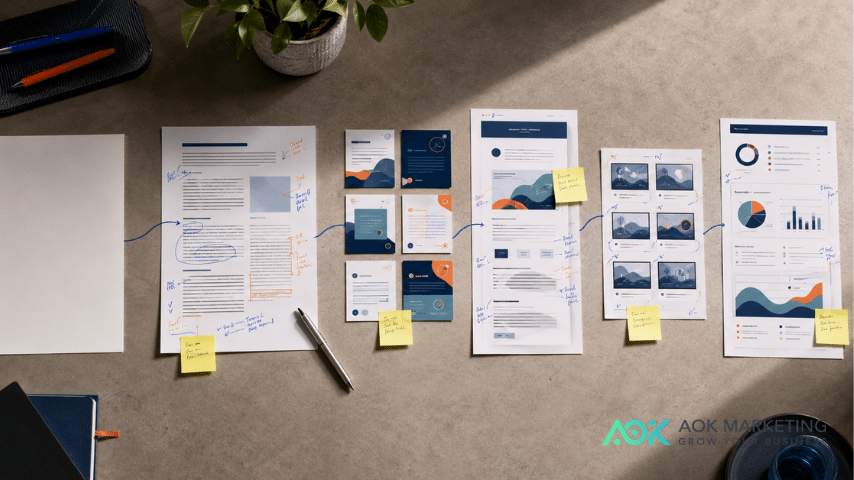
A prompt such as “write a blog about SEO” is likely to produce broad information that resembles thousands of existing articles. A stronger prompt includes the intended reader, search intent, angle, outline, tone, examples, and information that must be incorporated.
You might provide AI with:
- Notes from a subject-matter expert
- An approved content brief
- Customer questions or objections
- An anonymized project example
- Original data or campaign observations
- Brand voice guidelines
- Product or service information
- Credible sources that have already been reviewed
The resulting draft should still be treated as raw material. AI can organize ideas, build transitions, and turn notes into readable prose, but a qualified person should review the article before publication.
Add what AI cannot know on its own
The most valuable sections often come from information unique to your organization. Strengthen the initial draft with:
- Firsthand experience
- Real customer stories
- Expert opinions
- Specific processes
- Original research or internal data
- Lessons from successful and unsuccessful projects
- A clear and defensible point of view
For instance, generic advice might tell businesses to publish content consistently. An experienced agency can add the situations in which updating existing pages would be more effective than increasing publishing volume. That distinction turns a broad recommendation into useful guidance.
The goal is not to disguise the role of AI. It is to use AI’s speed while ensuring that the finished content reflects genuine knowledge and careful judgment.
4. Repurpose Existing Content for Multiple Channels
One of the most efficient ways to use AI for content creation is to get more value from material your business has already developed.
A detailed blog article can become:
- A series of LinkedIn posts
- A short email newsletter
- A carousel or infographic outline
- A video script
- Talking points for a webinar
- Frequently asked questions for a service page
- Short social media captions
- A lead-nurture email sequence
- Sales enablement material
AI can identify the strongest ideas in the original piece and adapt them for different audiences, formats, and character limits. This is faster than recreating every asset from the beginning and helps maintain consistency across channels.
Repurposing should not mean copying the same text everywhere. Each platform has a different purpose and user behaviour. A blog may explain a topic in depth, while a LinkedIn post may focus on one surprising insight and invite discussion. An email may summarize the problem and direct subscribers to the complete resource.
Give AI channel-specific instructions
When adapting content, specify:
- The intended platform
- The target audience
- The desired length
- The tone
- The main takeaway
- The call to action
- Formatting requirements
- Phrases or styles to avoid
Always supply the approved source content rather than asking AI to recreate the topic from memory. This keeps the repurposed assets aligned with the original message and reduces the risk of introducing unsupported claims.
AI can also help identify valuable content hidden in other business materials. Webinar transcripts, podcast episodes, presentations, research reports, sales-call notes, and customer interviews may contain insights that can be developed into new marketing assets, provided the material is appropriate and authorized for use.
5. Edit and Improve Existing Content
AI is often just as valuable during editing as it is during drafting. It can provide a fresh review of content your team has already written and help identify areas that need attention.
You can ask AI to review a draft for:
- Repetition
- Unclear explanations
- Weak transitions
- Inconsistent tone
- Long or complicated sentences
- Missing questions
- Unsupported claims
- Sections that do not match search intent
- Opportunities for stronger examples
- Unnatural keyword use
It can also produce several alternative versions of a headline, introduction, meta description, or call to action. Your team can then select and refine the option that best supports the article.
Use AI as a reviewer, not the final authority
Not every suggestion will improve the content. AI may remove necessary nuance, simplify technical details too aggressively, or recommend language that does not sound like your brand.
The person completing the final edit should understand the topic, audience, and business. They must decide whether each change increases clarity and accuracy or simply makes the writing different.
A useful review prompt could ask AI to identify issues without rewriting the article immediately. This lets the editor evaluate the feedback before any wording changes are made. You can then request revisions for specific sections rather than replacing the entire draft.

How to Maintain Your Brand Voice When Using AI
Many businesses worry that AI-generated content will sound generic or inconsistent. That usually happens when the tool receives vague instructions or has no examples of the desired voice.
Create a simple brand voice guide that includes:
- The tone your brand should convey
- The level of formality
- Preferred sentence and paragraph length
- How technical terms should be explained
- Words or phrases the company frequently uses
- Clichés, claims, and expressions to avoid
- Examples of content that sounds correct
Be more precise than “professional but friendly.” For example, you might instruct AI to use a confident and conversational tone, explain marketing terminology in plain language, keep paragraphs easy to scan, and avoid exaggerated claims or generic references to a rapidly changing digital world.
AI can then use the guide during outlining, drafting, repurposing, and editing. A human reviewer should still confirm that the final piece reflects the way the business genuinely communicates.
Use AI Responsibly
AI can accelerate content production, but speed should not come at the expense of accuracy, confidentiality, or trust.
Build several safeguards into your process:
- Verify facts, statistics, quotations, and references before publication.
- Consult original or authoritative sources when available.
- Do not enter confidential customer or company information into tools that are not approved for it.
- Confirm that examples accurately represent real experiences.
- Review content for bias, misleading statements, and unsupported conclusions.
- Ensure a qualified person approves technical, legal, medical, financial, or other high-stakes material.
- Check that the final content provides original value rather than merely repeating familiar information.
These practices do not limit the usefulness of AI. They create the conditions for businesses to use it confidently and sustainably.
A Simple AI-Assisted Content Workflow
The five uses above can work together in one practical process:
- Research the audience. Gather search data, customer questions, sales insights, and business priorities.
- Use AI to expand topic possibilities. Generate angles based on the research rather than broad industry prompts.
- Create and test the brief. Define the purpose, audience, structure, evidence, and desired action.
- Gather original input. Add expert notes, real examples, internal observations, and verified sources.
- Develop the first draft. Use AI to organize the supplied material into a coherent article.
- Complete a human-led edit. Review accuracy, usefulness, originality, brand voice, and SEO.
- Repurpose the approved article. Adapt it into platform-specific assets using the final version as the source.
- Measure the results. Track engagement, rankings, leads, and conversions to inform future content.
This workflow allows AI to handle much of the organizational and production work without asking it to make decisions that require business knowledge or accountability.
Make AI Part of a Better Content Strategy
The best ways to use AI for content creation are not based on replacing people. They are based on helping people spend less time on repetitive work and more time on strategy, creativity, expertise, and customer understanding.
AI can help your team generate stronger ideas, build organized briefs, develop first drafts, repurpose valuable material, and edit more efficiently. Your people give that work its purpose, credibility, and distinctive voice.
When those strengths are combined, businesses can create more content without automatically sacrificing quality. The result is not merely faster production. It is a smarter and more adaptable content process.
Ready to Build an AI-Assisted Content Strategy?
AI tools can increase your content output, but meaningful results still depend on the right topics, search strategy, original insights, and editorial standards. Our digital marketing team combines efficient AI-supported workflows with SEO expertise and human oversight to create content designed for both search engines and real customers.
If you want to use AI more effectively without losing the voice and experience that make your brand valuable, we can help you develop a content strategy built around your goals.
About The Author