Answer Engine Optimization: Answer Blocks That Get Quoted
AEO is what you do when you accept a harsh reality: sometimes the SERP is going to answer the question without the click. If that’s the game, your job is to be the answer that gets lifted.
Not “rank #3.” Not “the best blog post.” The answer.
This cluster article gives you templates and patterns you can use immediately, without rewriting your entire site.
AEO in one sentence
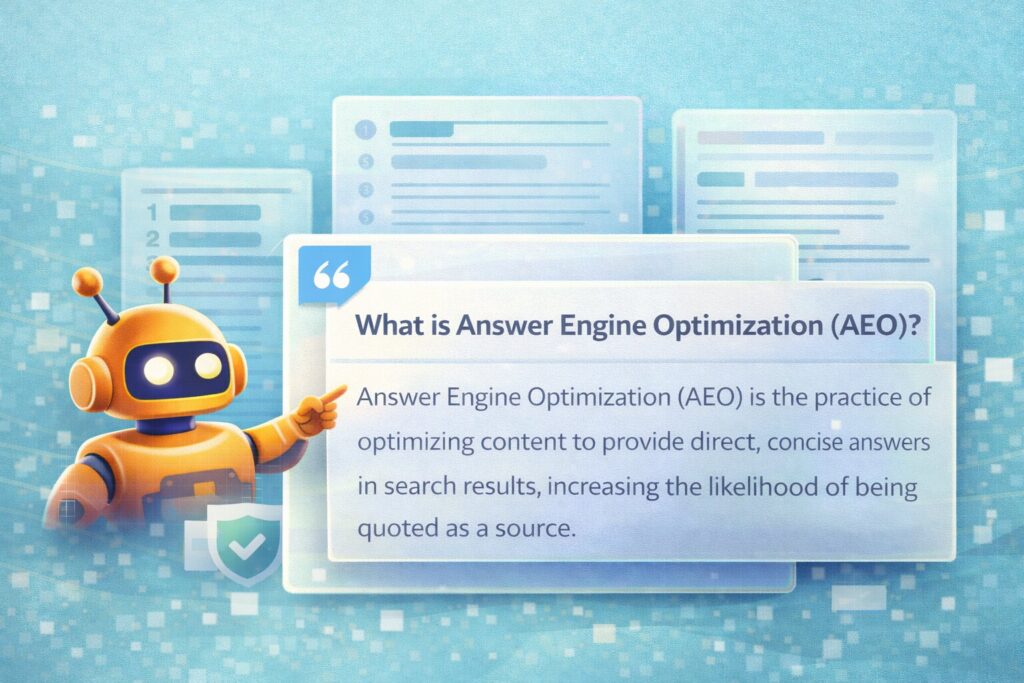
Answer Engine Optimization is structuring content so an engine can confidently extract a clean, accurate answer, then quote, summarize, or speak it.
The new unit of content is the answer block
An answer block is a small piece of content designed to stand on its own. Think: one tight paragraph, one list, one step-by-step sequence. No throat-clearing. No “in today’s digital world.”
- Put the direct answer in the first 1–2 sentences under the heading.
- Expand after the answer (not before).
- Use short lists and steps that can be lifted cleanly.
- Write like you expect to be quoted, because you do.
The simplest answer block template (copy/paste)
- Heading as a question (or a definition):
- “What is AEO?”
- Direct answer (1–2 sentences).
- Answer Engine Optimization (AEO) is the practice of structuring content so search engines and AI systems can easily extract a clear, accurate answer and quote or summarize it directly in the SERP. The goal isn’t just to rank, it’s to become the answer that gets lifted.
- How it works (2–4 bullets).
-
Put the direct answer in the first 1–2 sentences under a clear, question-based heading.
-
Structure content in extractable formats (tight paragraphs, bullet lists, numbered steps).
-
Match the format to intent (definition, comparison, checklist, troubleshooting).
-
Add short FAQs with specific, quotable answers.
-
- When to use it (mini examples).
-
Informational query: “What is AEO?” → Definition + brief explanation.
-
Comparison query: “AEO vs SEO” → Clear differences + when to use each.
-
How-to query: “How to optimize for featured snippets” → Numbered steps + pitfalls.
-
Transactional query: “Best AEO agency” → Evaluation checklist + proof points.
-
- Next step (link to the deeper section or related page).
- See the section on Three patterns that win extraction to apply proven answer structures (definition → differences → example, steps → pitfalls, checklist → proof) to your own pages, or check out the related SEO vs AEO vs GEO vs AIO post.
If you do nothing else, do that.
It’s boring.
It works.
Three patterns that win extraction
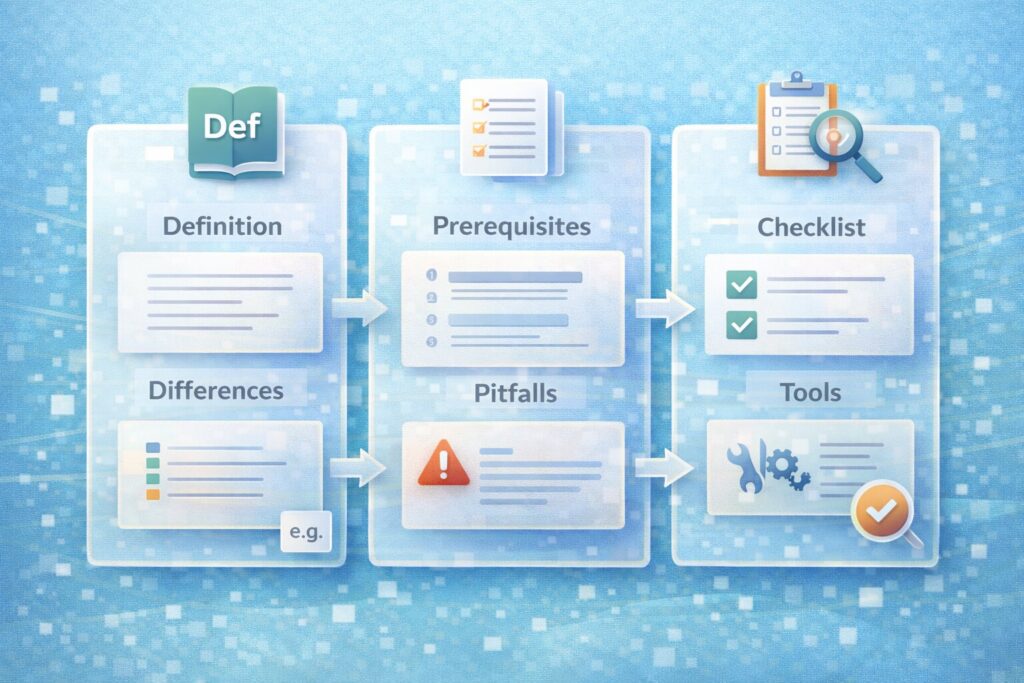
1) Definition → differences → example
Perfect for acronyms, frameworks, and “vs” topics.
- Start with a clean definition (no metaphors yet).
- List the 3–5 differences.
- Show one real-world example of how the difference changes an outcome.
2) Steps → prerequisites → pitfalls
Perfect for “how to” queries and implementation posts.
- Number the steps in the order you’d actually do them.
- Add prerequisites before the steps if skipping them breaks the process.
- Call out 3 common pitfalls so your answer looks safer to use.
3) Checklist → tools → proof
Perfect for operational content (audits, setups, weekly routines).
- Give the checklist first (engines love checklists).
- Then mention tools or methods to complete each item.
- Add proof: what “done” looks like.
Formatting moves that make extraction easy
You don’t need to “write for robots.” You need to write in shapes robots can pick up without dropping.
- Use H2/H3 headings that match the query (“How do I…”, “What is…”, “Best way to…”).
- Keep paragraphs short (2–4 sentences).
- Prefer bullets for lists and criteria; prefer numbered lists for sequences.
- Use consistent terminology (don’t call it “AI summaries” in one section and “overview cards” in another).
- Add a short FAQ section with direct answers (these often become extractable chunks).
AEO isn’t just content. It’s content + intent.
AEO fails when you write a beautiful answer to the wrong question. Before you build answer blocks, map the intent behind the query:
- Informational: “What is GEO?” → definition + differences.
- Comparative: “AEO vs SEO” → side-by-side criteria + when to use each.
- Transactional: “AEO agency” → evaluation checklist + proof points + next step.
- Troubleshooting: “Why am I not in featured snippets?” → diagnostic checklist.
See Also: Write Like You Expect to Be Cited: GEO Signals That Actually Travel
AEO checklist (use this on every cluster page)
- ✅ Every main heading has a 1–2 sentence direct answer underneath
- ✅ At least one list (bulleted or numbered) per major section
- ✅ One “definition box” for key terms (short and quotable)
- ✅ One FAQ section with 5–8 direct Q&As
- ✅ Clear internal links to: pillar + next-step cluster (GEO or SEO foundation)
See Also: SEO Is Still the Admission Ticket (Even in AI Search)
Common mistakes
- Hiding the answer behind a long intro (you’re making extraction harder).
- Using clever language at the cost of clarity (save clever for the examples).
- Writing paragraphs that contain three different answers (engines don’t know which part to lift).
- FAQ answers that are vague or salesy (AEO rewards specificity).
FAQ
Do I need to create separate pages for every question?
No. You need to structure your existing pages so they *contain* extractable answers. Add answer blocks to the sections people actually search for.
Will AEO cannibalize clicks?
Sometimes. But it also increases qualified impressions and can drive higher-intent clicks when users want depth, tools, or a provider.
What’s the fastest AEO upgrade?
Rewrite your H2 sections so each has a direct-answer opening, then add 5–8 FAQs at the bottom.
About The Author