GEO Pricing for SMB: How to Budget 6 Months Without Setting Cash on Fire?
Let’s talk about GEO pricing like adults.
Not the kind of “adult” where you pretend you understand a vendor’s 43-page deck and then sign a retainer out of social pressure. The other kind. The kind where you buy what you need, skip what you don’t, and keep your eyebrows intact.
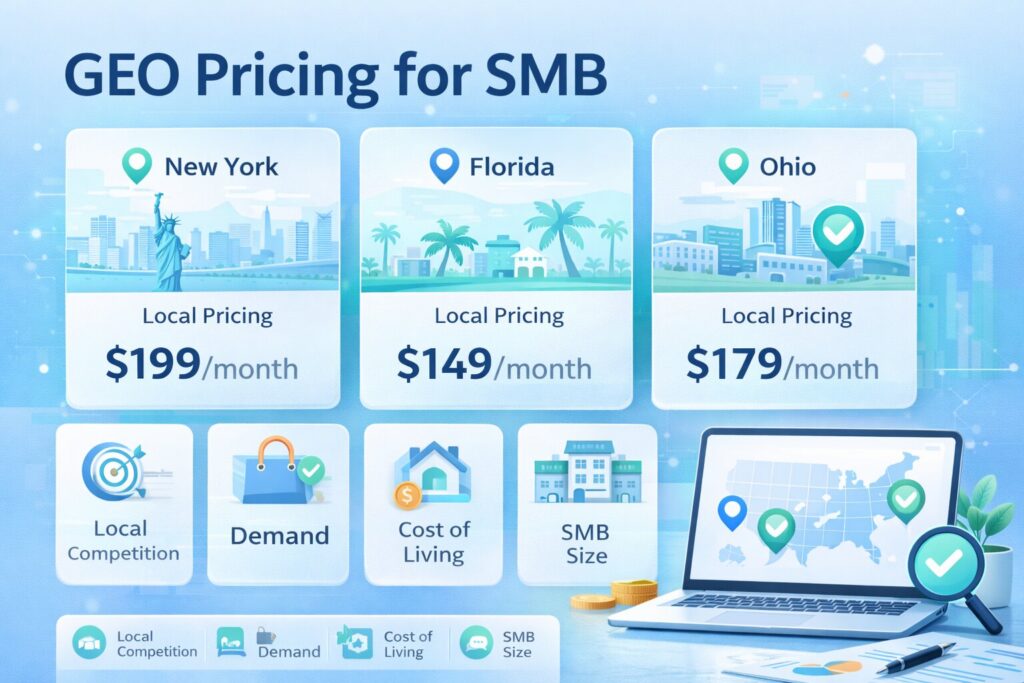
First, the benchmark (because numbers stop the hand-waving):
Across agency packages, SMB GEO retainers most commonly land in these bands:
- $1,500-$5,000/month (≈ $9,000-$30,000 over 6 months) for foundational execution and basic content/technical work.
- $2,000-$7,000/month (≈ $12,000-$42,000 over 6 months) when you add more content velocity and stronger reporting/QA.
- Common startup/audit work: $2,000-$8,000 for an AI visibility audit/readiness assessment.
Rule of thumb: most SMBs end up planning roughly $11k-$32k (lean) to $25k-$50k (competitive) for a 6-month run.
Want the full range comparison with enterprise? That’s in the pillar article: “GEO Pricing Benchmark: 6-Month GEO Costs (SMB vs Enterprise).”
Now, here’s the part nobody puts on the pricing page:
You’re not buying ‘GEO.’ You’re buying a mix of four things:
- Clarity: what questions you want to own, and what the AI systems are currently using as their “source of truth.”
- Plumbing: the technical foundation (indexing, templates, internal linking, schema) so your content is eligible to be used.
- Answers: content that is structured, specific, and actually helpful (not 1,800 words of throat-clearing).
- Trust: proof the web can point at (citations, profiles, PR, reviews, author credibility).
Pricing tiers make sense when you map them to outcomes. So let’s do that.
The three SMB GEO tiers (what they usually mean)
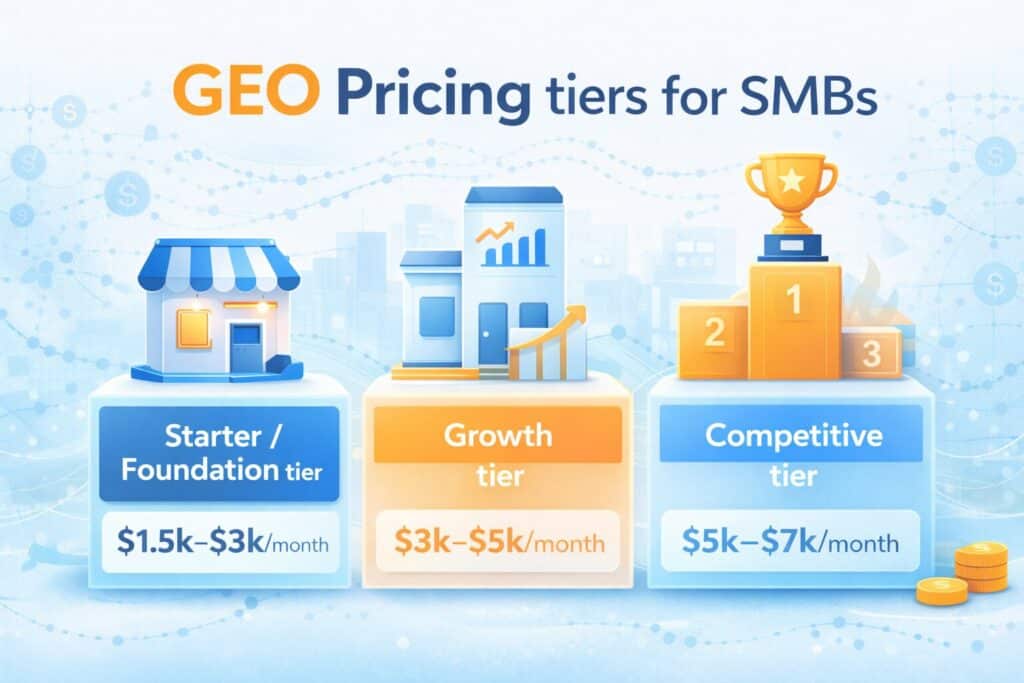
1) Starter / Foundation tier ($1.5k-$3k/month)
This is for businesses that already have decent SEO basics and just need to stop being invisible in AI answers.
Typical inclusions:
- AI visibility baseline (light audit + quick wins).
- On-page/content upgrades to key pages (services, category pages, core FAQs).
- Basic schema pass (Organization, LocalBusiness, FAQ/HowTo where appropriate).
- A small monthly publish cadence (often 2-4 pieces or updates).
- Monthly reporting (simple, not NASA).
What it’s not: a full reputation/PR engine. If you need citations and coverage, you’ll feel this tier’s ceiling by month two.
2) Growth tier ($3k-$5k/month)
This is the ‘we’re serious’ tier. You’re producing more answers, tightening the site, and actually measuring if it’s working.
Typical inclusions:
- Fuller audit and prioritized backlog (technical + content + entity signals).
- Higher content velocity (4-8 updates/articles per month, depending on complexity).
- Template-level improvements (internal linking modules, author blocks, structured sections).
- Basic digital PR/citation strategy (not a massive campaign, but intentional).
- QA on how answers appear across multiple AI surfaces (prompt testing + corrections).
If you’re in a competitive local market, a crowded B2B category, or you have multiple services with different intent profiles, this tier usually wins.
3) Competitive tier ($5k-$7k/month)
This is for SMBs that are basically ‘enterprise in behavior’ even if they aren’t in headcount. Multi-location, multi-service, or aggressively competitive niches.
Typical inclusions:
- Everything in Growth, plus more consistent publishing and refresh cycles.
- More aggressive trust-building (citations/mentions, partnerships, expert quotes, media angles).
- Deeper technical work (information architecture, indexing cleanup, schema at scale).
- More advanced reporting (dashboards, cohorts, assisted conversions).
This tier is where you stop asking ‘how much content?’ and start asking ‘how fast can we learn what AI is using and replace it with us?’
How to choose the right tier (a simple decision filter)?
Pick the smallest program that can actually win. Here are the filters that matter:
Filter 1: How many “things” are you, really?
Single location + one core offer + one sales motion? That’s simple.
Three locations + five services + multiple audiences? You’re not ‘small.’ You’re just underfunded.
Filter 2: How much content can you ship?
If you can’t publish (or update) consistently, you’re basically paying for a gym membership you never use.
- If you can contribute SMEs/notes weekly, Growth or Competitive makes sense.
- If you can’t, pick Starter and focus on upgrading high-intent pages first.
Filter 3: How wrong is the web about you?
If AI answers are incorrect (wrong founders, wrong product, wrong locations), you need more than content. You need entity cleanup and citations.
That pushes you up-tier fast.
What to demand in an SMB GEO proposal (so you don’t buy fluff)?
- A list of target queries/questions AND the pages/entities they map to (no vague ‘we’ll optimize content’ language).
- An audit deliverable you can actually use: prioritized fixes, not a PDF museum.
- A publishing plan that states monthly output (and who writes what).
- A measurement plan that includes AI visibility checks AND business metrics (leads, pipeline, revenue).
- A list of off-site trust activities (citations, PR, profiles) with realistic expectations.
If a proposal won’t commit to outputs and instrumentation, it’s not a GEO plan. It’s a vibe.
Common pricing gotchas (a quick warning label)
- “We guarantee you’ll be cited in AI answers.” Nobody credible guarantees a specific AI output.
- “We’ll do 20 articles per month” with no SME input plan. That’s how you get 20 articles of word salad.
- No technical scope. If you can’t get crawled, you can’t get used.
- Reporting that only shows impressions and ‘visibility’ but can’t tie to conversions or assisted conversions.
Your 6-month success metric (what ‘good’ looks like)
A solid SMB GEO program should produce:
- More accurate brand/entity information across AI answers.
- More citations and mentions that point back to your site and profiles.
- More qualified traffic (even if total traffic doesn’t spike immediately).
- A repeatable content system you can keep running after month six.
If month six ends and you’re still asking ‘what did we actually build?’ that wasn’t GEO. That was rent.
See Also: Enterprise GEO Budgeting: 6-Month Costs (Standard vs Complex)
About The Author