SEO Is Still the Admission Ticket (Even in AI Search): A Practical Foundation Checklist
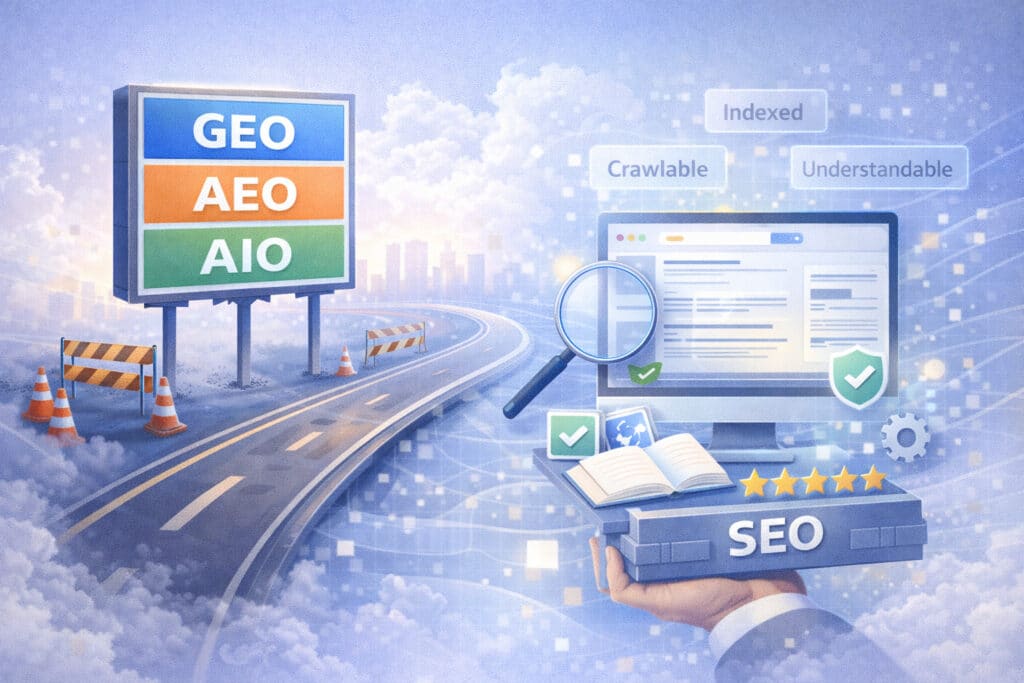
If you’re trying to “do GEO” or “do AEO” while your pages aren’t reliably indexed, you’re basically designing a billboard for a road that doesn’t exist.
Here’s the uncomfortable truth the new acronyms don’t fix: SEO is still the admission ticket. Every AI surface that cites, summarizes, or quotes the web needs the same boring fundamentals, crawlable, indexable, understandable pages.
This article is the practical “foundation layer” cluster for the reality of AI search. Use it to make the rest of the stack (AEO, GEO, AIO) actually work.
Why “no special AI requirements” still has a big asterisk
When platforms say there are “no special requirements” for AI features, they usually mean there’s no secret switch you can flip to force your way into an AI summary.
The asterisk is eligibility. If your page isn’t indexed (or isn’t eligible to show a snippet), it can’t be used as a supporting link. No indexation = no invitation.
Step 1: Make indexation boring (boring is good)
Indexation problems are rarely dramatic. They’re death-by-a-thousand-paper-cuts: a noindex tag here, a canonical pointing somewhere weird there, a faceted navigation multiplying URLs like rabbits.
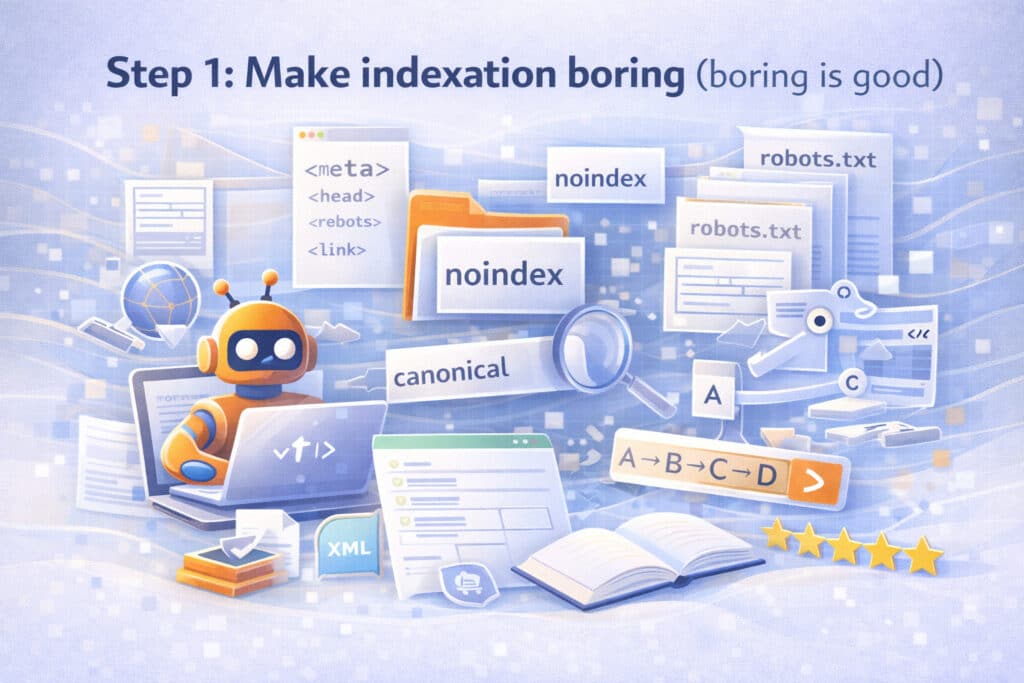
- Robots.txt: confirm you’re not blocking important sections, JS/CSS, or your entire site (yes, it happens).
- Meta robots: check for “noindex”, “nofollow”, or “nosnippet” on pages you want to be discoverable and quotable.
- Canonicals: make sure canonical tags point to the correct “main” URL (and don’t canonical everything to the homepage).
- Sitemaps: submit clean XML sitemaps that include only canonical, indexable URLs.
- Duplicate/parameter URLs: control faceted filters and tracking parameters with proper canonicalization and URL handling.
- Redirect chains: reduce “URL A → B → C → D” to a single hop wherever possible.
- Thin pages: consolidate or improve pages that don’t add unique value, especially programmatic pages that look “generated.”
Step 2: Build internal links like you’re laying down street signs
AI visibility starts with discoverability. Discoverability starts with internal linking. If Google (or any crawler) can’t reach a page easily, it’s not going to be the page the system trusts enough to quote.
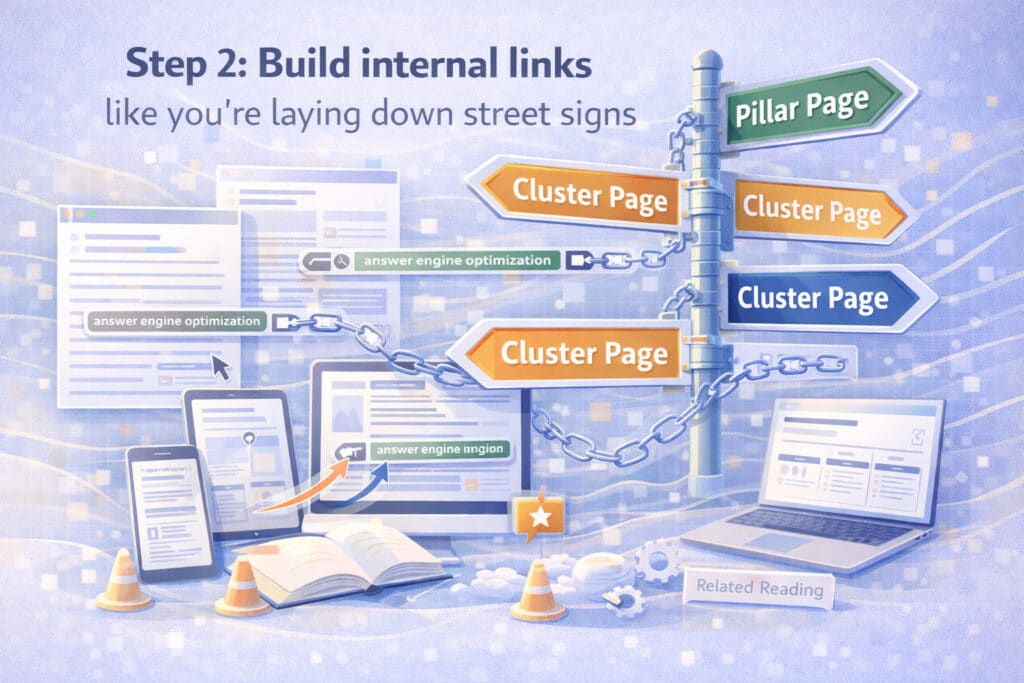
- Use hub-and-spoke internal links: pillar ↔ clusters ↔ supporting subpages.
- Link contextually inside paragraphs, not only in navs and footers (context helps machines understand why a page matters).
- Keep anchor text descriptive (“answer engine optimization checklist”), not vague (“click here”).
- Make sure every cluster links back to the pillar with consistent anchor text to reinforce topical relevance.
- Add “related reading” modules to reduce orphan pages and increase crawl paths.
Step 3: Write pages that deserve to exist (or don’t publish them)
A lot of “SEO content” fails because it’s written as if the goal is to occupy a keyword. But modern search surfaces reward pages that *resolve uncertainty*, clearly, accurately, and fast.
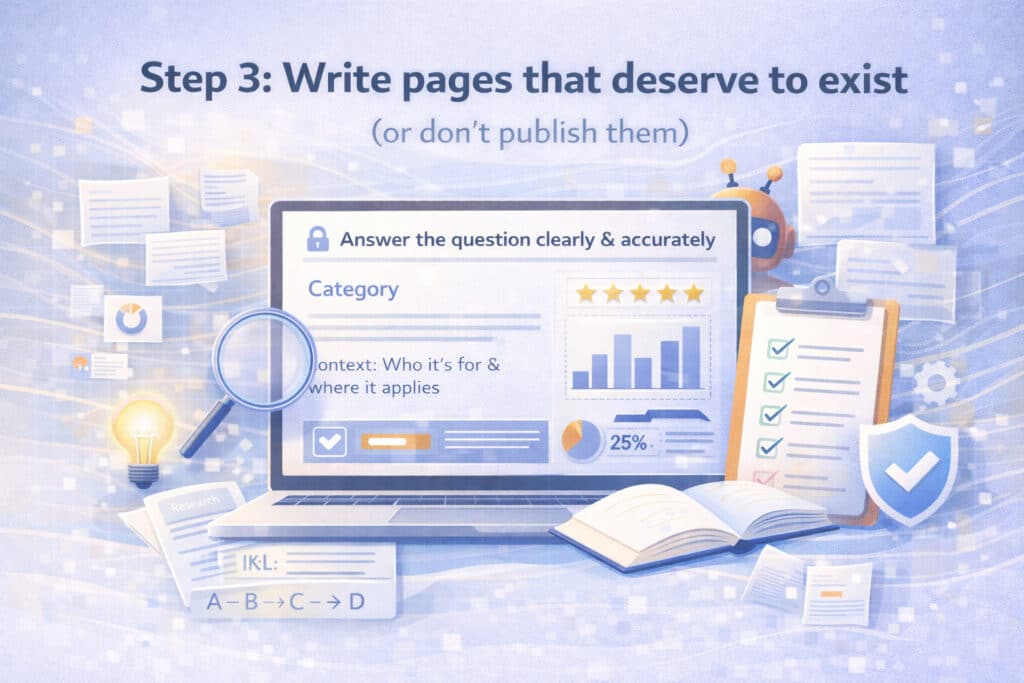
- Answer the intent in the first 2–3 sentences under each main heading.
- Pick one job per page. If the page is trying to rank for 12 different intents, it will satisfy none of them well.
- Use clear entity language: name the thing, the category, and the context (who it’s for, where it applies).
- Add proof where it matters: examples, data, screenshots, and citations (your future GEO self will thank you).
- Delete or merge pages that are 80% repeated templates with 20% swapped words.
Step 4: Structured data is icing, not cake
Schema won’t rescue a weak page, but it can make a good page easier to interpret, extract, and display.
- Start with the basics that match your content: Organization, Article, FAQ (when appropriate), Breadcrumb, Product/Service.
- Make sure your structured data reflects what is actually visible on the page.
- Use schema to clarify entities (brand, product, author), not to “game” features.
- Keep it clean: no spammy markup, no hidden FAQ answers, no mismatched fields.
A 60-minute audit you can run today
- Pick 10 URLs you want to show up in search and AI summaries (pillar + top clusters).
- Check each URL for indexability: is it blocked by robots or tagged noindex?
- Check canonical tags: do they point to themselves (or the correct canonical)?
- Confirm internal links: can you reach the page in 3 clicks from the homepage?
- Scan the SERP: does Google show a snippet for the page when you search a relevant query?
- Add one “answer block” under the main heading (you’ll use the AEO cluster for the full playbook).
- Add one “citable” element: a stat with attribution, a definition, or a concrete example (GEO cluster expands this).
- Log what you changed so you can correlate improvements later.
Quick checklist (copy/paste into your task manager)
- Key pages are indexable (no robots/noindex issues)
- Canonicals and redirects are clean
- Sitemap contains only canonical, indexable URLs
- Every cluster links back to the pillar
- Each page answers intent early and clearly
- Thin/duplicate pages are merged or improved
- Basic schema is accurate and aligned to visible content
Common mistakes (a.k.a. how SEO dies quietly)
- Publishing 50 “supporting” pages that you forgot to build internal links to other relevant content.
- Letting a CMS template generate near-duplicate pages at scale without guardrails.
- Trying to fix visibility with schema instead of fixing the page.
- Chasing new acronyms while ignoring crawlability, quality, and structure.
FAQ
Is SEO dead because AI answers reduce clicks?
No. The click is less guaranteed, but visibility still depends on the same foundation. SEO evolves from “rank for clicks” to “rank + be eligible to be used.”
Will adding schema guarantee I show up in AI summaries?
No. Schema can help interpretation, but the page still needs to be high-quality, relevant, and indexable.
What’s the fastest win?
Fix indexation and internal linking first. Then add an answer block to your top pages.
Sources
- Google Search Central: AI features and your website (AI Overviews / AI Mode eligibility guidance).
- Google Search Central: SEO Starter Guide.
About The Author