Scenario A vs Scenario B: Two Ways to Price a 6-Month GEO Program
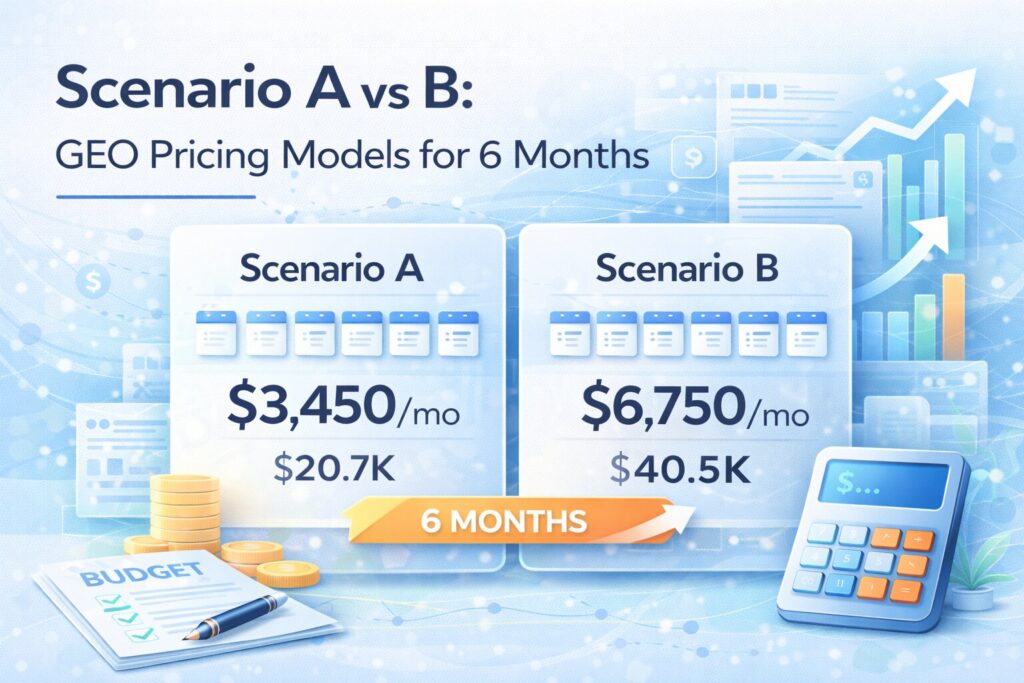
If you have asked three agencies, you have probably gotten four answers.
Not because GEO is fake. Not because everyone is making things up.
But because when someone says “GEO program,” they might mean one of two completely different scopes:
- Do a readiness audit, then iterate month to month (Scenario A).
- Do the audit, then fix the content/knowledge foundation first, then iterate (Scenario B).
Those two paths can both be “GEO”. They just have very different labor profiles. And in 2026, labor is the line item.
This article is one of the cluster posts supporting the pillar: “6-Month GEO Program Cost Estimate“. If you want the short version, the range tables, and the calculator, that pillar is the hub.
The difference in one sentence
Scenario A is “audit, then optimize.”
Scenario B is “audit, then restructure, then optimize.”
If you picture your website as a library, Scenario A is re-labeling shelves and improving signage. Scenario B is admitting the shelves are in the wrong rooms and moving the walls first.
Scenario A: Audit/Readiness project + monthly GEO retainer
These totals combine one-time project work plus 6 months of GEO retainer (before tax).
| Program tier | 6-month total (low) | 6-month total (high) |
| Entry-level | $14,000 | $32,000 |
| Mid-market | $32,000 | $56,000 |
| Enterprise | $50,000 | $98,000 |
When Scenario A is a good fit:
- Your site already has decent structure (clear product/service pages, logical categories, clean internal links).
- You have existing content that can be updated and expanded without a major rebuild.
- You can publish consistently (or you have an internal team that can).
- You want a budget that is easier to phase: a smaller project up front, then monthly iteration.
Scenario B: Audit + content/knowledge restructuring project + monthly GEO retainer
These totals add an additional restructuring project to improve content architecture and “knowledge” alignment (before tax).
| Program tier | 6-month total (low) | 6-month total (high) |
| Entry-level | $22,000 | $47,000 |
| Mid-market | $40,000 | $71,000 |
| Enterprise | $58,000 | $113,000 |
When Scenario B is a good fit:
- Your content is “spaghetti” (lots of posts, few hubs, no clear topical map).
- Your services/products overlap, and your naming is inconsistent across pages.
- You are missing the definitional content that AI systems love to cite (FAQs, comparisons, clear “what is” pages).
- Your internal linking is weak (good pages exist, but crawlers and humans cannot find them).
- You are rolling out across multiple markets/languages and need a clean architecture before scaling.
Quick decision rules (so you can stop overthinking it)
Here is a simple way to choose without turning this into a three-week committee project.
Choose Scenario A if:
- You can point to your top 20 pages and say, “These are the pages we want AI to cite,” and the list makes sense.
- Your site navigation matches how customers talk about the problem.
- You mostly need iteration: better answers, better structure, better internal links, better schema.
Choose Scenario B if:
- You have multiple pages competing for the same topic (duplicate intent).
- Your category structure was built around internal org charts instead of user questions.
- Your best content is buried three clicks deep and nobody links to it.
- You know you need hubs/FAQs/entity coverage and you do not have it yet.
How to get apples-to-apples quotes from agencies?
Most confusion happens because proposals blur project work and ongoing work into one number. You can fix that with one sentence:
Ask for three separate line items:
- Audit/Readiness (one-time).
- Restructuring (optional, one-time).
- Monthly retainer (6 months) plus any monthly tools/PR/add-ons.
Now you can compare proposals without playing detective.
About The Author