There’s a reason so many content marketing efforts quietly fizzle out after a few months. Someone gets excited, publishes a burst of blog posts, waits for the phone to ring, and when it doesn’t happen fast enough, the whole thing gets shelved. That’s not a content marketing problem. That’s a pacing problem.
Content marketing has never been a sprint. It behaves more like a marathon: slow to build momentum, demanding in the middle stretch, and genuinely rewarding for the brands that pace themselves properly and keep showing up. The same is true of email marketing, social media marketing, and internet marketing more broadly. Every one of these channels has a learning curve. It takes real time to understand your audience, and it takes even longer to figure out which strategies actually move the needle for your specific goals. Brands that treat content marketing like a quick-win tactic almost always give up right before it starts paying off.
This guide breaks down practical content marketing tips for setting the right goals, building a content marketing strategy that can actually go the distance, and measuring progress along the way, so your content efforts look less like a failed sprint and more like a marathon you’re actually built to finish.
Why Content Marketing Takes Time to Work
Every marketing channel worth investing in has a runway before it produces results, and content marketing’s runway tends to be longer than most, for good reason. Search engines need time to crawl, index, and rank new content. Audiences need repeated exposure to a brand before they start to trust it. And your own team needs time to learn what resonates, what falls flat, and how your specific audience actually behaves, information that simply doesn’t exist until you’ve published consistently for a while.
Compare this to a paid ad campaign, where results are visible almost immediately, but disappear the moment you stop spending. Content marketing works in the opposite direction: slow to build, but compounding. A well-written, well-optimized page published today can keep generating traffic, leads, and trust for years, something no single ad campaign can replicate. That compounding effect is exactly why patience isn’t just a nice attitude to have, it’s a structural requirement for content marketing to actually work, and it’s also why pairing content with strong on-page and technical SEO matters so much: great content that search engines can’t find or rank properly never gets the chance to compound at all.
Setting the Right Goals Before You Start Running
One of the most common reasons content marketing efforts stall is a lack of clarity around what success actually looks like. Before publishing anything, it’s worth asking a simple but often skipped question: what is this content actually supposed to achieve?
Most content marketing goals fall into a handful of core categories:
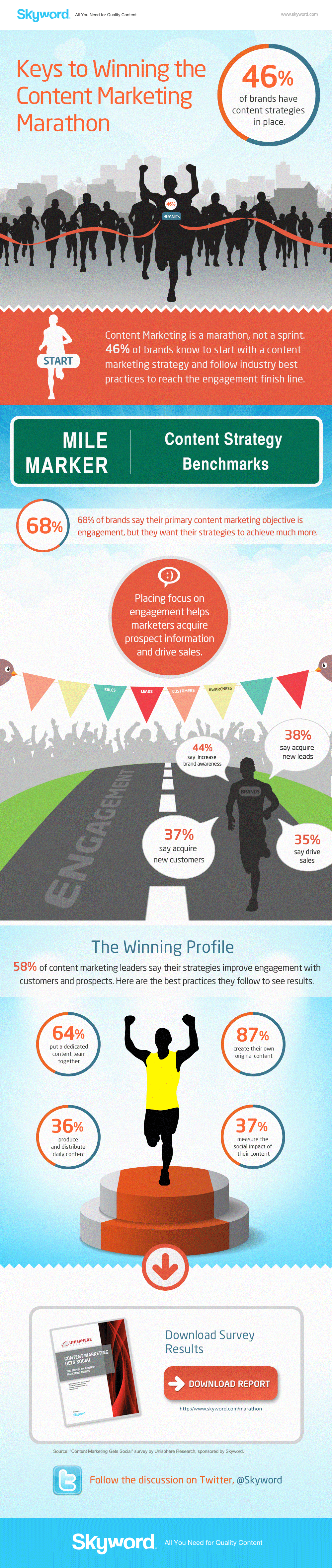
Engagement. Getting people to read, comment, share, and spend meaningful time with your content. Engagement is often the entry point for a broader content marketing strategy, since it signals whether your content is actually resonating before you ask for anything bigger.
Brand awareness. Making sure people recognize your name, understand what you do, and think of you when a relevant need comes up. Brand awareness content tends to be broader and more top-of-funnel, designed to reach people who aren’t ready to buy yet but need to know you exist.
Lead generation. Capturing contact information from readers who are interested enough to want more, whether that’s a newsletter signup, a downloadable guide, or a consultation request. Lead-focused content usually goes deeper into a specific problem your audience faces.
Customer acquisition. Converting engaged readers and leads into actual paying customers. This stage of content often includes case studies, comparisons, and content that directly addresses buying objections.
Sales enablement. Supporting an existing sales process with content your team can share directly with prospects, think detailed guides, FAQs, and proof points that shorten the sales cycle.
Many brands say engagement is their primary content marketing objective, but the honest goal is almost always something bigger sitting behind it, new leads, new customers, or more sales. That’s not a contradiction. Engagement is frequently the mechanism that gets you there. People rarely convert from a first interaction with your brand; they need repeated, valuable engagement first, which builds enough trust to eventually take action.
Building Your Mile Markers: Content Strategy Benchmarks
A marathon runner doesn’t just run blindly toward a finish line, they track mile markers along the way to know whether they’re on pace. Content marketing needs the same kind of checkpoints. Without benchmarks, it’s nearly impossible to tell whether your strategy is actually working or just generating activity.
Useful benchmarks to track over time include:
- Traffic growth to your core content pages, month over month and year over year
- Engagement metrics like average time on page, scroll depth, comments, and shares
- Lead conversion rate from content-driven traffic, tracked separately from paid or referral traffic
- Search ranking movement for your target keywords, since content marketing and SEO are deeply intertwined
- Content-to-customer attribution, tracking how many actual customers first discovered your brand through a piece of content
Set these benchmarks early, before you start publishing at scale, so you have a clear baseline to measure against. Revisit them quarterly rather than daily. Content marketing momentum builds slowly enough that day-to-day fluctuations rarely tell you anything meaningful, but a quarter-over-quarter trend line will. If you want to see what these benchmarks look like in practice, our case studies walk through how real brands tracked progress and adjusted their strategy along the way.
The Winning Profile: What Strong Content Teams Do Differently
Brands that consistently see results from content marketing tend to share a handful of specific habits, and none of them are particularly flashy or complicated. They’re just consistently applied.
They build a dedicated content function. Even a small, focused team, sometimes just one or two people with clear ownership, produces far more consistent results than content created as an afterthought by whoever has spare time that week. Ownership creates accountability, and accountability creates consistency. This is exactly why so many growing brands eventually turn to dedicated content development support rather than trying to squeeze content creation into an already full plate.
They create original content rather than recycled summaries. The brands seeing the strongest engagement are the ones producing their own research, perspectives, and expertise, not just repackaging what’s already ranking elsewhere. Original content is harder to produce, but it’s also far harder for competitors to copy.
They publish consistently, not obsessively. There’s a meaningful difference between publishing regularly and publishing constantly. A steady, sustainable cadence, whether that’s twice a week or twice a month, consistently outperforms sporadic bursts of high-volume publishing followed by long silences.
They measure the actual impact of their content, not just how much of it they produce. Tracking real engagement, conversion, and social impact metrics lets a content team course-correct quickly instead of continuing to invest in formats or topics that aren’t actually working.
They treat content as a long-term asset, not a disposable announcement. A guide, an in-depth article, or a website content hub created today should be built to still be useful, accurate, and relevant a year or two from now, with periodic updates rather than a one-and-done mindset.
Turning Engagement Into Real Business Results
Engagement is a meaningful early signal, but it isn’t the finish line. The real value of content marketing shows up when engagement translates into something the business actually needs: new leads, new customers, and ultimately, more sales.
A few practical ways to bridge that gap:
Add clear next steps to high-engagement content. If an article or guide is consistently getting strong traffic and time-on-page, it’s a natural candidate for a more direct call to action, a related offer, a deeper resource, or a way to get in touch.
Segment content by funnel stage. Not every piece of content needs to sell. Top-of-funnel content should build awareness and trust. Middle-of-funnel content should address specific problems and objections. Bottom-of-funnel content should make the case for choosing you specifically, with proof points and comparisons.
Nurture rather than pitch. Readers who engage with your content once rarely convert immediately. Building an email list, retargeting audience, or subscriber base off the back of content lets you continue the relationship over multiple touchpoints instead of hoping a single article does all the work.
Track the full journey, not just the first click. A customer might read three or four pieces of your content over several weeks before ever filling out a form. Attribution models that only credit the very first or very last interaction miss most of that story, so it’s worth looking at the fuller picture whenever possible. Reviewing your free growth proposal is a useful way to see where content fits into that broader journey alongside your other marketing channels.
Common Content Marketing Mistakes That Slow the Race Down
Even well-intentioned content marketing efforts run into predictable obstacles. Watching for these can save months of wasted effort:
- Expecting sprint-speed results. Judging a three-month-old content strategy the same way you’d judge a two-week ad campaign sets unrealistic expectations and often leads to abandoning a strategy right before it starts working.
- Publishing without a clear goal. Content created without a specific engagement, awareness, lead, or sales objective in mind tends to underperform simply because there’s nothing to optimize toward.
- Ignoring your own data. Many brands publish consistently but rarely go back and analyze what’s actually working, missing obvious opportunities to double down on high-performing topics and formats.
- Treating content as disposable. Publishing an article once and never revisiting it wastes the compounding value content is capable of generating over time.
- Chasing every trend instead of building a core strategy. Trend-driven content can be a useful supplement, but a content marketing strategy built entirely around chasing trends rarely builds the kind of durable topical authority that produces long-term results.
Why Patience in Content Marketing Matters Even More in the Age of AI Search
As more research and buying decisions start inside AI tools and generative search assistants rather than a traditional list of search results, the marathon mindset behind content marketing becomes even more important, not less. AI systems favor established, consistently updated, genuinely authoritative content when deciding what to cite or recommend. A single hastily published article rarely earns that kind of trust. A body of consistent, well-maintained content built over months and years does.
This means the brands willing to run the marathon, publishing consistently, building real topical depth, and measuring what actually works, are increasingly the ones showing up not just in traditional search results, but inside AI-generated answers and summaries as well. Shortcuts that might have worked for quick search engine wins in years past are far less effective in an environment where both human readers and AI systems are getting better at recognizing genuine expertise versus rushed, thin content.
A Practical Roadmap for Getting Started
If you’re building or resetting a content marketing strategy, here’s a simple sequence to follow:
- Define your primary goal. Choose whether engagement, brand awareness, lead generation, or sales enablement matters most right now, understanding the others will likely follow as your strategy matures.
- Set your mile marker benchmarks. Establish a baseline for traffic, engagement, and conversions before you start publishing at scale, so you have something concrete to measure progress against.
- Build a small, accountable content team, even if it’s just one dedicated person to start, rather than treating content creation as an occasional side task.
- Commit to a sustainable publishing cadence. Choose a frequency you can genuinely maintain for the next twelve months, not just the next few weeks.
- Create original, genuinely useful content rather than recycling what’s already been said elsewhere, since originality is what earns both reader trust and long-term search visibility.
- Review your benchmarks quarterly, adjusting your topics, formats, and distribution based on what the data actually shows, rather than gut feeling alone.
- Revisit and update your best-performing content periodically instead of letting it go stale, extending its useful life well beyond its original publish date.
Final Thoughts
Content marketing rewards the brands willing to run the full distance, not the ones sprinting for a quick burst of attention. Set clear goals before you start. Track meaningful mile markers along the way. Build a small, dedicated team that treats content as a long-term asset rather than a disposable announcement. And measure what’s actually working, not just how much you’re publishing.
The brands that internalize this marathon mindset consistently outperform the ones looking for a shortcut, not because they work harder in any single week, but because they keep showing up, mile after mile, long after the brands chasing quick wins have already given up. Browse our learning center for more guides like this one, or explore our full resources hub to see how content, SEO, and strategy come together to help brands go the distance.
Frequently Asked Questions
How long does it typically take to see results from content marketing?
Most brands start seeing meaningful traffic and engagement gains somewhere between three and six months of consistent publishing, with stronger, more compounding results building over twelve months and beyond. This varies by industry competitiveness and how consistently content is produced and promoted.
What’s the single most important content marketing tip for beginners?
Define your goal before you publish anything. Content created without a clear objective, engagement, leads, awareness, or sales, is far harder to optimize and measure, and it’s the most common reason early content marketing efforts stall out.
Should I focus on quantity or quality when starting out?
Quality, paired with a sustainable, consistent cadence. A smaller volume of genuinely useful, well-researched content will consistently outperform a large volume of rushed, generic posts, both for readers and for how search engines and AI tools evaluate your site.
How do I know if my content marketing strategy is actually working?
Track a handful of clear benchmarks, traffic growth, engagement metrics, lead conversion rate, and content-to-customer attribution, and review them quarterly. A strategy that’s working should show a gradual upward trend over several months, even if individual weeks fluctuate.
Source: www.skyword.com
About The Author