Mobile devices have changed more than where people see advertisements. They have changed how advertising must look, feel and behave.
People move quickly through social feeds, switching between videos, images, conversations, recommendations and branded content within seconds. An advertisement that interrupts this experience or feels designed for a desktop screen can be ignored almost immediately. A successful mobile ad must capture attention without making the surrounding experience feel broken.
This is where mobile native advertising becomes valuable. Native ads are designed to fit naturally within the platform where they appear. They use familiar layouts, content styles and interaction patterns while remaining clearly identified as paid promotion.
The combination of mobile design and native placement helps brands reach customers within the digital environments they already use. However, fitting into a feed is only the beginning. Effective campaigns still need a relevant message, credible creative, transparent disclosure and a clear path from attention to action.
The infographic originally published with this page reflects mobile and native advertising forecasts from approximately 2012 to 2017. It provides useful historical context, but its projections should not be treated as current 2026 advertising benchmarks.
What Is Mobile Native Advertising?
Mobile native advertising is paid content designed to match the format and user experience of the mobile platform on which it appears.
Instead of looking like a traditional banner placed around the main content, a native advertisement may appear as a sponsored post in a social feed, a recommended article, a promoted video or an in-app placement. It follows the platform’s visual structure while communicating a commercial message.
LinkedIn, for example, describes Sponsored Content as a native advertising format that places promoted campaigns within the LinkedIn feed. Its native ad options include single-image posts, videos, documents, carousels, articles and newsletters displayed across desktop and mobile experiences. (LinkedIn Business Solutions)
The word “native” does not mean the advertisement should conceal its commercial purpose. It means the creative fits the surrounding environment well enough to feel useful and familiar rather than disruptive.
A well-designed native ad should resemble the type of content people expect to encounter on that platform while still being visibly labelled as sponsored or promoted.
Why Mobile and Native Advertising Work So Well Together
Social platforms are built around continuous discovery. People scroll through posts, pause on subjects that interest them and move past content that appears irrelevant.
Mobile screens intensify this behaviour because they provide limited space. Advertisers cannot rely on large desktop banners, lengthy introductions or detailed information appearing before the customer understands the main message.
Native formats solve part of this challenge by placing the advertisement inside the user’s existing content stream. The ad does not require the viewer to learn a new layout or interaction. A person can watch, swipe, tap, comment or visit a product using controls that already feel familiar.
This compatibility is why mobile and native advertising have developed together. Social feeds, Stories, Reels, sponsored articles and in-app placements are all designed around content experiences that work naturally on a phone.
Businesses should still remember that mobile behaviour extends beyond social networks. Customers may see an advertisement, visit a website, check reviews and search for the brand before taking action. The broader shift in smartphone behaviour is explored further in our guide to how consumers have gone mobile.
Native Ads Should Belong in the Feed Without Disappearing Into It
The most effective native advertisements achieve a careful balance.
They fit the platform well enough to avoid feeling intrusive, but they remain distinctive enough to communicate a recognizable brand message. When an advertisement looks completely disconnected from the surrounding content, users may scroll past it. When it imitates editorial content too closely, it can create confusion and undermine trust.
A strong native ad normally shares several qualities with successful organic content. It has a clear opening, an immediate visual focus and a message that can be understood before the viewer loses interest.
The creative should also match the reason people use the platform. A polished professional insight may suit LinkedIn, while a fast product demonstration may work better in a short-form video feed. A visually led retail campaign may benefit from an immersive mobile shopping format.
Meta’s collection ads, for example, combine a main image or video with related product images and can direct users into a fast-loading mobile browsing experience. Meta positions the format as a way to connect product discovery with consideration and purchase.
The format should follow the customer’s natural behaviour rather than forcing the same advertisement into every placement.
Start With the Customer’s Reason for Stopping
People rarely open a social platform because they want to view advertisements. They stop when something appears relevant, useful, entertaining or emotionally meaningful.
A successful mobile native advertising strategy therefore begins with the customer’s interests rather than the company’s sales message.
An advertisement may earn attention by answering a common question, demonstrating a product in action, presenting a recognizable problem or sharing an insight the audience can use. Once the creative has established relevance, the brand can explain the offer and introduce the next step.
This is especially important when customers are at different stages of the buying journey. Someone encountering a problem for the first time may respond to educational content, while a person already comparing products may need proof, pricing or a clear point of difference.
The five stages of awareness can help advertisers align native ad creative with what a potential customer already understands.
An awareness-stage ad does not need to force an immediate purchase. Its role may be to introduce the problem and encourage the user to learn more. A decision-stage ad can be more direct because the customer already understands the need.
Build the Creative for a Mobile Screen
Mobile-first advertising is not created by shrinking a desktop design. It begins with the space, pace and behaviour of a smartphone user.
The main visual idea should be identifiable quickly. Text needs to remain readable without zooming, and the opening frame of a video should give viewers a reason to continue watching.
Important details should not be placed close to the edge of the design, where platform controls or cropping may hide them. Videos should also communicate visually because users may encounter them without sound.
Advertisers should prepare several aspect ratios and creative variations rather than expecting one asset to perform equally well everywhere. Meta encourages advertisers to use a mix of formats and placements, while Google’s responsive display ads automatically adjust their size, appearance and format to fit available advertising spaces.
Automation can make assets more adaptable, but it cannot rescue an unclear message. Each variation still needs a recognizable subject, a focused benefit and a logical call to action.
The same principle applies to organic social publishing. Understanding how to create an effective post for different social media platforms can help advertisers produce paid creative that feels appropriate to each feed.
Native Video Should Feel Natural, Not Unfinished
Video has become central to mobile social advertising because it can communicate movement, personality and product value in a compact format.
Native video does not necessarily need the production style of a television commercial. In many feeds, a direct demonstration, customer perspective or behind-the-scenes clip can feel more appropriate than a highly polished corporate video.
That does not mean quality no longer matters. The image should be clear, the audio should be understandable when used, and the message should feel intentional. “Authentic” should not become an excuse for confusing or careless creative.
Meta describes native video as a mobile-oriented format that matches the way people watch content across feeds, Stories and immersive experiences. It also recommends adapting video to the intended placement rather than treating all video inventory as identical.
A useful native video often follows a simple flow: it opens with a recognizable situation, demonstrates the value and then presents a relevant next action. The brand does not need to wait until the final second to become visible, particularly when many viewers will not watch the entire advertisement.
The Landing Experience Must Continue the Promise
A native ad may feel smooth within the social feed, but the experience can collapse as soon as the user taps it.
Sending mobile visitors to a slow homepage, an unrelated service page or a complicated form creates a disconnect between the advertisement and the destination.
The landing page should continue the same message, offer and visual expectations established in the ad. A promotion for a particular product should lead to that product. An ad inviting users to book a consultation should open a clear booking or enquiry experience.
The page must also work comfortably on mobile. Calls should be tappable, forms should be short enough to complete and key information should appear without forcing the visitor to search through several sections.
This consistency improves more than conversion rates. It helps the customer feel that the advertisement was accurate and that the business understands the intention behind the click.
AI Is Changing How Native Ads Are Created and Delivered
Artificial intelligence now supports several parts of digital advertising, including audience modelling, bidding, creative variation, image adaptation and campaign optimization.
Google states that responsive display ads can use AI to adjust ad assets for available spaces. Its advanced creative options can also apply features such as smart cropping, image expansion and resolution improvement.
These tools can help advertisers create more variations and serve ads across a wider range of placements. They can also reduce some of the manual production involved in adapting creative for multiple screens.
However, AI should not determine the complete campaign strategy. Automated systems do not possess the company’s full understanding of its customers, brand promises or wider commercial priorities.
The advertiser still needs to decide what the campaign should communicate, which proof is credible and whether the resulting creative accurately represents the product. Our guide to the different applications of AI in advertising explores where automation can support targeting, production and campaign management.
AI is also changing how social platforms select and recommend content. Understanding the role of AI in social platforms can help marketers plan for feeds that are increasingly personalized by automated systems.
Authenticity Still Needs Human Judgment
The growing availability of AI-generated images, video and copy has made it easier to produce large volumes of advertising material. It has also made it more difficult for brands to stand out through production alone.
Customers may respond better to advertising that includes recognizable experience, real demonstrations and a clear point of view. An advertisement does not become authentic simply because it uses an informal style or appears to have been filmed on a phone.
The message must still reflect something true about the product and the customer’s situation.
Brands should review AI-generated creative carefully for unrealistic visuals, incorrect details and claims that cannot be supported. The distinction between authentic and synthetic media is examined further in Real vs. AI: Can You Spot the Difference?.
Human oversight is especially important when the advertisement involves people, customer results, regulated services or sensitive claims.
Transparency Is Part of Good Native Advertising
Native advertising should blend into the platform’s experience, but it should never mislead users about who created or paid for it.
The Federal Trade Commission states that disclosures for native advertising should be clear and prominent on every device and platform where the advertisement appears. The disclosure should be noticeable and understandable from the perspective of the intended audience.
Platform labels such as “Sponsored,” “Promoted” or “Ad” help distinguish commercial material from organic posts. Advertisers should not hide this information through vague wording, poor contrast or a disclosure placed far away from the claim it qualifies.
Endorsements and creator partnerships also require care. The FTC’s guidance emphasizes that endorsements should be honest and should not mislead customers about the relationship between the endorser and advertiser.
Transparency does not make an advertisement less effective. Clear disclosure can protect trust by allowing the creative to persuade people through genuine relevance rather than confusion.
Advertisers should also understand the rules that apply to their products, claims and creative. Our overview of how Google and Meta handle advertising policy violations provides additional context on platform review and enforcement.
Measure What Happens Beyond the Scroll
Native ad performance should not be judged by impressions or video views alone.
Those metrics show that the content was delivered or noticed, but they do not reveal whether the campaign supported a valuable business outcome. Measurement should reflect the purpose of the campaign.
An awareness campaign may focus on qualified reach, video completion and branded search activity. A consideration campaign may be evaluated through landing-page visits, engaged sessions or content downloads. A direct-response campaign should connect advertising costs with leads, purchases, booked appointments and revenue.
Marketers should also compare creative performance rather than relying only on overall campaign averages. One opening line, visual style or audience problem may produce substantially stronger results than another.
A practical review should examine:
- Whether the ad reached the intended audience
- Which creative variations earned meaningful attention
- What happened after users clicked
- Whether conversions became qualified customers
- Whether the financial return justified continued investment
Campaign data should lead to a decision. Weak creative may need a new opening. Strong engagement with poor conversions may indicate a problem on the landing page. A high cost per lead may still be acceptable when those leads produce greater customer value.
Common Native Advertising Mistakes
Native ads tend to underperform when advertisers focus on fitting the format but neglect the customer journey.
One common mistake is disguising an ordinary sales message as a social post without making it genuinely useful. Another is using the same creative across feeds, Stories, video placements and external apps without adapting it to the available space.
Some campaigns attract attention but create no clear next step. Others use a strong ad and then send visitors to a slow or irrelevant page.
A successful native campaign needs continuity. The audience, message, creative, disclosure, landing experience and measurement should all support the same objective.
The aim is not to make advertising invisible. It is to make the message feel relevant to the environment and valuable to the person seeing it.
Mobile Native Advertising in 2026
Mobile and native advertising are no longer emerging concepts. They have become established parts of paid social media and digital campaign planning.
The formats have evolved from simple sponsored posts into video, carousels, product collections, documents, creator partnerships and interactive mobile experiences. AI has also made it easier to adapt assets and optimize delivery across placements.
The central principle, however, has remained the same.
An effective native advertisement respects the environment in which it appears. It gives the user a reason to pause, communicates honestly and makes the next step easy.
Brands that combine mobile-first design with clear strategy and useful creative can build campaigns that feel less like interruptions and more like relevant moments within the customer’s social stream.
Frequently Asked Questions
What is mobile native advertising?
Mobile native advertising is paid content created to match the appearance and interaction style of the mobile platform where it appears. Common examples include sponsored feed posts, promoted videos, recommendation ads and in-app native placements.
What are the benefits of mobile native ads?
Mobile native ads fit naturally within feeds and apps, allowing brands to reach users without relying on disruptive banner formats. They can support awareness, engagement, website visits, leads and sales when the creative and landing experience match customer intent.
How do you create native ads for social media?
Begin with the audience’s needs and the platform’s normal content style. Use mobile-readable creative, communicate the main idea early, include transparent sponsorship labels and guide users toward a destination that continues the same message.
Are native ads the same as sponsored content?
Sponsored content is a common type of native advertising. It usually appears within a platform’s regular feed or editorial experience while being identified as paid material. Native advertising can also include recommendation placements, in-app ads and other integrated formats.
How should native advertising performance be measured?
Measurement should match the campaign objective. Relevant metrics may include qualified reach, video engagement, landing-page activity, leads, sales, customer acquisition cost and return on ad spend. Impressions alone do not show whether the campaign created business value.
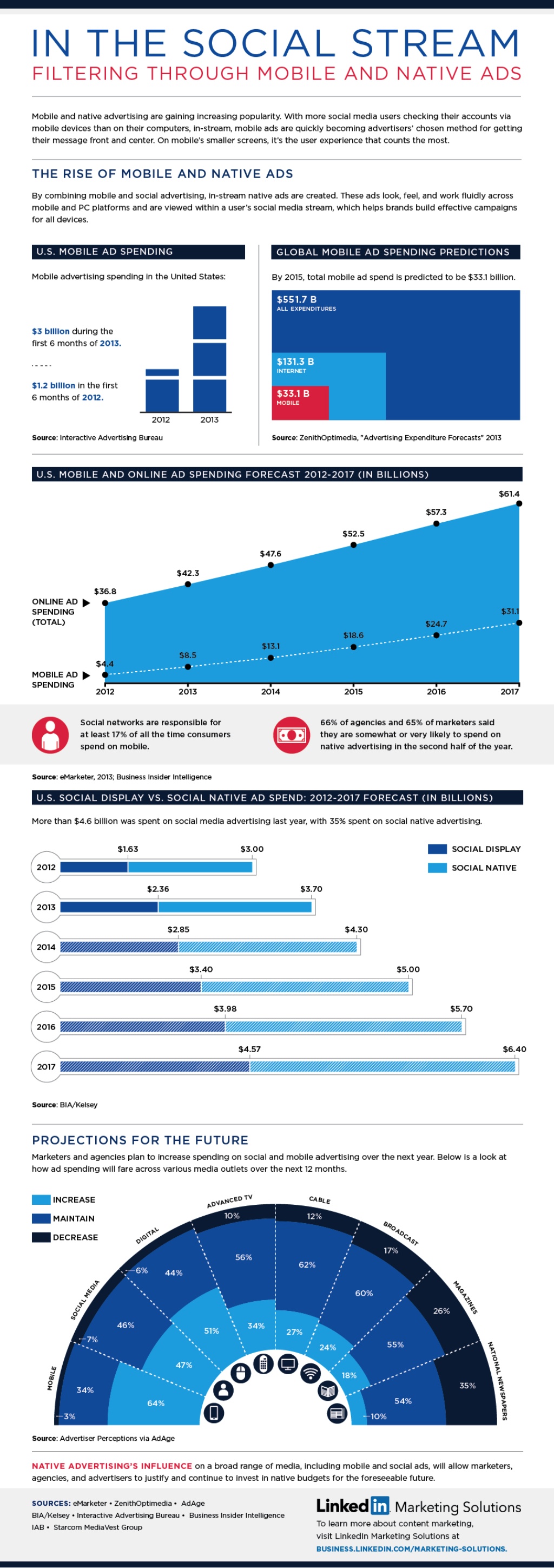
Source: http://marketing.linkedin.com/blog/
About The Author