Real vs. AI: Can You Spot the Difference?
Five images appear side by side.
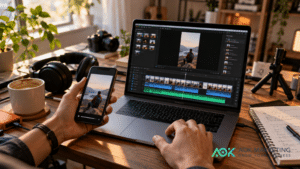
A modern workspace by a sunlit window.
A city street at dusk.
A cozy coffee shop interior.
A dramatic mountain range under golden light.
A neatly styled product flat lay.
At first glance, they all feel familiar. Ordinary. Real.
But only some of these images were captured by a camera.
The rest were generated by artificial intelligence.
Before scrolling further, take a moment. Look closely.
If these images were placed side by side, could you confidently point to which one is AI-generated?
That’s the challenge.
As image-generation tools continue to improve, the visual gap between photography and AI has narrowed to the point where even experienced designers and photographers sometimes pause before answering. What once felt obvious now requires attention, patience, and a closer look.

Why This Is a Real Challenge
This comparison isn’t about proving one medium better than the other. It’s about perception.
Images today shape decisions across marketing, media, e-commerce, architecture, and education. When both real and AI-generated visuals can look equally polished, the way images are interpreted starts to change.
What makes this challenge interesting is not how advanced AI has become—but how similar both outputs now appear on the surface.
The Five Image Types in This Challenge
Each pair below represents a common category where real and AI-generated images are frequently mistaken for one another.
As you read, imagine each image presented in a left vs. right format. Try to guess which side is AI-generated before reaching the reveal at the end.
1. Workspace by a Sunlit Window
A desk setup with natural light feels routine, which lowers suspicion. These scenes are especially convincing because they mirror everyday environments.
Subtle clues to look for:
– Reflections that don’t quite match the room
– Lighting that feels evenly balanced across every object
– Edges that appear slightly softened
Initial guesses here are often split.

2. City Street at Dusk
Urban scenes are full of depth, signage, and architectural detail. Historically, this made them easier to identify as real.
Now, not always.
Details to examine:
– Repeating window patterns
– Text on signs that lacks clarity
– Perspective that feels just slightly off
City scenes reward slow observation.

3. Coffee Shop Interior
Warm lighting, wood textures, and styled furniture make interiors feel inviting—and deceptively believable.
Look closely at:
– Uniformity of textures
– Lighting that appears designed rather than incidental
– Furniture placement that feels unusually precise
These images often look “perfectly composed.”

4. Mountain Landscape Under Golden Light
Landscapes tend to impress instantly, which can override skepticism.
Examine:
– Whether light direction matches terrain shadows
– Color saturation and contrast
– Atmospheric haze that feels too consistent
The most cinematic scenes often deserve a second look.

5. Product Flat Lay
Flat lays are clean by design, which makes them one of the hardest categories to judge.
Zoom in on:
– Micro-text on packaging
– Edge transitions
– Reflections on glossy surfaces
– Symmetry that feels mathematically exact
This category frequently produces the most confident—and incorrect—guesses.

Why the Difference Is Harder to See Now
AI-generated images used to have obvious tells. Today, those cues have largely disappeared.
At the same time, real photography is heavily enhanced through HDR, color correction, sharpening, and automated processing. As a result, both real and AI images now occupy the same visual middle ground: polished, balanced, and refined.
The challenge isn’t that AI looks real.
It’s that real images already look engineered.
The Reveal: Real vs. AI Cheat Sheet
Here’s how the images break down when placed side by side.
Workspace by a sunlit window
– AI-generated: Right
– Real photo: Left
City street at dusk
– AI-generated: Left
– Real photo: Right
Coffee shop interior
– AI-generated: Right
– Real photo: Left
Mountain landscape
– AI-generated: Left
– Real photo: Right
Product flat lay
– AI-generated: Right
– Real photo: Left
If you didn’t get all five right, you’re not alone. Most viewers miss at least two.
What This Challenge Really Shows
This exercise isn’t about catching mistakes. It’s about how visual standards are changing.
Both photography and AI imagery now coexist as valid creative tools. The difference often lies not in appearance, but in intent, context, and disclosure.
As visuals continue to evolve, the most valuable skill isn’t instantly labeling an image—it’s learning to look more closely.
Because when the difference isn’t obvious at first glance, attention becomes the deciding factor.
And that’s what makes the challenge worth trying.
READ ALSO:
About The Author