From a distance, the startup world can appear almost magical. Someone identifies an idea, builds a product, attracts investors, and eventually creates a company worth millions—or even billions—of dollars.
The reality is far less mysterious. Understanding how startups make money requires looking beyond funding announcements, ambitious valuations, and high-profile acquisitions. A startup creates real economic value by solving a meaningful problem, attracting customers, generating revenue, and developing a model that can grow without costs rising at the same rate.
There is no guaranteed formula for startup success. However, successful companies often follow a recognizable process: identify a problem, validate demand, create a useful solution, find paying customers, improve the product, and scale what works.
The original infographic on this page presents a simplified version of that journey. While several of its principles remain useful, modern founders also need to consider customer research, digital distribution, unit economics, data privacy, sustainable growth, and changing funding conditions.
Quick Answer: How Does a Startup Make Money?
A startup makes money by providing a product or service that customers are willing to pay for. Revenue may come from direct sales, subscriptions, transaction fees, commissions, advertising, licensing, usage charges, or a combination of models.
Investment does not automatically make a startup profitable. Funding gives a company capital to develop its product, hire employees, acquire customers, and pursue growth. The business must still establish a reliable way to generate more value than it consumes.
What Makes a Startup Different From a Small Business?
The terms “startup” and “small business” are often used interchangeably, but they do not always describe the same type of company.
A traditional small business may be designed to serve a defined local or specialist market and generate stable income for its owners. A startup is generally built around a model that founders believe can expand quickly across a much larger market.
Paul Graham described a startup as a company designed for rapid growth. This does not mean every new company must pursue venture funding, develop software, or prepare for an initial public offering. It means scalability is central to the business model. (Paul Graham)
A local consulting practice, for example, may increase revenue by adding more consultants. A software startup may be able to serve thousands of additional users without expanding its team at the same rate. Both can be successful businesses, but their growth models are different.
Step 1: Start With a Problem Worth Solving
A startup should not begin with the question, “How can we become a billion-dollar company?” It should begin with a more practical question:
What important problem can we solve better than the available alternatives?
Useful startup ideas often emerge from recurring frustrations, inefficient systems, expensive processes, underserved customer groups, or changes in technology and customer behaviour.
The strongest opportunities usually involve more than an interesting concept. They connect a specific problem with people or companies that actively want a solution.
A founder might notice that small retailers struggle to manage product information across advertising channels. That observation could lead to a product-feed management service or software platform. However, noticing the problem is only the beginning. The founder must determine how frequently it occurs, how businesses currently handle it, and whether they would pay for an improved solution.
Paul Graham’s original startup guidance emphasized three broad elements: work with capable people, create something customers want, and control spending. The specific startup environment has changed since the essay was published in 2005, but the underlying principle of creating customer value remains relevant.
Step 2: Validate the Idea Before Building Too Much
One of the most expensive startup mistakes is spending months developing a polished product before confirming that customers actually want it.
Validation helps founders test whether a problem is real, urgent, common, and commercially valuable. This research may include customer interviews, surveys, landing pages, prototype testing, competitor analysis, pre-orders, waiting lists, or small paid pilot programs.
The goal is not to persuade people to praise the idea. It is to gather evidence.
Founders should try to answer questions such as:
- Who experiences this problem most frequently?
- How are they solving it now?
- What does the current solution cost?
- Why are available alternatives inadequate?
- Who controls the purchasing decision?
- What would make someone switch?
- Would customers pay before the complete product exists?
The U.S. Small Business Administration explains that market research can help businesses identify customers, understand demand, assess alternatives, and reduce risk before making major investments.
Validation may reveal that the original idea needs to change. That is not necessarily a failure. Changing direction early is usually less expensive than launching a product the market does not need.
Step 3: Choose a Sustainable Revenue Model
A useful product is not automatically a viable business. Founders must decide who will pay, what they will pay for, how often they will pay, and whether the resulting revenue can support continued operation.
Common startup revenue models include:
| Revenue model | How it works | Common applications |
| Direct sales | Customers pay once for a product or service | Products, projects and professional services |
| Subscription | Customers pay regularly for continued access | SaaS platforms, memberships and media |
| Usage-based pricing | Charges increase with consumption | Cloud services, APIs and communications tools |
| Transaction fees | The company earns from completed transactions | Payment platforms and marketplaces |
| Commission | The company receives a percentage of a sale | Booking and referral platforms |
| Licensing | Customers pay for rights to use technology or content | Software, intellectual property and media |
| Advertising | Advertisers pay for access to an audience | Search, publishing and social platforms |
| Freemium | Basic access is free while advanced features are paid | Apps and software platforms |
The right model depends on customer behaviour, the product’s value, operating costs, buying frequency, competition, and the amount of support required.
A startup should test pricing early. Customers saying that they like an idea is not the same as customers being willing to pay for it.
Step 4: Build a Minimum Viable Product
A minimum viable product, commonly called an MVP, is the simplest version of a solution that allows the company to test its most important assumptions with real users.
“Minimum” does not mean careless, unreliable, or unsafe. It means avoiding unnecessary features until the startup understands what customers genuinely value.
An MVP might be:
- A manually delivered service
- A working prototype
- A limited software application
- A small product range
- A no-code platform
- A paid pilot for selected customers
Early users can reveal whether the product solves the intended problem, which features matter, where confusion occurs, and what prevents repeat use.
Founders should avoid treating every request as an instruction. One customer may ask for a feature that few other users need. The team should look for repeated patterns and consider whether a proposed improvement supports the product’s central purpose.
Step 5: Find the First Paying Customers
The first customers are important because they provide more than revenue. They provide evidence that the company can solve a genuine problem.
Early customer acquisition is often highly manual. Founders may contact potential users directly, participate in industry communities, attend events, request referrals, offer demonstrations, or build relationships with complementary businesses.
At this stage, the company should not try to appear larger than it is. Direct conversations can provide valuable information about buyer expectations, objections, terminology, implementation concerns, and purchasing criteria.
A startup should document why each customer purchased, which message gained attention, how long the decision took, and what nearly prevented the sale. These insights can later shape the website, sales process, advertising, and content strategy.
Step 6: Build a Website That Supports Conversion
A startup website should do more than describe the product. It should help visitors quickly understand:
- Who the product is for
- What problem it solves
- How the solution works
- Why it is different
- What evidence supports its claims
- What the visitor should do next
Clear positioning is more valuable than impressive but vague language. Claims such as “revolutionary,” “innovative,” or “next-generation” mean little without a specific customer benefit.
Website performance also influences trust and conversion. Slow pages, unclear navigation, weak mobile usability, and complicated forms can prevent interested users from taking the next step. This makes ongoing website optimization an important part of startup growth.
Step 7: Choose Marketing Channels Based on Customer Behaviour
Startups frequently waste money by trying every available platform at once. A better approach is to determine where potential customers research problems, compare solutions, and make purchasing decisions.
The best marketing channel will depend on the audience, product, sales cycle, price, and business model.
A B2B software company may rely on search visibility, direct outreach, partnerships, webinars, and industry publications. A consumer product startup may depend more heavily on social media, creators, ecommerce marketplaces, email, and paid product advertising.
Instead of spreading a limited budget across ten channels, founders can begin with one or two channels that closely match customer behaviour. Once a repeatable acquisition process is established, the company can expand carefully.
Step 8: Balance SEO and Paid Customer Acquisition
Organic and paid marketing serve different purposes.
Paid advertising can generate immediate visibility and provide fast feedback about offers, audiences, and landing pages. Search engine optimization generally takes longer, but it can build sustained visibility for problems and questions customers repeatedly search for.
A startup deciding between the two can compare SEO and paid ads for small businesses rather than treating them as opposing strategies.
SEO can be particularly valuable when the company serves an established search demand. Useful guides, product pages, comparisons, case studies, and FAQs can continue attracting relevant visitors after publication. This is why SEO can become a long-term business investment when it is aligned with customer intent.
B2B software companies may also require a more specialized SaaS SEO strategy that addresses long buying journeys, multiple decision-makers, integrations, alternatives, and use cases.
Step 9: Use Paid Advertising Carefully
Paid campaigns can help a startup test demand, reach new audiences, promote a launch, and generate leads. However, advertising cannot compensate for weak positioning or a product customers do not value.
Before increasing the budget, the startup should understand its conversion rate, customer acquisition cost, average order value, retention, and contribution margin.
Search advertising may work when users are actively looking for a solution. Display advertising can support awareness, remarketing, and audience development. Founders unfamiliar with the format should first understand how display advertising works.
Channel selection also matters. The comparison between Microsoft Ads and Google Ads can help businesses evaluate audience reach, competition, features, and campaign costs instead of automatically selecting the largest platform.
Ecommerce startups should maintain accurate product data across advertising and shopping destinations. Strong product-feed management can improve product visibility and reduce inconsistencies in titles, availability, pricing, and descriptions.
Step 10: Create Content Around Real Customer Questions
Content marketing should support customer decisions rather than fill a publishing calendar.
A useful content strategy answers questions that appear during discovery, evaluation, purchase, onboarding, and continued use. It may include educational guides, product comparisons, case studies, implementation advice, demonstrations, customer stories, and troubleshooting resources.
A social media content calendar can help the team publish consistently without repeating the same promotional message.
Startups should not build their entire strategy around achieving viral reach. Understanding why content goes viral can improve creative planning, but relevant content that attracts a smaller group of qualified customers may produce greater business value than millions of unfocused views.
Step 11: Understand the Difference Between Revenue and Funding
A common misunderstanding about how startups make money is the assumption that raising investment is the same as earning revenue.
Revenue comes from customers. Funding comes from founders, lenders, investors, grant programs, crowdfunding participants, or other capital providers.
Investment may help a company hire employees, improve technology, enter markets, or operate while developing its business model. In exchange, equity investors typically receive an ownership interest and accept the possibility that the company may not succeed.
Not every startup needs outside investment. Common funding routes include:
- Founder savings or bootstrapping
- Revenue from early customers
- Friends-and-family financing
- Bank or government-backed lending
- Grants and research programs
- Angel investment
- Venture capital
- Crowdfunding
- Strategic corporate investment
The correct option depends on the amount required, speed of growth, cash-flow profile, founder objectives, level of risk, and willingness to share ownership.
A company should seek funding because it has a credible plan for using the capital—not simply because other startups are announcing investment rounds.
Step 12: Protect Founder Equity
The infographic suggests finding an investor, giving away a percentage of the company, locating a co-founder, and dividing ownership. In practice, equity decisions require considerably more care.
A founder should not choose a co-founder only because that person has money or technical skills. Co-founders need compatible expectations about responsibilities, decision-making, compensation, working hours, risk, long-term goals, and what happens when someone leaves.
Equity agreements should be documented properly and may include vesting provisions so that ownership is earned over time. Founders should obtain qualified legal and financial advice before issuing shares, accepting investments, or making commitments to potential partners.
Giving away too much equity too early can reduce the founders’ control and make future investment rounds more complicated.
Step 13: Measure Unit Economics Before Scaling
Growth is not automatically healthy. A company can increase customers and revenue while losing more money with every sale.
Before scaling, founders should understand key economic measures such as customer acquisition cost, gross margin, customer lifetime value, churn, retention, payback period, and cash burn.
The exact metrics vary by model. A subscription company may focus heavily on monthly recurring revenue and churn. An ecommerce company may prioritize contribution margin, repeat-purchase rate, inventory turnover, and average order value.
Marketing reports should connect activity with business outcomes. Traffic, impressions, followers, and downloads can be useful indicators, but they do not replace revenue, qualified opportunities, retention, and profitability.
Step 14: Improve the Product Through Customer Feedback
Early products are rarely perfect. Successful startups use customer feedback and behavioural data to determine where the solution creates value and where it causes friction.
Feedback can come from interviews, support tickets, cancellation reasons, product analytics, reviews, sales objections, and user testing.
Teams should separate isolated preferences from repeated problems. A feature request made by one large customer may be important, but it may also pull the product away from its wider market.
Improvement should remain connected to the problem the company originally set out to solve.
Step 15: Scale What Has Already Been Proven
A startup is ready to scale when it has stronger evidence that customers want the product, remain satisfied, and can be acquired through a reasonably repeatable process.
Scaling may involve increasing marketing investment, expanding the team, automating delivery, entering new locations, introducing additional products, or developing partnerships.
It may also be the right time to obtain professional help. Founders can review when to invest in digital marketing consulting services if internal teams lack the expertise, capacity, or strategic perspective required for the next growth stage.
Businesses should also avoid expanding campaigns before resolving fundamental weaknesses. Reviewing common digital marketing mistakes can help startups identify issues involving unclear goals, poor audience targeting, weak measurement, inconsistent messaging, or disconnected channels.
How Founders Eventually Earn Money
Founders can receive financial value from a startup in several ways.
They may earn a salary once the company can support one. A profitable company may distribute dividends, although growth-focused startups often reinvest earnings. Founders may also sell some of their shares during an approved secondary transaction.
The largest returns generally occur when another company acquires the startup or when shares eventually become tradable through a public listing. Neither outcome is guaranteed, and both may take many years.
An acquisition or public offering should not be treated as the only definition of success. A sustainable company that serves customers, employs people, and generates reliable profit may produce significant value without becoming a household name.
A Practical Startup Path
The startup journey is more accurately represented as a repeating cycle than a straight line:
Problem → Research → Validation → Prototype → Customer feedback → Revenue → Improvement → Repeatable acquisition → Sustainable growth
Founders may move backward as new information appears. They may change their audience, product, pricing, channel, or business model.
That flexibility is part of the process. The objective is not to follow an infographic perfectly. It is to learn faster than the company spends its available time and capital.
Frequently Asked Questions
How do startups make money in the beginning?
Early-stage startups usually make money through initial product sales, paid pilot programs, subscriptions, service work, transaction fees, or pre-orders. Some companies use founder capital or investment while developing a reliable source of revenue.
Does a startup need investors to succeed?
No. Many startups are bootstrapped using founder savings and customer revenue. External investment may be useful when a company needs substantial capital to develop technology, expand quickly, or enter a competitive market.
What is the best revenue model for a startup?
There is no single best model. The right choice depends on how customers receive value, how frequently they use the product, what alternatives cost, and how much it costs the company to deliver the solution.
What should founders build first?
Founders should build the simplest credible version of the product that allows them to test the main problem and collect feedback from real users. They should avoid developing unnecessary features before validating demand.
How can a startup attract its first customers?
The first customers may come from direct outreach, professional networks, referrals, partnerships, industry communities, events, organic search, social content, or targeted advertising. The best channel depends on where the intended customers already look for solutions.
What is the difference between startup revenue and valuation?
Revenue is money the company earns from customers. Valuation is an estimate of what the business may be worth based on factors such as revenue, growth, technology, market potential, assets, risk, and investor expectations.
When should a startup begin marketing?
Customer research should begin before the product is complete. Broader marketing should increase as the startup gains confidence in its audience, offer, positioning, and ability to deliver a satisfactory experience.
Conclusion
The real answer to how startups make money is less dramatic than the stories commonly associated with Silicon Valley. They identify valuable problems, create solutions customers want, select workable revenue models, attract paying users, control costs, and improve continuously.
Investors, co-founders, crowdfunding, and eventual share sales may play a role, but they are not substitutes for customer value and a sustainable business model.
The startup process is difficult, uncertain, and rarely linear. Nevertheless, it becomes more manageable when founders replace assumptions with research, test before overspending, measure meaningful outcomes, and scale only after finding evidence that the model works.
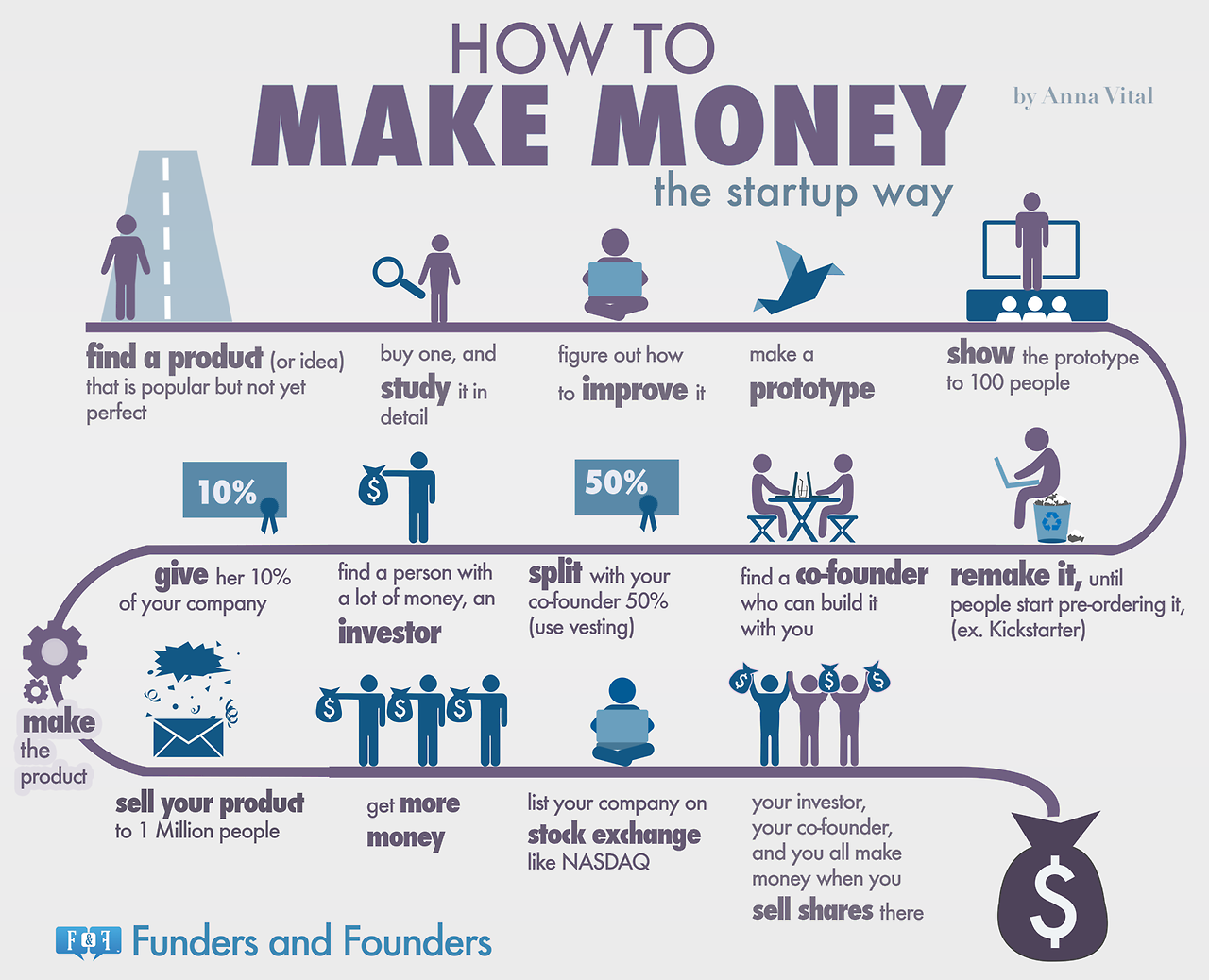
Source: www.fundersandfounders.com
About The Author