Instagram Photo Marketing: How to Create Photos People Notice and Trust

A successful Instagram photo does more than look attractive. It gives someone a reason to pause, understand the message, and take the next step.

For a retailer, that next step may be viewing a product. A service business may want someone to visit its profile, read a caption, or request a quote. Other brands may use photography to build familiarity, demonstrate expertise, or turn real customer experiences into persuasive social proof.

That is the purpose of Instagram photo marketing. It is not simply about filling a feed with polished images. It is about choosing and creating photographs that support a clear marketing goal.

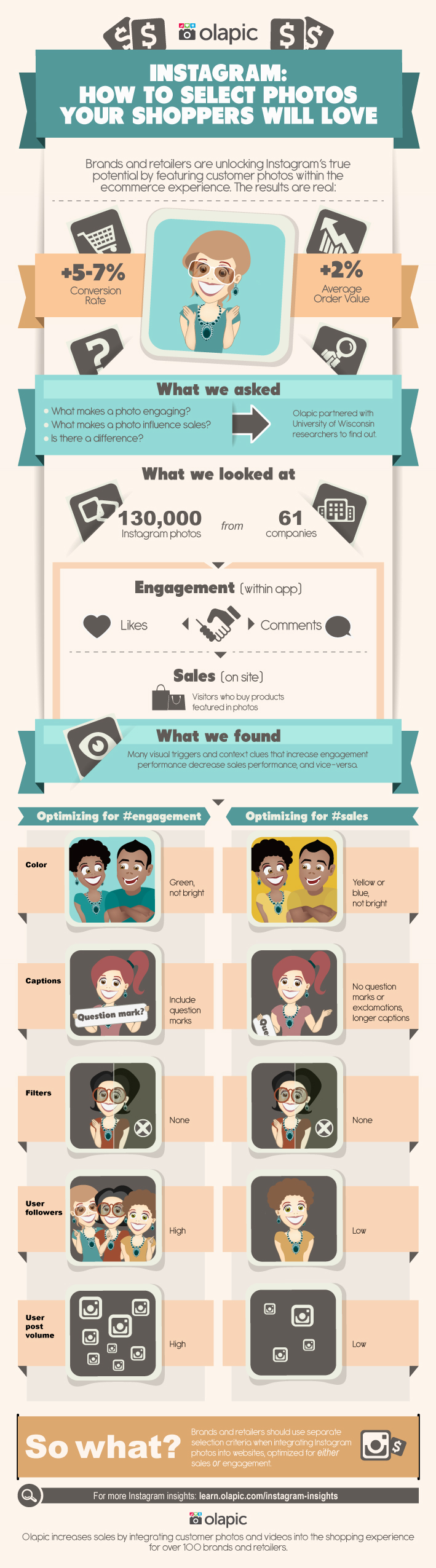
The original infographic on this page examined 130,000 Instagram photos from 61 companies. Its research suggested that the qualities associated with engagement were not always the same qualities associated with sales. That remains a useful strategic lesson, even though the statistics and platform environment represented in the infographic are now historical.

In 2026, brands need separate criteria for photographs designed to start conversations, demonstrate products, build trust, and generate revenue.

Why Instagram Photos Still Matter in 2026

Instagram has expanded far beyond its original photo-sharing format. Reels, Stories, Notes, direct messages, shopping content, and creator collaborations now contribute to how people discover and interact with businesses.

Still images have not disappeared from that experience. Photos and carousels continue to give brands a controlled way to present products, explain ideas, show customer results, and create content that people can study at their own pace.

Instagram reinforced the importance of original static content in April 2026 when it extended its originality guidance to photos and carousels. The update was intended to reduce the reach of accounts that repeatedly repost content they did not create while providing more opportunity for original creators. 

For businesses, originality does not mean every photograph must be an elaborate professional production. It means the image should contribute something recognizable from the brand: a real product, an original design, a customer experience, a company perspective, or a useful visual explanation.

A broader understanding of the platform can be found in these three things businesses need to know about Instagram marketing in 2026. This page focuses more narrowly on how photography supports that strategy.

Begin With the Purpose of the Photo

One of the most important findings in the original infographic was that an image optimized for engagement may not always be the image most likely to support a sale.

That distinction is easy to overlook.

A colourful lifestyle photograph featuring several people may earn comments because it feels social and relatable. A cleaner product image may receive fewer reactions but help a potential buyer understand the item more clearly.

Neither image is automatically better. They serve different purposes.

Before creating or selecting a photograph, decide what it should accomplish. Is it intended to:

  • Introduce the brand to new people?
  • Encourage comments, saves, or shares?
  • Explain a product feature?
  • Show the product being used?
  • Provide evidence of customer satisfaction?
  • Send qualified visitors to a product or service page?

The objective influences the composition, caption, call to action, and way the photo should be measured.

When every post is judged by likes alone, brands can unintentionally prioritize content that attracts attention without moving customers closer to a decision.

What Makes an Instagram Photo Engaging?

An engaging Instagram photo creates an immediate reason to stop scrolling.

That reason may be visual beauty, curiosity, recognition, emotion, usefulness, or a situation the intended customer understands. The image does not need to be complicated, but its subject should be clear.

People generally need to recognize the focal point quickly. A crowded image containing several competing products, excessive text, unrelated props, and a distracting background can make the message difficult to process on a mobile screen.

Strong engagement-focused photographs often include a human or situational element. A person using the product, a behind-the-scenes moment, or a familiar customer problem can create more emotional context than an isolated catalogue image.

The caption can then extend the idea by asking a relevant question, explaining the story, or giving the viewer a reason to save the post.

Engagement should not be created through empty prompts. Asking followers to comment with an emoji may produce activity, but it does not necessarily build a useful relationship. A question tied to the customer’s experience is more likely to generate meaningful responses.

Brands should also understand that Instagram does not use one universal ranking formula. Feed, Stories, Explore, and Reels are ranked according to different signals and expected user behaviours. Instagram has explained that information about the post, the account, user activity, and previous interactions can all influence what appears.

Our guide to how Instagram ranking works provides more context on why a visually strong post still needs relevance and audience response.

What Makes an Instagram Product Photo More Likely to Convert?

A sales-focused photograph needs to reduce uncertainty.

Customers should be able to understand what the product looks like, how it may be used, and why it is relevant to them. Attractive styling can support the presentation, but it should not hide important details.

For physical products, consider showing the item from several perspectives. A main image can establish the overall appearance, while additional photos can demonstrate scale, texture, packaging, colour options, or the product being used.

Service businesses can apply the same principle by showing evidence rather than relying only on promotional graphics. A contractor may show completed work. A restaurant can present actual menu items. A consultant may share a workshop, presentation, or client-approved result.

The strongest sales photography feels desirable without becoming misleading. Heavy editing that changes a product’s colour, shape, texture, or likely result can create disappointment after purchase.

A clear product photo should work with the caption and destination page. The post introduces the value, while the linked page provides the details needed to make a decision.

Use Carousels to Tell a Complete Visual Story

A single image is useful when the message can be understood immediately. A carousel is better when customers need more context.

Instagram increased the carousel limit to as many as 20 photos and videos in one post in 2024, giving brands more room to combine product views, demonstrations, customer examples, and supporting explanations. 

That does not mean every carousel should contain 20 slides. Additional images are valuable only when each one helps move the story forward.

A product carousel might begin with the strongest lifestyle photograph, followed by close-ups, key features, use cases, size information, and a final call to action. An educational carousel could open with a recognizable problem and then explain the solution one stage at a time.

The first slide has the greatest responsibility because it must communicate the subject and create a reason to continue. The following slides should feel connected rather than like unrelated images collected into one post.

Instagram’s expanded creative options also make it possible to combine static images with text, music, and video. Brands exploring these formats may find additional ideas in this guide to Instagram’s creative tools.

Customer Photos Can Build Stronger Trust

Professional product photography gives a brand control over lighting, presentation, and visual consistency. Customer photography provides something different: evidence that real people are using the product.

User-generated content can help potential buyers imagine how an item looks outside a studio or how a service fits into everyday life. It often feels more relatable because it reflects the customer’s environment rather than the brand’s controlled production process.

A useful customer-photo strategy begins by making participation easy. Businesses can invite customers to tag the brand, use a campaign hashtag, or submit photographs through an approved form. The request should explain how the image may be used.

A public tag should not automatically be treated as unrestricted permission to reuse someone’s photograph in advertising, email campaigns, or ecommerce pages. Businesses should request clear permission, retain a record of that approval, and respect any conditions attached to it.

When a customer receives payment, a free product, a discount, or another benefit in connection with a recommendation, that relationship may also require disclosure. The FTC states that endorsements must be honest and that material connections which could affect how an audience evaluates a recommendation should be disclosed clearly and conspicuously. 

The same transparency is important when working with creators. Our guide to influencer marketing in 2026 explains how creator relationships can support visibility without weakening audience trust.

Create a Visual Identity Without Making Every Post Identical

A recognizable Instagram presence does not require every photograph to use the same template.

Consistency can come from the way products are framed, the style of lighting, the choice of backgrounds, the treatment of text, or the emotional tone of the photography. These elements can help people recognize the brand before reading the account name.

However, excessive uniformity can make the feed feel predictable. When every post uses the same composition and graphic treatment, the content may begin to blend together.

A practical visual system allows variation within clear boundaries. A retailer might use one approach for product launches, another for customer photos, and a third for educational carousels. The styles can remain connected through typography, subject treatment, or brand colours.

The goal is not to create a perfect grid that looks attractive only when viewed as a profile. Most people will encounter individual posts within Feed, Explore, search results, or shared messages. Each image must therefore work independently.

Write Captions That Complete the Image

The image attracts attention, but the caption gives that attention direction.

A strong caption does not need to describe everything already visible. It can explain why the subject matters, add a customer insight, answer a likely objection, or tell the story behind the photograph.

The opening line is particularly important because it determines whether the reader has a reason to continue. Avoid beginning every caption with generic phrases such as “We’re excited to announce” or “Check out our latest post.”

Begin with the part most relevant to the customer.

A product caption might explain the problem the item solves. A customer photograph could describe the context in which the product was used. A behind-the-scenes image may reveal a process that demonstrates quality or expertise.

The call to action should match the stage of the journey. A discovery post may invite someone to save the idea or follow the account. A product post can encourage users to view details, check availability, or ask a question.

Timing Helps, but Strong Photography Matters More

Businesses often search for one perfect time to publish an Instagram photo. Timing can affect how quickly existing followers see and respond to a post, but there is no universal hour that guarantees reach.

Audience location, daily routine, industry, content type, and previous behaviour can all affect performance. The most useful publishing schedule comes from the account’s own insights and repeated testing.

A weak photograph does not become effective because it was posted at the correct time. Similarly, a useful post can continue attracting engagement after its first hour when people save it, share it, or discover it through recommendations.

The relationship between timing and audience behaviour is covered more fully in our analysis of the best time to upload on Instagram in 2026.

Brands should pay attention to early response without becoming obsessed with the first few minutes. The speed and quality of audience interaction can provide useful feedback, especially when comments, shares, and saves show genuine interest. This broader effect is examined in our guide to engagement velocity in 2026.

Use AI to Support Photography Without Losing Authenticity

AI tools can help brands plan compositions, remove distracting backgrounds, resize assets, generate variations, and explore creative directions. They can reduce production time, particularly for small teams managing several content formats.

The risk appears when synthetic imagery creates expectations the real product cannot meet.

An AI-generated lifestyle scene may look impressive, but customers can lose trust when details are unrealistic or the item shown does not accurately represent what they will receive. This is especially important for fashion, beauty, food, property, and other categories where appearance directly affects the buying decision.

AI should support the creative process rather than erase the product’s identity. Use it for experimentation and production assistance, but review every output for accuracy, brand suitability, and potentially misleading details.

The growing difficulty of distinguishing synthetic content from photography is explored in Real vs. AI: Can You Spot the Difference?.

Measure Engagement and Sales Separately

The original infographic made an important distinction between photographs that encouraged in-app engagement and those associated with onsite sales. Modern reporting should maintain that distinction.

An awareness post can succeed by reaching the right audience and encouraging profile visits. A customer story may be valuable because it earns saves and shares. A product photo should be assessed according to actions such as product-page visits, enquiries, add-to-cart activity, and purchases.

Useful measurements may include:

  • Reach among followers and non-followers
  • Saves, shares, comments, and profile visits
  • Website or product-page visits
  • Direct messages and qualified enquiries
  • Purchases or leads connected with the post
  • Revenue generated by paid or organic campaigns

Do not assume the post with the most likes created the greatest business value. Compare performance according to the original objective.

A sales-focused image with modest engagement may still be successful when it generates qualified traffic and purchases. An engaging lifestyle photo may play an earlier role by introducing the brand to people who later convert through another channel.

A Simple Instagram Photo Marketing Process

Strong photography becomes easier to produce when the business follows a repeatable process.

Begin with the audience and objective. Decide what the viewer should understand or do after seeing the image. Select a format that suits that goal, whether it is a single photo, carousel, customer image, or product demonstration.

Create the photograph for a mobile screen, making the main subject easy to recognize. Write a caption that adds information rather than repeating the visual. Publish when the audience is reasonably active, respond to relevant interaction, and review the result according to the post’s purpose.

The final step is learning. Identify which subjects, compositions, customer situations, and calls to action produce meaningful outcomes. Use those findings to improve the next group of photographs rather than copying isolated trends.

Instagram Photos Should Support the Customer Journey

The best Instagram photography is not always the brightest, most polished, or most heavily edited.

It is the photography that helps the right person notice the brand, understand the offer, and feel confident enough to continue.

Engagement-focused photos can create familiarity and conversation. Product-focused images can reduce uncertainty and support sales. Customer photographs can provide credible proof, while carousels can explain details that one image cannot communicate alone.

Brands should not force every photograph to accomplish all of these goals at once. Give each post a clear role, measure it accordingly, and use the complete feed to support different stages of the buying journey.

That is the foundation of an effective Instagram photo marketing strategy in 2026.

Frequently Asked Questions

What is Instagram photo marketing?

Instagram photo marketing is the strategic use of single images, carousels, product photography, and customer photos to increase brand awareness, engagement, website visits, enquiries, or sales.

How can businesses take better Instagram photos?

Use a clear focal point, suitable lighting, accurate colours, uncluttered backgrounds, and compositions that remain understandable on a mobile screen. The style should reflect the brand while showing the product or subject honestly.

Do Instagram photos still perform well in 2026?

Photos and carousels remain active Instagram formats. Their effectiveness depends on originality, audience relevance, presentation, and the action the business wants the viewer to take.

Are carousels better than single Instagram photos?

Carousels are useful when a subject requires several product views, steps, examples, or supporting details. A single image may be more effective when one visual can communicate the complete message immediately.

How can brands use customer photos on Instagram?

Invite customers to tag or submit photographs, request clear permission before reuse, and explain where the content may appear. Any incentive or commercial relationship connected with the recommendation should be disclosed appropriately.

Should Instagram photos be optimized for likes or sales?

That depends on the post’s objective. Engagement-focused photographs can improve visibility and familiarity, while sales-focused images should clarify the product and reduce purchasing uncertainty. Measure each according to its intended role.

Instagram photo marketing infographic comparing image characteristics that influence social engagement and ecommerce sales.

Source: www.olapic.com

About The Author