In 2025, the shift started getting loud.
In 2026, it’s obvious.
The new “first page” is a paragraph inside an AI response.
And if AI can’t find, understand, and trust your brand… you don’t exist.
So here’s the playbook, tuned for the 2025–2026 reality:
- Google AI Overviews / AI Mode
- ChatGPT Search
- Perplexity
All of them cite sources. All of them reward clarity.
Step 1: Make sure you’re eligible (crawl + index basics)
This is where people skip ahead and then wonder why nothing works.
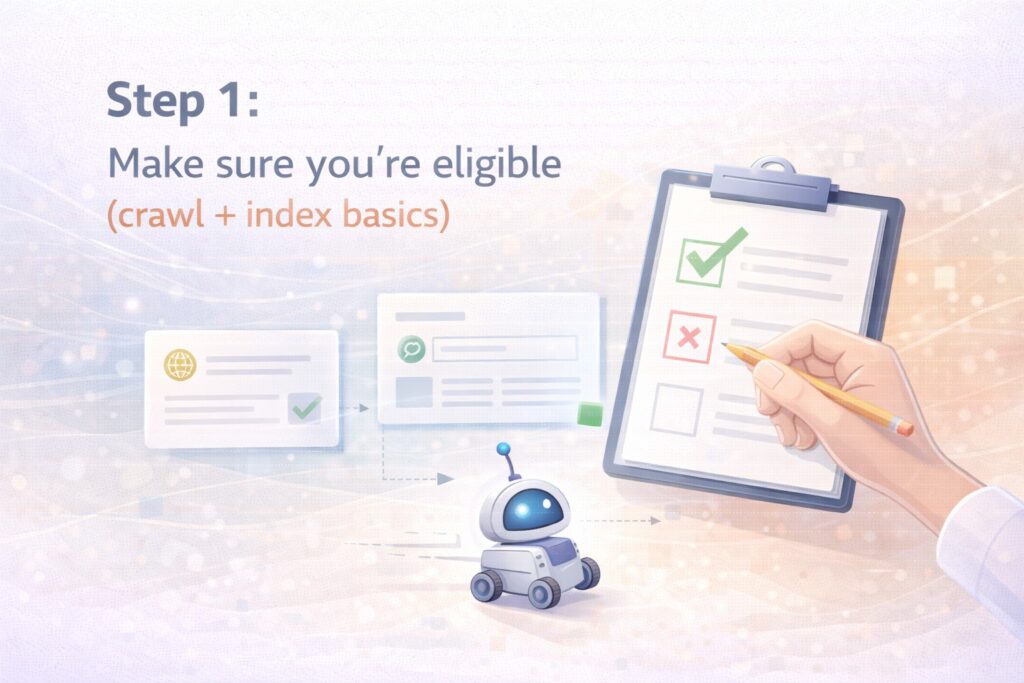
Check robots.txt
Don’t block your service pages, blog, About page, or the resources needed for pages to render correctly.
Check your sitemap
If your sitemap is full of junk, you’re basically handing search engines a messy map and saying “good luck.” Keep it clean and intentional.
Step 2: Make meaning easy (structured data + entity clarity)
Structured data provides explicit clues about what your pages mean.
Clearly label who you are, what you offer, where you operate, how people contact you, and what each page is about.

Step 3: Write content that’s easy to cite
If your answer is buried, you won’t be quoted.

For every important page, include:
- A one-sentence definition
- A short direct answer
- Bullets or steps
- Supporting details (numbers, examples)
Step 4: Optimize for Google’s AI features specifically
Google’s AI features may use query fan-out across related subtopics, so build topic clusters that cover the full question set.
Format pages so they can be cleanly extracted: definitions, lists, and step-by-step sequences.
Also: do not ignore image SEO. Use helpful, descriptive alt text.
Step 5: Get found in ChatGPT Search
ChatGPT Search can retrieve web sources and include citations. Your goal: be the source that deserves the citation.
That means: clean, factual pages; clear headings; real expertise; references and supporting details; and off-site credibility.
Step 6: Get found in Perplexity (don’t block yourself)
Perplexity’s crawler respects robots.txt. If you disallow it, it won’t index your text content for citation.
Perplexity also publishes official bot infrastructure details to help sites configure security tools without accidental blocking.
So:
- Decide if you allow PerplexityBot
- Ensure robots.txt aligns with that decision
- Ensure your security stack aligns with that decision
- Publish quote-ready content
The “Do This Today / This Week / This Month” plan
Today (1–3 hours)
- Check robots.txt
- Check your sitemap
- Pick 5 pages that matter most and add a direct answer block near the top
This week (5–10 hours)
- Restructure top pages into extractable sections
- Add or fix structured data
- Publish 1–2 supporting articles targeting real buyer questions
This month (20–40 hours)
- Build 10–20 citation assets
- Push PR mentions
- Create a prompt monitoring sheet and review weekly
FAQs
Does Google treat AI Overviews differently than classic Search for SEO?
Foundational SEO still applies, but the winning outcome increasingly includes being surfaced and cited within AI experiences.
What’s the #1 thing that changed from 2025 to 2026?
The first impression moved from a ranking to a generated answer.
What’s the fastest path to visibility?
Make your best page quote-ready, then build supporting clusters so you win the fan-out.
References
[AOK Marketing. “How To Get Found In AI Search.”
Google Search Central. “AI features and your website.”
Google Search Central. ” Crawling and Indexing”
Google Search Central. “Learn about sitemaps ”
Google Search Central.” Introduction to structured data markup in Google Search”
Google Search Central.” Creating helpful, reliable, people-first content”
Google Search Central.” Google image SEO best practices
OpenAI. “Introducing ChatGPT search.”
OpenAI. ” ChatGPT generated links:
Perplexity: How does Perplexity follow robots.txt?
Perplexity: Perplexity Crawlers
ARXIV.ORG” Generative Engine Optimization
About The Author