Content marketing affects search engine rankings because search engines want to show users helpful, relevant, and trustworthy information. When your website consistently publishes useful content, it gives Google more reasons to understand, index, and rank your pages. Strong content also attracts backlinks, social shares, engagement, and repeat visitors, which all support better online visibility.
SEO is no longer only about keywords, backlinks, and technical optimization. Those elements still matter, but they work best when supported by high-quality content. A strong content creation strategy helps your business answer customer questions, target long-tail keywords, build authority, and create more opportunities to appear in search results.
For businesses that want to improve organic traffic, content marketing is one of the most reliable long-term strategies.
What Is Content Marketing?
Content marketing is the process of creating and sharing valuable content to attract, educate, and engage a specific audience. This content can include blog posts, guides, videos, infographics, case studies, FAQs, podcasts, newsletters, and social media posts.
The goal is not just to publish more content. The goal is to create content that solves real problems for your audience. When people find your content useful, they are more likely to stay on your website, explore additional pages, trust your brand, and eventually become leads or customers.
Content marketing also supports digital marketing because it gives every channel something valuable to promote. SEO, social media, email marketing, and paid campaigns all perform better when they are backed by useful content.
Why Content Helps Search Engine Rankings
Search engines rank pages based on relevance, usefulness, authority, and user experience. Content plays a role in all of these areas.
When your website includes detailed and well-structured content, search engines can better understand what your pages are about. This helps your pages appear for relevant searches. For example, a short page about “SEO services” may struggle to rank because it does not answer enough questions. A detailed guide that explains SEO strategy, keyword research, technical SEO, local SEO, and content optimization gives search engines more context.
Content also helps you rank for long-tail keywords. These are more specific search phrases, such as “how content marketing improves SEO rankings” or “best content strategy for small businesses.” Long-tail keywords often have lower competition and stronger user intent, making them valuable for lead generation.
Content Builds Topical Authority
Topical authority means your website is seen as a trusted source on a specific subject. If your business publishes one article about SEO, that may help slightly. But if your website has a full library of helpful SEO-related content, Google can begin to understand that your site has depth and expertise in that area.
For example, an agency offering SEO marketing can build authority by publishing content about keyword research, on-page optimization, technical SEO, local SEO, link building, content strategy, and analytics.
Each article supports the others. When these pages are connected through smart internal linking, search engines can see the relationship between topics. This makes your website stronger overall and improves the chances of ranking for multiple related keywords.
Longer Content Can Provide More Value
The infographic highlights that many pages ranking on the first page of Google tend to have detailed content. This does not mean every page must be extremely long. It means content should be complete enough to answer the user’s question properly.
Thin content often fails because it does not provide enough value. A page with only a few sentences may not answer search intent, include enough keyword variations, or keep users engaged. In contrast, detailed content can include explanations, examples, FAQs, statistics, steps, and supporting information.
However, length alone does not guarantee rankings. A 2,000-word article filled with repeated ideas will not perform well. The content must be clear, useful, and organized. Quality matters more than word count.
Blogging Creates More Ranking Opportunities
Companies with active blogs often generate more traffic because each blog post creates a new opportunity to rank in search engines. Every article can target a different keyword, question, or customer need.
A blog also gives your business a way to educate prospects before they are ready to buy. Someone may not search for your service directly at first. Instead, they may search for a question or problem. If your blog answers that question, your brand enters the conversation early.
For example, a user searching “how to improve website conversion rate” may later become interested in conversion rate optimization. Helpful blog content can guide that visitor from awareness to consideration and eventually to action.
Content Attracts Backlinks and Social Traffic
High-quality content is more likely to earn backlinks from other websites. Backlinks remain an important SEO signal because they show that other sites trust and reference your content.
Useful guides, original research, infographics, case studies, and industry insights are especially link-worthy. When another website links to your content, it can improve your authority and help your page rank better.
Content also performs well on social media when it is useful or shareable. Interesting blog posts, infographics, and short tips can attract attention on platforms like LinkedIn, Facebook, Instagram, and X. While social shares may not directly guarantee higher rankings, they can increase visibility, traffic, and brand recognition. A strong social media management strategy helps distribute your content to the right audience.
Content Improves User Engagement
Search engines care about user satisfaction. If visitors click your page and quickly leave because the content is weak, confusing, or irrelevant, that can signal a poor experience.
Strong content keeps users engaged. Clear headings, helpful explanations, internal links, visuals, and practical examples encourage visitors to stay longer and explore more pages. This can improve important engagement signals such as time on page, pages per session, and lower bounce rates.
Your website design also matters. Even great content can underperform if the page loads slowly, looks outdated, or is difficult to read on mobile devices.
Internal Linking Strengthens SEO
Internal linking helps search engines discover and understand your pages. It also helps users move through your website naturally.
For example, a blog post about content marketing can link to related service pages, case studies, tools, or guides. This passes authority between pages and helps visitors find the next useful resource.
Internal links should be natural and relevant. Avoid forcing links into unrelated anchor text. Instead, link helpful phrases such as “content strategy,” “SEO marketing,” “website design,” or “paid social media” to pages that genuinely match the topic.
Content Supports Lead Generation
Content marketing does more than improve rankings. It helps turn visitors into leads.
A helpful blog post can guide users toward a related service, downloadable resource, consultation, or proposal request. When content answers questions and builds trust, visitors are more likely to take the next step.
For example, a business owner reading about SEO challenges may be ready to request a free growth proposal if they feel your brand understands their problem.
This is why content should always have a purpose. Every article should educate the reader while gently guiding them toward a meaningful action.
Tips to Make Content Marketing Work for SEO
To improve rankings with content marketing, start by understanding your audience. Know what questions they ask, what problems they face, and what information they need before making a decision.
Next, focus on specific topics instead of random posts. Build content clusters around your main services or products. Use clear headings, optimize title tags and meta descriptions, include internal links, and update old content regularly.
Most importantly, create content that is genuinely useful. Search engines are getting better at identifying content written only for rankings. The best content is written for people first, then optimized for search.
Final Thoughts
Content marketing affects search engine rankings by helping your website become more useful, relevant, and authoritative. It gives search engines more content to index, helps you target long-tail keywords, attracts backlinks, improves engagement, and supports lead generation.
SEO is not a one-time task. It is an ongoing process, and content marketing is one of the strongest ways to keep building momentum over time.
By creating helpful, detailed, and well-optimized content, your business can improve search visibility, attract more qualified traffic, and build stronger trust with potential customers.
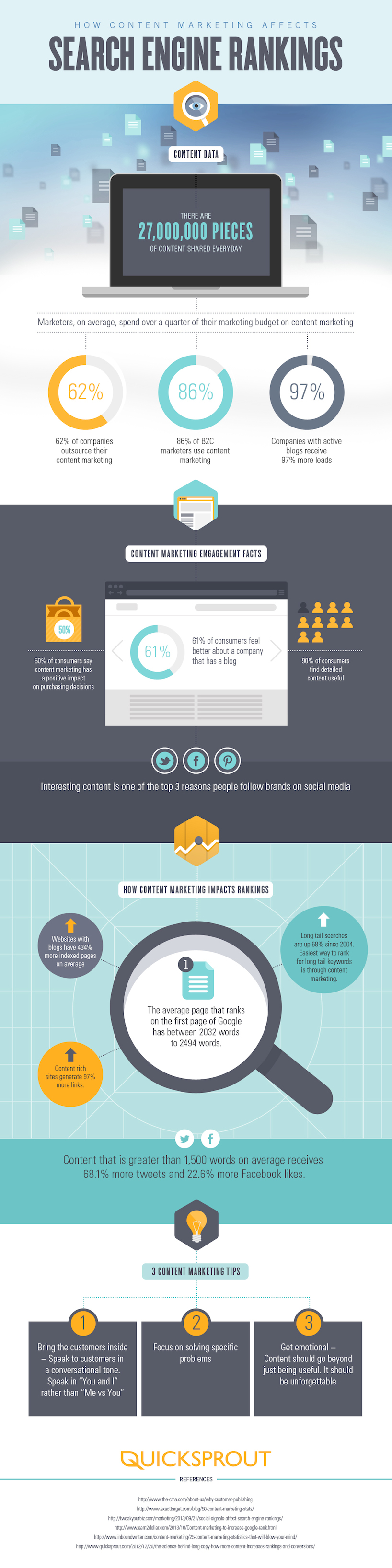
Source: quicksprout.com
About The Author