SEO, email marketing, paid search, social media, content, direct mail, events, and traditional advertising can all contribute to business growth. The difficult question is deciding where to focus your time and budget.
There is no single marketing channel that produces the highest return for every company. The best choice depends on your target audience, average order value, profit margins, sales cycle, customer lifetime value, competitive environment, and ability to measure results accurately.
A local service company may generate its strongest short-term return from paid search because customers actively search when they need help. A B2B company with a long sales cycle may receive more value from SEO, thought leadership, email nurturing, and direct outreach. An ecommerce brand may need paid social for discovery, Google Shopping for demand capture, and email for repeat purchases.
That is why a useful marketing ROI by channel analysis should not simply declare one universal winner. It should explain what each channel is designed to do, how quickly it can produce results, and how it supports the rest of the customer journey.
Which Marketing Channel Has the Best ROI?
The highest ROI marketing channel is usually the one that reaches the right audience at the right stage of the buying process while keeping customer acquisition costs below the value generated by those customers.
In practice, businesses rarely succeed through one channel alone. SEO may introduce the company during research. Social media may build familiarity. Email may nurture the prospect. Paid search may capture the final high-intent visit. A sales conversation may then complete the purchase.
The table below provides a practical starting point.
| Marketing channel | Main strength | Typical time to produce value | Best suited for |
| SEO | Compounding organic visibility | Medium to long term | Demand capture, education and authority |
| Paid search | Immediate high-intent traffic | Short term | Leads, ecommerce sales and demand testing |
| Email marketing | Retention and lead nurturing | Short to medium term | Repeat sales, follow-up and customer value |
| Social media | Discovery and community | Short to long term | Awareness, engagement and demand creation |
| Content marketing | Education and trust | Medium to long term | Complex offers and longer buying journeys |
| Partnerships and outreach | Targeted relationship building | Short to medium term | B2B growth, referrals and niche markets |
| Traditional marketing | Geographic or mass-market reach | Varies | Local audiences, events and broad awareness |
These strengths are not guarantees. The performance of any channel depends on strategy, execution, offer quality, conversion experience, and measurement.
1. Start With Business Economics, Not Channel Popularity
A popular platform is not automatically a profitable platform for your business.
Before comparing channels, calculate what a customer is worth and what the company can responsibly spend to acquire one. This requires more than looking at revenue from the first transaction.
A useful analysis considers:
- Gross profit generated by a customer
- Repeat purchases and retention
- Sales and fulfilment costs
- Marketing and technology expenses
- Refunds, returns, or cancellations
- Time required to close the sale
Marketing ROI is commonly calculated by subtracting marketing costs from the profit attributed to marketing, dividing the result by the marketing cost, and converting it into a percentage. Return on ad spend, or ROAS, is narrower because it compares revenue with advertising spend rather than accounting for the full cost of generating and serving the customer.
A campaign can therefore show a positive ROAS while producing weak overall profitability. Advertising may generate sales, but margins can disappear after agency fees, creative production, software, discounts, sales-team time, and fulfilment are included.
AOK Marketing’s guide to measuring return on investment explains why businesses should connect marketing performance with financial outcomes rather than judging campaigns through clicks or impressions alone.
2. Match Each Channel to Customer Intent
Marketing channels perform different jobs because customers use them for different reasons.
Someone searching Google for an emergency repair service has immediate intent. Someone watching a short social video may not be ready to purchase, but the video can introduce a problem, product, or brand they did not previously know.
Before allocating budget, define the audience and identify what they are trying to accomplish at each stage of the journey. A clear ideal customer profile can help the company understand which customers are most valuable, what influences their decisions, and where they research solutions.
High-intent channels usually include paid search, organic search, comparison sites, marketplaces, and direct enquiries. These channels are effective when customers already understand their need.
Demand-creation channels include social media, video, public relations, sponsorships, podcasts, and display advertising. They can introduce the company before a customer actively searches.
Neither category is automatically better. A company that relies entirely on demand capture may struggle when search volume is limited. A company that invests only in awareness may attract attention without creating enough sales opportunities.
The strongest marketing mix connects demand creation with demand capture.
3. SEO Can Produce Compounding Long-Term Value
SEO helps businesses become visible when potential customers search for problems, products, services, comparisons, and answers.
Unlike paid advertising, organic visibility does not disappear immediately when daily campaign spending stops. A useful page can continue attracting relevant visitors after publication, although rankings still require maintenance, technical health, authority, and periodic updates.
SEO can support several parts of the customer journey. Educational articles reach people researching a problem. Service and product pages attract users comparing options. Case studies and reviews help prospects evaluate whether the business is credible.
The main limitation is time. New pages may take months to gain meaningful visibility, particularly in competitive markets. SEO also requires investment in research, content, technical improvements, internal linking, and authority development.
Search Console can report which Google searches produce impressions and clicks, while Google Analytics shows what visitors do after reaching the website. Google describes Search Console as the source of truth for Google Search performance and Analytics as the source of truth for on-site behaviour.
SEO is most valuable when the business has consistent customer demand, useful expertise to share, and the patience to build an asset that improves over time.
4. Paid Search Can Capture Demand Quickly
Paid search allows businesses to appear when people enter commercially relevant queries. It can generate traffic almost immediately and provide useful data about search demand, messaging, offers, and landing-page performance.
This speed makes paid search valuable for new campaigns, seasonal promotions, urgent services, competitive product categories, and businesses that cannot wait for organic rankings to develop.
However, paid search is not automatically profitable. Weak keyword targeting can attract irrelevant clicks. Broad campaigns may spend money on users who are researching rather than buying. Poor landing pages can waste otherwise qualified traffic.
Successful campaigns need control over:
- Search terms and negative keywords
- Geographic targeting
- Conversion tracking
- Ad messaging
- Landing-page relevance
- Bids and budgets
- Customer value and margins
AOK Marketing’s guide to untapped opportunities in PPC advertising shows why profitable paid search often depends on finding overlooked opportunities rather than simply bidding more aggressively on the most obvious terms.
Paid search works best when the company knows what a qualified conversion is worth and has a follow-up process capable of turning enquiries into customers.
5. Email Marketing Supports Retention and Nurturing
Email is an owned channel. Unlike social platforms, it gives a company direct access to people who have chosen to subscribe, enquire, purchase, or maintain a relationship with the brand.
Its value often comes from improving the return generated by traffic acquired through other channels. SEO, advertising, social media, events, and partnerships can bring people into the audience. Email then supports follow-up, education, onboarding, repeat purchases, renewals, and reactivation.
Email performs poorly when businesses send the same message to every subscriber. A new lead requires different information from a repeat customer. A prospect comparing services should not receive the same sequence as someone who abandoned a shopping cart.
Understanding the five stages of awareness helps businesses align email content with what each recipient already knows and what they need to understand next.
Useful email metrics include click-through rate, conversion rate, revenue per recipient, unsubscribe rate, repeat purchase activity, and assisted conversions. Open rates can provide directional information, but privacy protections and automated loading can make them less reliable as a standalone measure.
The strongest email programs focus on relevance and customer value rather than sending more frequently simply to remain visible.
6. Social Media Creates Discovery and Builds Familiarity
Social media can help brands reach audiences before those people begin actively searching for a product or service.
Its role varies by platform. LinkedIn may support B2B authority, recruitment, and professional relationships. Instagram and TikTok can support visual discovery, demonstrations, and creator-led content. Facebook may contribute to local awareness, communities, retargeting, and customer communication. YouTube can educate customers who need to see a product, process, or complex idea explained.
Organic social media can be difficult to attribute directly because people may watch a post, remember the company, and return later through search or direct traffic. Paid social provides more campaign control, but performance still depends heavily on creative quality, audience targeting, and the offer.
AOK Marketing’s updated social media planning guide can help businesses compare current platforms based on audience fit, content format, and campaign purpose.
Social media ROI should not be judged only through likes or follower counts. Better indicators include qualified website visits, enquiries, assisted conversions, audience growth within the target market, content saves, meaningful comments, and sales influenced by social touchpoints.
7. Content Marketing Builds Trust Across Multiple Channels
Content marketing is not limited to blog publishing. It includes guides, case studies, videos, webinars, research, tools, email resources, social posts, and sales materials.
Its return often appears across several channels. A useful article can rank in search, support an email campaign, give salespeople a resource to send prospects, attract backlinks, and provide material for social posts.
This makes content valuable but more difficult to measure through a simple last-click report. A buyer may read several articles before returning through a branded search or direct visit. Giving all the credit to the final click would undervalue the content that supported the decision.
A balanced content program should include foundational information, timely commentary, and original expertise. AOK Marketing explains this approach through content that works across base information, news, and thought leadership.
Content ROI improves when each asset supports a defined audience and business purpose. Publishing without a distribution plan, conversion path, or connection to customer needs often creates traffic without meaningful commercial value.
8. Traditional Marketing Still Has a Role
Digital channels provide detailed targeting and reporting, but traditional marketing can still be useful when the audience, geography, and buying situation support it.
Direct mail may help businesses reach a defined household or business list. Events can create high-quality conversations for complex B2B services. Radio, outdoor advertising, print, and sponsorships may build local awareness where repeated exposure matters.
The challenge is measurement. A customer may see an outdoor advertisement and later search for the brand online. Without a dedicated landing page, call-tracking number, promotional code, customer survey, or regional test, the original influence may remain invisible.
Traditional and digital channels should not be treated as opposing choices. A campaign can use traditional media to create awareness and digital channels to capture, nurture, and measure the resulting demand.
The comparison between digital marketing and traditional marketing can help businesses evaluate targeting, reach, costs, speed, and measurement before selecting the right combination.
9. Measure the Complete Customer Journey
The final click is not always the channel that created the customer.
A prospect may discover a company through social media, read an SEO article, join an email list, click a paid search ad, and then contact the sales team. Assigning the entire conversion to paid search would ignore the earlier interactions.
Google Analytics defines attribution as assigning credit to different ads, clicks, and other factors along the user’s path to an important action. Its attribution reports allow businesses to compare how different models change the value assigned to marketing touchpoints.
A useful measurement framework should connect:
- Channel spend
- Qualified traffic
- Leads or purchases
- Lead-to-customer conversion rate
- Customer acquisition cost
- Gross profit
- Customer lifetime value
- Time required to convert
AOK Marketing’s pipeline math framework helps businesses work backward from revenue goals to the number of opportunities, leads, and visitors required.
Do not compare channels only through cost per lead. A channel producing fewer but better-qualified leads may create more profit than one generating a large volume of weak enquiries.
How to Allocate a Marketing Budget Across Channels
Begin with a clear business objective rather than dividing the budget equally.
A practical allocation process is:
- Protect channels already producing profitable demand.
- Invest in long-term assets such as SEO, content, and email.
- Reserve a controlled testing budget for new audiences, messages, and platforms.
- Review performance according to profit and customer quality.
- Reallocate gradually instead of reacting to short-term fluctuations.
The exact mix should reflect the company’s maturity. A new business may need faster channels to generate early sales and data. An established business can invest more confidently in long-term organic assets and retention.
The framework described in the three buckets for seeing and scaling a business can help leaders separate proven activity, underperforming areas, and future growth opportunities.
Frequently Asked Questions
Which marketing channel has the highest ROI?
There is no universal winner. The highest-ROI channel is the one that reaches your target audience efficiently, supports the appropriate stage of the buying journey, and produces customer value above its full cost.
Is SEO better than paid advertising?
SEO is usually better suited to compounding long-term visibility, while paid advertising can produce traffic and demand data more quickly. Many businesses use paid search for immediate demand and SEO to reduce long-term dependence on paid traffic.
Does email marketing have a high ROI?
Email can produce strong returns because it supports an audience the business already owns. Its performance depends on list quality, segmentation, relevance, deliverability, offer strength, and the value created after subscribers click.
Should a small business use every marketing channel?
No. A small business should focus on a manageable combination that reaches its customers and can be executed well. Spreading a limited budget across too many channels often produces weak data and inconsistent performance.
How often should marketing channel performance be reviewed?
Operational campaign data may be reviewed weekly, while budget decisions should account for the channel’s normal sales cycle and time to produce value. SEO and content should not be judged on the same timeframe as a short paid campaign.
Build a Marketing Mix Around Profitable Growth
The best marketing channel is not necessarily the newest, cheapest, or most popular. It is the one that performs a useful role in attracting, educating, converting, and retaining valuable customers.
SEO can create compounding discovery. Paid search captures active demand. Social media introduces the brand. Content builds trust. Email strengthens relationships. Traditional channels can expand reach in the right market.
The strongest results usually come from understanding how these channels work together rather than forcing them to compete for all the credit.
AOK Marketing’s revenue-focused case studies show how channel selection, campaign execution, measurement, and ongoing optimization can contribute to measurable business growth.
Choose channels according to customer behaviour and business economics, track the full journey, and move budget toward the combination that creates sustainable profit rather than the channel producing the most visible activity.
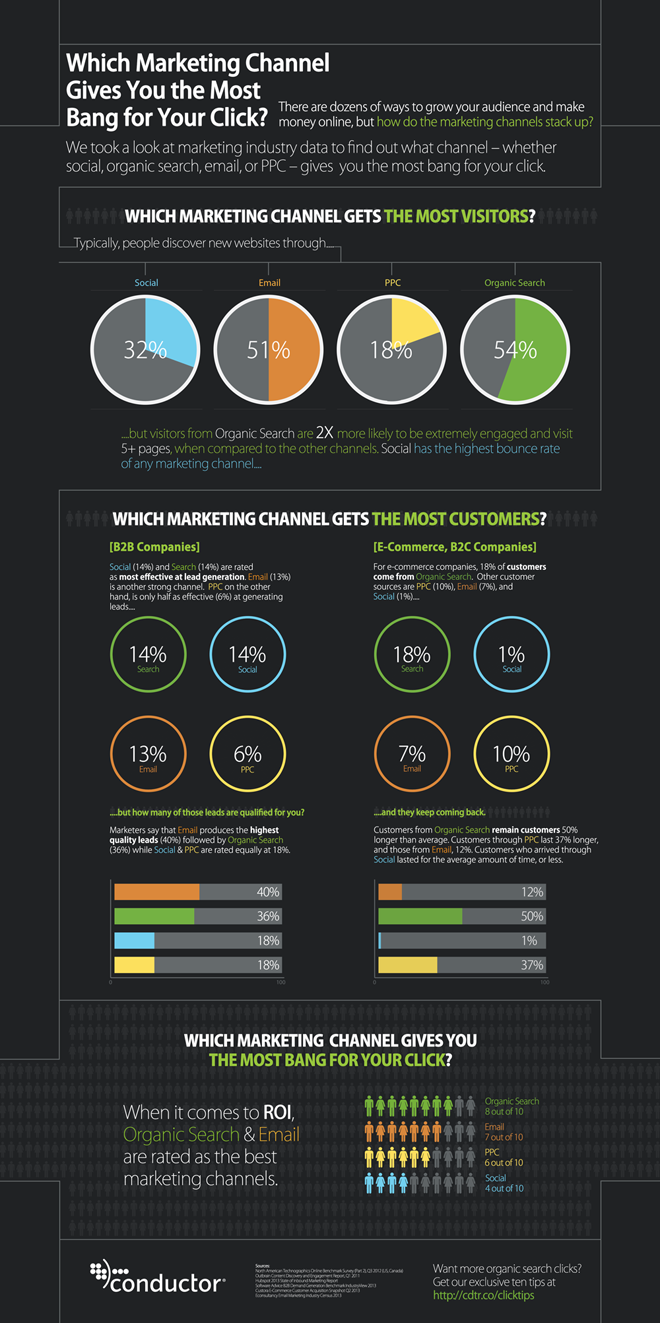
Source: www.conductor.com
About The Author