
If you run a business in 2026, you’re not just fighting for rankings.
You’re fighting to be included inside the answer.
Because the new first impression is often a paragraph, a comparison, or a shortlist, generated by AI.
So here’s the business-grade strategy. No fluff.
See Also: How To Get Found In AI Search.”
Strategy #1: Treat AI visibility like a real channel (with KPIs)
Most businesses still treat “AI search” like a weird SEO side quest. Bad move.
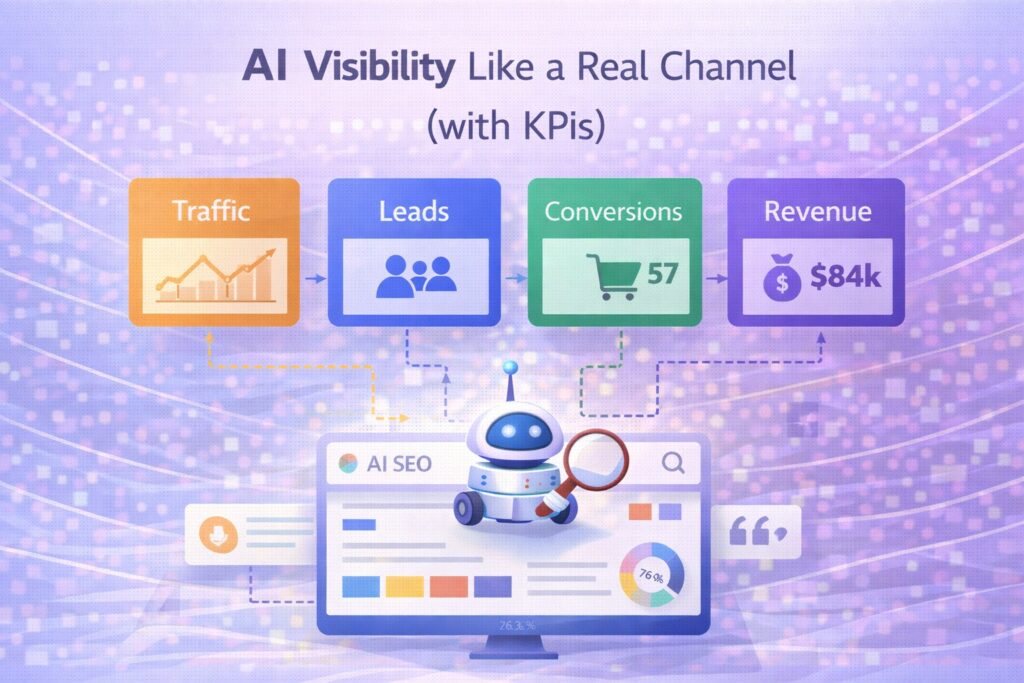
Treat it like an acquisition channel with KPIs like:
- Answer Share-of-Voice: how often you appear in AI answers for your category prompts
- Citation Rate: percent of answers that include your domain as a source
- Branded Prompt Coverage: how accurate AI answers are about your company
- Downstream Impact: assisted conversions from brand lift (not just last-click)
Strategy #2: Lock down crawl and index foundation
This is boring. Which is why it’s where most companies lose.
Robots.txt (don’t shoot yourself in the foot)
Use robots.txt to manage crawler access and avoid wasting crawl budget on junk, without blocking money pages.
Sitemaps (tell machines what matters)
Keep your sitemap clean and intentional. Remove low-value pages and keep canonical URLs.
Structured data (reduce ambiguity)
Label what you are and what you offer. Do the basics:
- Organization schema with accurate details
- Product / Service schema
- FAQ schema where appropriate
- Article schema for editorial content
See Also: How to Appear in AI Search Results: Gemini, ChatGPT, and Perplexity?
Strategy #3: Build a citation-first content library
Your content library should have two layers:
Layer A: “Source of truth” pages
- About
- Services / products
- Pricing / process
- Location pages (if relevant)
- Comparison pages (you vs alternatives)
Layer B: Citation assets (the pages that win answers)
Supporting articles that answer:
- “Best X for Y”
- “X vs Y”
- “How does X work?”
- “Cost of X”
- “Is X worth it?”
- “How to choose X”
Format them to be extracted: definitions, steps, bullets, stats, and clear headings.
Strategy #4: Optimize for Google AI Overviews (because it’s still Google)
Google’s AI features reward content that can be summarized and linked as a jumping-off point.
Your Google AI strategy:
- Content clusters that cover related sub-questions
- People-first quality standards (no junk pages)
- Clean structure for snippets, lists, and definitions
Also: your media matters. Use helpful, descriptive alt text for images.
Strategy #5: Don’t ignore ChatGPT Search and Perplexity (they cite sources)
ChatGPT Search
ChatGPT can search the web and provide answers with links and citations. That means your job is to become a source worth citing.
Perplexity
Perplexity is citation-first. Its crawler respects robots.txt, and Perplexity also publishes bot infrastructure details to help sites avoid blocking it unintentionally.
So for businesses:
- Decide if you allow PerplexityBot
- Ensure robots.txt aligns with that decision
- Ensure your WAF/security stack aligns with that decision
- Publish quote-ready, citation-friendly content
See Also: How to Optimize for AI Overviews and Perplexity (Get Cited in 2026)?
90-day roadmap (business-ready)
Days 1–15: Audit + fix eligibility
- Indexation review
- Robots + sitemap cleanup
- Structured data validation
- Restructure top pages for extractability
Days 16–45: Build citation assets
- Publish 10–20 supporting articles for high-intent prompts
- Build FAQ hubs and comparison pages
- Add stats, quotes, and benchmarks
Days 46–90: Authority + monitoring
- PR placements and reputable mentions
- Earn citations from trusted industry sources
- Prompt monitoring and iteration
FAQs
Is AI search optimization just SEO with a new name?
Foundational SEO still applies, but the winning outcome increasingly includes being cited in AI-generated answers.
What should a CEO care about?
Brand inclusion in answers. Because being absent from the answer is the new “page 2.”
References
- AOK Marketing. “How To Get Found In AI Search.”
- Google Search Central. “AI features and your website.”
- Google Search Central. “Introduction to robots.txt”
- Google Search Central. “Learn about sitemaps“
- Google Search Central. “Organization structured data.”
- Google Search Central.” Creating helpful, reliable, people-first content”
- Google Search Central. “Google image SEO best practices
- OpenAI Help Center. “ChatGPT search.”
- OpenAI. ” ChatGPT generated links:
- Perplexity: How does Perplexity follow robots.txt?
- Perplexity: Perplexity Crawlers
- Reuters. “Google tests an AI-only version of its search engine.”
- ARXIV.ORG” Generative Engine Optimization
About The Author


