Indexed, Eligible, Quotable: What It Takes to Show Up in Google AI Overviews (Without Magical Thinking)
When Google says there are “no special technical requirements” for AI features, it’s easy to hear: “Great, I don’t have to do anything.”
What they actually mean is: there’s no new secret handshake. But you still have to be indexed and eligible to appear with a snippet. That’s the gate.
The three-part gate: indexed → eligible → quotable
- Indexed: Google has your page in the index.
- Eligible: the page can show in Search with a snippet (not blocked, not suppressed).
- Quotable: the content is structured so it can be lifted safely (AEO) and supported confidently (GEO).
Most “AI visibility” problems happen in the first two gates, not the third.
See Also: AEO answer block playbook
Gate 1: Indexed (the boring part that breaks everything)
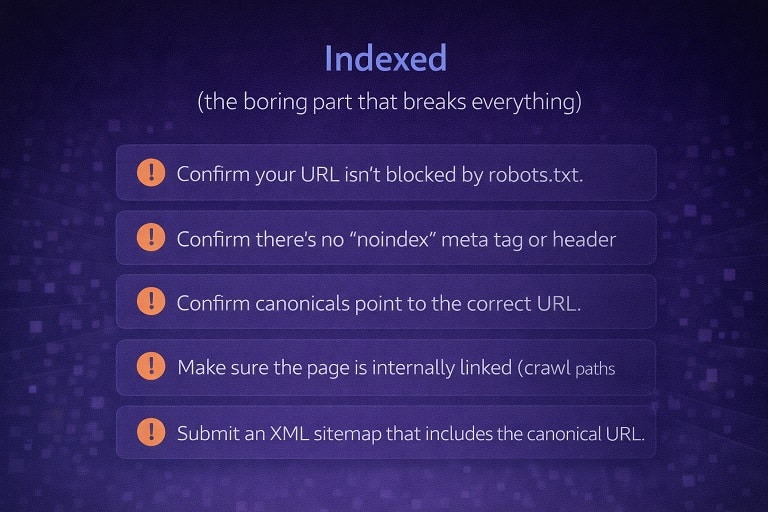
- Confirm your URL isn’t blocked by robots.txt.
- Confirm there’s no “noindex” meta tag or header.
- Confirm canonicals point to the correct URL.
- Make sure the page is internally linked (crawl paths matter).
- Submit an XML sitemap that includes the canonical URL.
Gate 2: Eligible to show a snippet
“Eligible” isn’t one checkbox; it’s the sum of signals that make a page safe and useful to show in Search.
- Content quality: clear, original, and aligned to the query intent.
- Page experience: loads, renders, and isn’t buried under intrusive UX.
- Transparency: who wrote it, why it’s trustworthy, and what it’s based on.
- Consistency: the page doesn’t contradict your other pages on the same topic.
Gate 3: Quotable (where AEO + GEO join hands)
- Put direct answers under headings (answer blocks).
- Use lists and steps for extraction-friendly formats.
- Add citable elements: definitions, stats, dates, and sources.
- Use clear entity language so the system can ground the claim.
See Also: SEO foundation checklist
A troubleshooting list for “Why am I not showing up?”
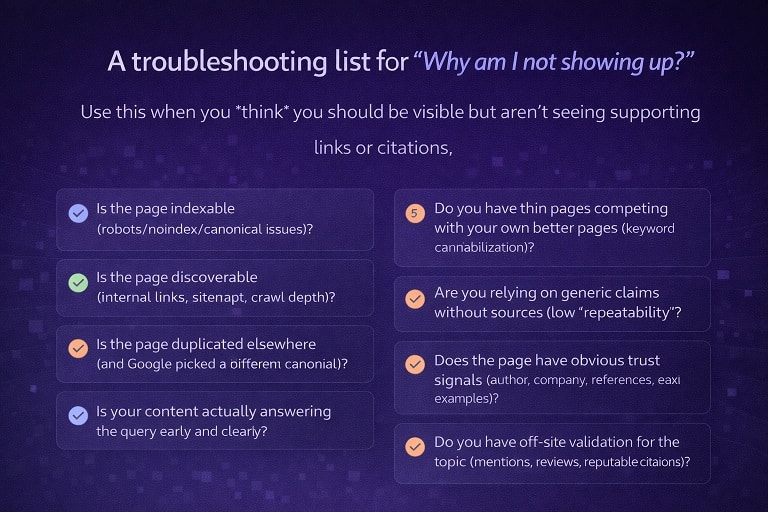
Use this when you *think* you should be visible but aren’t seeing supporting links or citations.
- Is the page indexable (robots/noindex/canonical issues)?
- Is the page discoverable (internal links, sitemap, crawl depth)?
- Is the page duplicated elsewhere (and Google picked a different canonical)?
- Is your content actually answering the query early and clearly?
- Do you have thin pages competing with your own better pages (keyword cannibalization)?
- Are you relying on generic claims without sources (low “repeatability”)?
- Does the page have obvious trust signals (author, company, references, examples)?
- Do you have off-site validation for the topic (mentions, reviews, reputable citations)?
- Are you expecting “AI visibility” for a query that’s brand-new or highly contested?
See Also: GEO citable content guide
AI Overviews eligibility checklist
- ✅ Page is indexable and indexed
- ✅ Canonical URL is clear and consistent
- ✅ Page can show a normal snippet in Search
- ✅ Direct answers exist under headings (AEO)
- ✅ Sources and concrete details exist (GEO)
- ✅ Internal links connect cluster ↔ pillar
See Also: SEO vs AEO vs GEO vs AIO: The 2026 Field Guide
FAQ
Is there a dedicated “GEO plugin” or tag for AI Overviews?
No. The gate is still basic eligibility: indexed pages with snippet-worthy content.
Should I block AI features to protect clicks?
That’s a strategic decision. Some publishers will prioritize reach and citations; others will prioritize control. If you operate in a sensitive or high-stakes category, weigh attribution and consent carefully.
What’s the fastest improvement?
Fix indexation and structure first. Then add answer blocks and sources so the page becomes quotable.
Suggested sources (for citations)
- Google Search Central — AI features and your website.
- Google Search Central — SEO Starter Guide.
About The Author