A business growth mindset is the belief that a company can improve through better decisions, stronger skills, useful feedback, and consistent action. It helps business owners move beyond familiar habits and look for smarter ways to serve customers, solve problems, and create sustainable growth.
This mindset is not based on blind optimism. It does not mean every idea will work or every risk will pay off. Instead, it encourages leaders to learn from results, adjust their approach, and keep improving when the first attempt does not produce the expected outcome.
For entrepreneurs, this way of thinking is especially valuable. Markets change, customer expectations evolve, new competitors appear, and technology continues to influence how people discover and evaluate businesses. Companies that refuse to adapt can remain busy while gradually losing relevance.
A strong business success mindset connects ambition with discipline. It helps leaders think bigger without losing focus, test ideas without wasting resources, and make decisions based on evidence rather than assumptions.
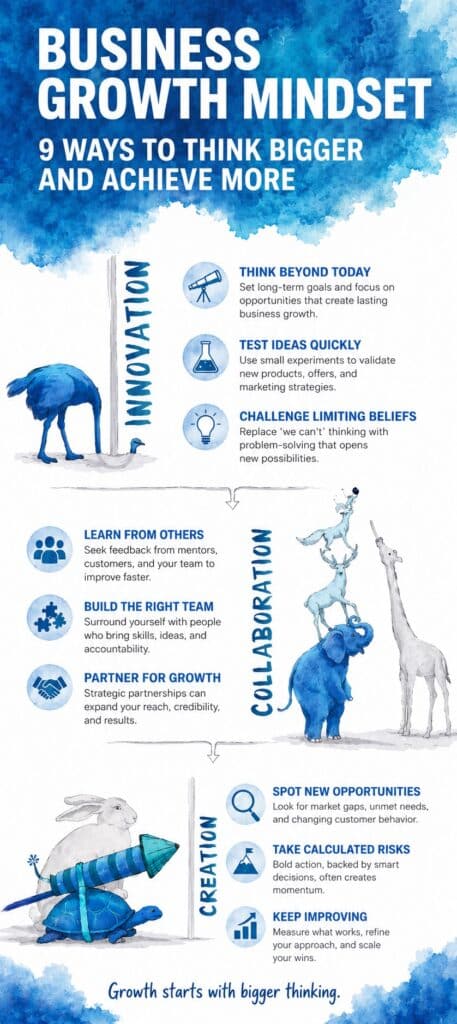
The following nine approaches can help business owners develop a stronger growth mindset in business and turn ambitious ideas into measurable progress.
1. Decide What Meaningful Growth Looks Like
Business growth should not simply mean more traffic, more followers, more leads, or more activity. Those numbers can look impressive without improving revenue, profitability, retention, or customer satisfaction.
A business growth mindset begins by defining what progress actually means for the company.
For one business, meaningful growth may involve entering a new market. For another, it may mean increasing repeat purchases, improving profit margins, attracting better-qualified leads, or reducing dependence on one marketing channel.
This is where entrepreneurial thinking becomes practical. Leaders need to ask whether a growth opportunity will make the business stronger or simply larger.
A company with weak customer service may not benefit from doubling demand. A business with poor retention may need to improve the customer experience before spending more money on acquisition. A company receiving plenty of traffic but few conversions may need clearer messaging rather than more visitors.
A useful way to assess the business is to separate its activities into areas that are working, underperforming, or capable of future growth. The framework explained in the three buckets for seeing and scaling your business can help leaders understand where their attention and resources will have the greatest impact.
Once growth has a clear meaning, every new idea becomes easier to evaluate. The business can ask whether the initiative supports its priorities or simply adds more work.
2. Turn Big Ambitions Into Clear Goals
Thinking bigger in business requires ambition, but ambition alone does not create progress. A goal becomes useful when it includes a clear outcome, a realistic timeline, measurable indicators, and someone responsible for moving it forward.
“Grow the business” is too broad to guide action.
A stronger goal might be:
Increase qualified consultation requests by 20 percent within nine months while maintaining the current lead-to-customer conversion rate.
This goal explains what should improve, how much improvement is expected, and when the result should be achieved.
Goal setting for business owners should also distinguish between activities and outcomes. Publishing more content is an activity. Increasing qualified organic leads is an outcome. Running more advertisements is an activity. Lowering customer acquisition cost while increasing sales is an outcome.
Every important business goal should answer four questions:
- What result are we trying to achieve?
- Why is this result important?
- How will we measure progress?
- Who is responsible for the next action?
Goals also need to reflect the right audience. A company cannot create a focused growth plan if it tries to appeal to everyone. Defining an ideal customer profile helps business owners understand who they serve, which problems matter most, and what makes their offer relevant.
Clear goals do not limit ambition. They give ambitious ideas a structure that teams can understand, manage, and measure.
3. Use Data to Learn, Not Just to Report
Growth-minded businesses do not treat disappointing results as final verdicts. They use them as information.
A campaign that performs poorly does not automatically mean the channel is ineffective. The audience may have been too broad, the offer may have been unclear, or the landing page may not have matched the advertisement. Tracking errors can also make a successful campaign appear weaker than it actually is.
A fixed business mindset often produces quick conclusions:
“SEO does not work.”
“Paid advertising is too expensive.”
“Customers are not interested.”
A business growth mindset asks better questions:
What did we expect to happen? What actually happened? Which assumption may have been wrong? What can we improve before the next test?
Data becomes useful when it changes a decision. Businesses should connect marketing and sales activity with qualified leads, sales opportunities, customer acquisition cost, revenue, and retention.
For example, a company may generate more leads but still miss its revenue target because sales follow-up is slow or lead quality is poor. A practical approach such as pipeline math that can be run in a spreadsheet helps leaders connect traffic, leads, opportunities, and closed sales.
The goal is not to collect as many numbers as possible. It is to understand what is happening, identify problems earlier, and make more confident decisions.
4. Make Continuous Improvement Part of Everyday Work
Continuous improvement in business does not mean changing everything at once. It means creating a regular process for identifying weaknesses, testing improvements, and keeping what works.
Small improvements can be applied across marketing, sales, customer service, operations, onboarding, and product development.
A company might improve a confusing service page, shorten a form, clarify a proposal, simplify the checkout process, or revise the way sales enquiries are handled.
The most effective improvement process is usually simple:
- Define the result you want.
- Review the available evidence.
- Identify the main obstacle.
- Make one meaningful change.
- Measure the outcome.
- Keep, revise, or replace the approach.
The key is to improve one important area at a time. When a business changes too many things together, it becomes difficult to understand which change influenced the result.
Customer awareness also matters. Someone who has only recently discovered a problem needs different information from a buyer who is already comparing providers. Understanding the five stages of awareness can help businesses create more relevant messages for each stage of the decision-making process.
Continuous improvement works because it reduces unnecessary risk. Instead of waiting for a major problem, the company learns how to make steady, evidence-based progress.
5. Encourage Entrepreneurial Thinking Across the Team
A company cannot build a strong growth mindset if only the owner is allowed to suggest ideas.
Employees who speak with customers, manage campaigns, answer support questions, or operate internal systems often notice problems before senior leaders do. They see repeated objections, common frustrations, and opportunities that may never appear in a report.
Entrepreneurial thinking means encouraging people to question assumptions, identify opportunities, and suggest better ways of working.
That does not mean every idea should be implemented. Suggestions still need to be evaluated based on customer value, cost, risk, available resources, and strategic relevance.
Leaders can encourage better thinking by asking questions such as:
- What are customers repeatedly asking about?
- Which part of our process creates unnecessary frustration?
- Where are we losing time or money?
- What could make our service easier to understand?
- Which task produces little value compared with the effort it requires?
Team members are more likely to share useful insights when leaders respond with curiosity rather than defensiveness.
Technology can support this process, but it should not replace human judgment. The discussion around whether AI can replace strategic and creative thinking in marketing shows why businesses still need people who understand customers, context, brand positioning, and commercial goals.
A company becomes more innovative when employees are expected to think, not simply follow instructions.
6. Test New Ideas Without Taking Unnecessary Risks
A growth mindset for entrepreneurs includes a willingness to experiment, but experimentation should be controlled and purposeful.
The best business tests are designed to answer one important question. They use a defined audience, a clear success metric, a reasonable timeframe, and one main change.
Before beginning an experiment, decide:
- What do we expect to happen?
- Who is the test intended for?
- Which element will change?
- How will success be measured?
- How long should the test run?
- What result will justify expanding or stopping it?
For example, a business that wants more qualified enquiries might test a clearer headline, stronger customer proof, or a shorter form. It should avoid changing the headline, audience, pricing, design, and offer at the same time because the result would be difficult to interpret.
Testing can also help a company explore new acquisition channels without committing a large budget immediately.
The client acquisition blueprint provides a useful way to consider different methods for attracting new customers. Depending on the business model, these methods may include inbound marketing, direct outreach, referrals, partnerships, content, and paid advertising.
The goal is not to chase every new idea. It is to learn responsibly, protect resources, and invest more confidently in approaches that show real potential.
7. Stay Adaptable Without Chasing Every Trend
Adaptability and business growth are closely connected, but adaptability does not mean reacting to every new platform, competitor, or technology.
A company that changes direction every few weeks may appear flexible, but it can also lose focus, waste resources, and confuse its audience.
Growth-minded businesses separate their long-term objectives from the methods used to achieve them.
The objective may be to become the most trusted provider in a specific market. The methods may include search marketing, social media, email, paid advertising, public relations, partnerships, or AI-powered discovery. Those methods can evolve while the central business position remains consistent.
Before investing in a new trend, leaders should ask:
Does this support an existing priority? Will it improve customer value? Can the result be measured? Do we have the skills and resources to use it properly?
The comparison between digital marketing and traditional marketing in 2026 shows that businesses often benefit from choosing the right combination of channels rather than assuming one approach is always superior.
Adaptability is most effective when the business understands what should remain stable and what needs to change.
8. Strengthen Existing Relationships
Many businesses focus heavily on attracting strangers while overlooking customers, former clients, partners, and warm prospects.
These relationships already contain a level of familiarity and trust. Maintaining them can create repeat business, referrals, partnerships, and new sales opportunities.
A business growth mindset treats relationships as long-term assets.
That means following up after a project, sharing relevant information, checking in with previous clients, and remaining helpful even when there is no immediate sale.
Warm outreach should feel relevant rather than automated. A previous customer may appreciate an update connected to a service they used. A professional contact may benefit from a useful guide. A former prospect may be ready to reconsider after the business introduces a new solution.
The advantages are explained in how warm outreach outperforms cold campaigns. The lesson is not that cold acquisition has no value. It is that companies should not ignore the trust and familiarity they have already built.
Sustainable growth often comes from balancing new customer acquisition with stronger communication across the existing network.
9. Measure Growth by Its Business Impact
A business success mindset requires leaders to separate activity from meaningful progress.
More content, more advertising spend, and more reports can create the appearance of momentum. These activities only matter when they improve customer value and business performance.
The right measurements depend on the company’s current priorities.
A business focused on acquisition may track:
- Qualified lead volume
- Lead-to-customer conversion rate
- Customer acquisition cost
- Proposal acceptance rate
A company focused on long-term value may give more attention to customer retention, lifetime value, repeat purchases, and revenue from existing clients.
Other useful indicators include sales-cycle length, profit margin, revenue by channel, and return on marketing investment.
Businesses do not need to track every available metric. They should focus on measurements that reveal whether the company is moving closer to its most important goals.
Return on investment should also include the full cost of an initiative. Advertising spend is only one part of the calculation. Employee time, software, production expenses, agency fees, and opportunity cost may also affect the result.
This guide to return on investment and ensuring your marketing pays off explains how companies can connect marketing activity with financial outcomes.
A true business growth mindset focuses on results rather than busyness. It asks whether the company is creating more value, improving its capabilities, and making better decisions over time.
Build a Business Growth Mindset That Produces Results
A business growth mindset is not simply a positive attitude. It is a practical way of leading and operating a company.
It means defining meaningful growth, setting measurable goals, learning from data, improving systems, encouraging useful ideas, testing responsibly, adapting with purpose, strengthening relationships, and measuring business impact.
For entrepreneurs, this mindset creates a healthier approach to uncertainty. A setback becomes information. A changing market becomes a reason to learn. A new technology becomes something to evaluate rather than blindly follow. An ambitious goal becomes a structured plan instead of an idea that disappears after the meeting.
The strongest businesses do not assume they already have every answer. They create systems that help them ask better questions, build stronger skills, and make better decisions over time.
AOK Marketing helps companies connect business goals with customer acquisition, digital visibility, strategic planning, and measurable performance. Start by identifying the biggest obstacle to growth, choose the priority that will create the greatest value, and build a plan that can be tested, measured, and improved.
About The Author