Writing a short social media post can sometimes take more effort than writing a long one. When space is limited, every unnecessary word becomes noticeable, and even a simple idea can start to feel cluttered if the message is not clear from the beginning. That was especially true during Twitter’s original short-character era, which inspired the infographic on this page.
Although social platforms and posting formats have evolved, the thinking behind 5 Best Practices for Shorter Tweets is still useful. Concise writing makes a message easier to scan, helps important ideas stand out, and encourages marketers to remove language that does not add anything meaningful. The objective today is not to squeeze every post into the smallest possible space. It is to communicate an idea clearly without making the reader work harder than necessary.
For businesses, that skill goes well beyond Twitter or X. The same approach can improve LinkedIn posts, Facebook updates, Instagram captions, paid social copy, email subject lines, and other forms of digital marketing where attention is limited.
Why Shorter Social Posts Can Still Work
People move quickly through social feeds. They may be checking updates between meetings, browsing on a phone, or looking through dozens of posts in a few minutes. A message that takes too long to reveal its point can easily be passed over.
This does not mean every post needs to be extremely short. Some ideas need context, and cutting useful information simply to reduce the length can make a post vague or confusing. The better goal is to remove repetition, unnecessary introductions, and overly complicated wording while keeping enough context for the reader to understand why the message matters.
A clear post usually feels effortless to read because the writer has already done the editing work. The audience sees the useful idea without having to dig through several sentences to find it.
Start With the Point You Actually Want to Make
Before shortening a post, decide what the reader should understand after seeing it. Many posts become unnecessarily long because the writer starts with background information instead of the main point.
If you are sharing an article, you do not need to repeat the entire headline and introduction before adding the link. Pull out the most interesting takeaway and use that to give people a reason to continue. If you are announcing something, make the announcement clear before explaining the background. When you are offering advice, bring the practical lesson forward rather than spending several lines setting it up.
This creates stronger social media copy because the opening immediately gives the audience a reason to keep reading. Once the main point is clear, it becomes much easier to recognize which words belong in the post and which ones can disappear.
Remove Words That Add Length but Not Meaning
Concise writing is not about randomly deleting words until a sentence becomes shorter. It is about recognizing phrases that make the message heavier without making it clearer.
Expressions such as “in order to,” “it is important to note that,” or “at this point in time” can often be simplified. Instead of saying, “Businesses should review their analytics in order to understand customer behavior,” a cleaner version would be, “Businesses should review analytics to understand customer behavior.” Nothing important has been lost, but the sentence now gets to the point faster.
This matters particularly for company accounts. Social media posts can quickly sound stiff when they are written in the same language as a formal report or corporate announcement. A more conversational sentence often takes fewer words while also sounding more natural.
Use Simple Words Without Making the Writing Sound Forced
The original infographic recommends using shorter synonyms, and the idea still makes sense when the replacement improves the sentence.
Words such as “use,” “help,” “start,” and “show” often feel more natural on social media than unnecessarily formal alternatives such as “utilize,” “facilitate,” “commence,” or “demonstrate.” Choosing simpler language can shorten a post while making it easier for a wider audience to understand.
However, the shortest word is not automatically the best word. A replacement should fit the meaning and the voice of the brand. If shortening a word makes the sentence sound unnatural, vague, or overly casual, there is no benefit in forcing it.
Good editing should make the writing feel smoother. The reader should notice the message rather than the effort that went into reducing the character count.
The Five Practices Worth Keeping
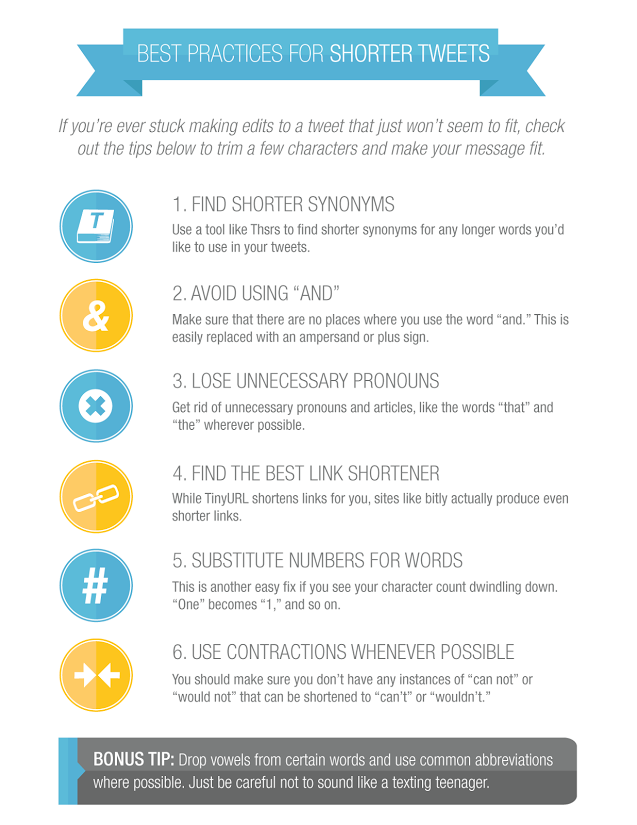
The original infographic contains several ideas from an older version of Twitter, but the central writing principles behind 5 Best Practices for Shorter Tweets can still be adapted for modern social media. Instead of treating them as rigid character-saving tricks, use them as a quick editing checklist:
- Choose simpler words where they sound natural. Replace unnecessarily long or formal wording with language people can understand immediately.
- Remove filler and repeated connectors. Words such as “and,” “that,” and other connecting phrases are useful, but repeated use can make a sentence longer and harder to follow.
- Cut unnecessary pronouns and introductory phrases. If removing a word does not change the meaning or make the sentence unclear, it may not need to be there.
- Use numbers when they improve readability. Numbers can make lists, statistics, dates, and quick takeaways easier to scan, but they should not be forced into ordinary sentences.
- Use contractions when they match your brand voice. “Don’t,” “we’re,” and “you’ll” often sound more natural on social media than their more formal equivalents.
These are not rules that every post must follow. They are simple ways to look at a draft and ask whether the same thought could be expressed more clearly.
Keep Enough Context for the Message to Make Sense
There is a point where shortening stops improving a post.
A message such as “Huge update coming. Stay tuned.” may be brief, but it gives the reader very little reason to care. A slightly longer post that explains what is changing and why it matters can be much more valuable.
This is especially important when businesses discuss technical, financial, legal, marketing, or industry-specific subjects. The audience may need a sentence of context before the takeaway makes sense. Removing that information simply to create a shorter post can hurt clarity rather than improve it.
The best length is therefore determined by the idea, not by an arbitrary target. If the audience can understand the point in two sentences, there is no reason to stretch it into five. If the subject genuinely requires additional explanation, give it the space it needs.
Make Links Part of the Conversation
Older Twitter advice placed a lot of emphasis on manually shortening URLs because every character mattered. The technical environment has changed, but marketers still need to think carefully about how links fit into social content.
A link should not be the entire reason for the post. Before asking someone to leave the feed and visit another page, give them enough information to understand why clicking is worthwhile.
Instead of simply posting the title of a blog article followed by a URL, introduce an interesting point from the article or answer part of the question it addresses. The linked content can then continue the discussion.
This approach also helps social media work more naturally with your broader content marketing strategy. Social posts can introduce useful website content without feeling like repetitive advertisements for the company blog.
Keep Hashtags and Extra Elements Under Control
A short post can still look cluttered if it is surrounded by hashtags, emojis, mentions, links, and promotional language.
Each element should have a reason to be there. A relevant hashtag can connect the post to a wider topic, while a mention may provide useful context or credit another account. Problems begin when these additions compete with the actual message.
For business accounts, a cleaner post often looks more confident than one trying to use every available social media feature at once. If the wording is strong enough, it should not need a large collection of hashtags or decorative elements to make the point understandable.
The same principle applies across different social platforms. Before publishing, look at the whole post rather than only the written sentence and remove anything that makes it unnecessarily difficult to scan.
Write Like a Person, Not a Corporate Press Release
One of the easiest ways to make social media content unnecessarily long is to write in an overly formal voice.
Compare a sentence such as “We are pleased to announce that our organization has recently implemented a number of significant improvements” with “We’ve made several important improvements.” The shorter version communicates essentially the same idea while sounding much closer to natural conversation.
Contractions can help with this. “We’re,” “you’ll,” “can’t,” and “don’t” often make social copy more approachable while using fewer characters. They should still match the brand voice, but most businesses do not need to sound like legal documents in everyday social posts.
A human tone does not mean being careless or unprofessional. It means using the kind of clear language people naturally understand.
If your business has difficulty finding a consistent voice across different platforms, it may be worth reviewing whether your social media presence needs a makeover.
Do Not Edit the Personality Out of the Post
There is also a danger in becoming too focused on efficiency. If every sentence is stripped down to its absolute minimum, the writing can begin to feel mechanical.
Brand personality still matters.
A small amount of humor, an interesting observation, or a conversational phrase can make a post more memorable even if it adds a few characters. The goal is to remove unnecessary language, not every trace of personality.
This is why the ideas behind 5 Best Practices for Shorter Tweets work best as editing guidance rather than strict rules. You want the final post to be clearer than the first draft, but it should still sound as though a person wanted to say something.
Read the post aloud before publishing. If it sounds unnatural when spoken, it will probably feel unnatural in the feed as well.
Think About the Action You Want the Reader to Take
A concise post becomes much easier to write when it has one clear purpose.
Do you want people to read an article, reply to a question, watch a video, visit a product page, share an opinion, or simply remember a useful idea? Trying to accomplish several things in the same short post often creates unnecessary wording and competing calls to action.
Keeping one primary purpose helps the message stay focused. It also makes performance easier to evaluate because you know what response the post was designed to encourage.
Not every post needs a direct call to action, either. Some content can simply educate, entertain, or start a conversation. Social media becomes repetitive when every useful point is immediately followed by a hard sales message.
Businesses that are still developing their overall approach can also review our guide to getting started with social media for a broader look at building a useful presence rather than simply publishing more posts.
Use the Original Infographic as a Writing Reminder
The infographic on this page belongs to an earlier period of Twitter, so some of its advice should be understood in that context. Concerns about manually leaving space for retweets or finding the shortest possible third-party URL are no longer the central challenges they once were.
Its broader lesson, however, has aged much better.
Good social writing benefits from editing. Shorter synonyms can help when they sound natural. Filler can often be removed. Contractions can improve the tone. Numbers can make certain information easier to scan, and a writer should always question whether every word is helping the reader.
That makes 5 Best Practices for Shorter Tweets useful beyond the platform and era that originally inspired it. The character limits and features of social networks will continue to change, but people’s attention will always be limited.
The aim is not to create the shortest post possible. It is to create the clearest version of the idea you want to share. When every sentence has a purpose and the wording feels natural, concise social media content becomes easier to read, easier to understand, and much more likely to hold someone’s attention.
Final Thoughts
The original 5 Best Practices for Shorter Tweets came from a very different Twitter environment, but the main lesson still holds up: concise writing is easier to read when every word has a purpose. The goal is not to make every post as short as possible, but to remove filler, simplify wording, and make the message clear from the start.
For businesses, these habits can improve much more than posts on X. The same editing approach can make LinkedIn updates, Facebook posts, Instagram captions, ad copy, and email subject lines feel sharper and more natural. Good social media writing should sound human, stay focused on one idea, and give the reader enough context to understand why the message matters.
Frequently Asked Questions
1. What are the best practices for writing shorter tweets?
The best practices include leading with the main point, removing filler words, using simpler language, choosing contractions where they sound natural, and keeping hashtags or extra elements under control. The aim is to make the post easier to scan without cutting important context or making the wording feel forced.
2. Are shorter posts better on X?
Shorter posts can work well because they are quick to read and easy to understand, but they are not automatically better. The ideal length depends on the message. A simple update may only need one or two sentences, while a more complex idea may require additional context to remain useful and clear.
3. How can businesses make social media posts more concise?
Businesses can make posts more concise by removing repetitive phrases, shortening long introductions, replacing formal wording with simpler alternatives, and focusing each post on one main purpose. Reading the draft aloud can also help identify sentences that sound unnecessarily complicated or unnatural.
4. Should businesses still use hashtags in shorter posts?
Yes, but hashtags should be used selectively. One or two relevant hashtags can help categorize a post or connect it to a useful conversation, while too many can make the content look cluttered. The message itself should remain the main focus rather than being surrounded by unnecessary tags.
5. Can the 5 Best Practices for Shorter Tweets be used on other social platforms?
Yes. The same principles can improve writing on LinkedIn, Facebook, Instagram, Threads, email, and even website copy. Clearer wording, less repetition, natural contractions, and a stronger opening can make almost any short-form marketing message easier to read and more engaging.
Source: http://www.pardot.com/social-media/8-ways-cram-tweets-140-characters-2
About The Author