Want the short version?
If AI can’t see you, it can’t recommend you.
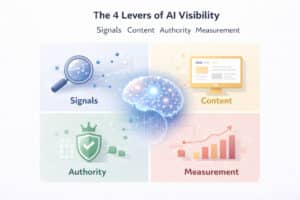
And AI sees the world through four levers. Pull them, and you show up. Ignore them, and you’re invisible.
This builds on the core framework in How To Get Found In AI Search. That page gives you the strategy. This one gives you the knobs and dials.
The 4 levers (one sentence each)
- Signals: the technical and structured data clues that tell machines what you are.
- Content: the words, structure, and answers engines can lift and reuse.
- Authority: the third-party validation that makes engines trust you.
- Measurement: the feedback loop that tells you what’s working (and what’s not).
A quick scorecard you can run in 15 minutes
| Lever | What it controls | Quick checks | Where AOK helps |
| Signals | Crawlability + understanding | Indexing, speed, schema, internal links | SEO for AI + Knowledge Graph |
| Content | Cite-ability + relevance | Clear headings, Q&A blocks, comparisons, citations | AI Readable SEO |
| Authority | Trust + selection | Mentions, backlinks, reviews, brand consistency | SEO for AI |
| Measurement | Iteration + proof | Prompt tracking, citations, sentiment, change logs | AI Visibility |
If that table feels too high-level, good. Let’s unpack each lever with specifics you can execute.
Lever 1: Signals (make your site easy for machines to parse)
Signals are the boring stuff that wins.
They tell crawlers and AI systems: “this page exists, it’s the canonical version, and here’s what it is about.”

The Signal Checklist
- Indexing: your important pages are indexable and actually indexed (no accidental noindex, no blocked resources).
- Speed + UX: pages load fast and work on mobile. Slow sites get crawled less and trusted less.
- Clean architecture: logical URLs, consistent internal links, no orphan pages.
- Schema: Organization, FAQ, Product/Service (where relevant).
- Entity clues: About page, author pages, consistent NAP (name/address/phone) where relevant.
If you want help building and validating these signals, start with SEO for AI and your Knowledge Graph: Knowledge Graph.
Signals that matter extra in AI search
AI engines love structured, disambiguated facts.
That means:
- Organization schema on your homepage (and consistent metadata across the site).
- FAQ schema where you have true FAQs (not spam).
- A clear set of ‘what we do’ pages that map to real use cases.
- Internal links that make the relationship between pages obvious (pillar -> cluster -> service).
Google explicitly notes that organization structured data can help it disambiguate an organization, and some properties can influence how your organization appears in search.
Lever 2: Content (make answers easy to lift)
If signals are the wiring, content is the conversation.
And in AI search, content needs to do two jobs at once:
- Help the human understand (so they trust you).
- Help the machine extract (so it can reuse you).

The Content Checklist
- Write like a person. Short sentences. Short paragraphs.
- Use question-based subheadings (the exact questions customers ask).
- Answer the question immediately, then expand.
- Add comparisons and criteria (AI engines love decision structure).
- Include examples, numbers, and references when you make claims.
- Use bullet lists for steps and checklists.
This is exactly what we mean by AI Readable SEO: content that performs in AI answers without becoming unreadable marketing mush.
A simple page pattern that gets cited
If you want a repeatable template, use this:
- A 2-3 sentence summary at the top (the answer).
- A definition section (what it is, in plain language).
- A ‘when to use it’ section (who it’s for, who it’s not for).
- A criteria list (how to choose / what matters).
- Examples (realistic, not generic).
- FAQ (short, direct).
- References (credible sources).
- Internal links to next steps (service pages and related articles).
Lever 3: Authority (earn trust outside your site)
Authority is the part most people want to skip.
But AI systems are trained on the idea that third-party validation matters. If nobody credible mentions you, you’re easy to ignore.
The Authority Checklist
- Backlinks from relevant, credible sites (not spam networks).
- PR mentions in places that get crawled frequently.
- Industry directory listings that confirm your identity and category.
- Consistent brand facts across the web (name, description, location, leadership, products/services).
- Reviews and reputation signals where they matter (local and vertical-specific).
Authority building that doesn’t feel gross
Here are a few methods that work without turning you into a link-begging robot:
- Publish something worth referencing (a report, a benchmark, a calculator, a glossary).
- Partner with industry organizations and contribute real expertise.
- Pitch genuinely useful stories (data-driven, not self-promotional).
- Create a canonical ‘about the category’ guide that others can quote.
Authority is also why SEO for AI includes off-page work. AI doesn’t just read your site. It reads the internet about you.
Lever 4: Measurement (because otherwise you’re just vibing)
Measurement is the lever most teams ignore until the CEO asks, “Are we showing up in AI yet?”
By then, you’re scrambling.
Don’t do that. Measure from day one.

What to measure?
- Mentions: does the engine name your brand for non-branded prompts?
- Citations: does it link to your pages as sources?
- Positioning: are you framed as a top recommendation or an afterthought?
- Sentiment and accuracy: is what it says about you correct?
- Coverage: which topics you win, which topics you don’t exist in.
How to measure (simple workflow)?
- Create a prompt list that maps to your category and customer journey.
- Run the same prompts weekly across engines you care about.
- Record results in a spreadsheet: engine, prompt, mention yes/no, citation yes/no, which URL, notes.
- When you update a page, annotate the change and re-test.
- Monthly: look for patterns (which formats get cited, which topics are missing).
If you want this operationalized, that is the goal of the upcoming AI Visibility page. And we also include monitoring inside our implementation work.
How the 4 levers map to the AOK 3-part framework
If you like systems (we do), here’s the mapping:
- On-page visibility: Signals + Content
- Off-page authority: Authority
- Monitoring: Measurement
The full explanation is on How To Get Found In AI Search.
Bottom line
AI visibility is not luck.
It’s inputs and outputs.
Pull the levers, measure the result, repeat.
References
[1] AOK Marketing. “How To Get Found In AI Search.” / (accessed January 11, 2026).
[2] AOK Marketing. “SEO for AI.” (accessed January 11, 2026).
[3] Google Search Central. “AI features and your website.” (accessed January 11, 2026).
[4] Google Search Central. “Organization structured data.” (accessed January 11, 2026).
[5] Schema.org. “Schema.org.” (accessed January 11, 2026).
[6] OpenAI. “Introducing ChatGPT search.” (accessed January 11, 2026).
[7] Microsoft. “Copilot Search in Bing.” (accessed January 11, 2026).
[8] Perplexity Help Center. “How does Perplexity work?” (accessed January 11, 2026).
About The Author