Social media marketing has changed considerably from the days when businesses simply created accounts on every major network and posted the same update everywhere. Each platform now attracts different audiences, supports different content formats, and plays a different role in how customers discover, evaluate, and interact with brands.
A strong social media strategy therefore requires more than regular posting. Businesses need to understand where their customers spend time, what type of content fits each platform, how people prefer to interact there, and what results actually support broader marketing goals.
The most effective approach is not to be everywhere. It is to choose the right social media platforms for your business and give people a reason to follow, engage with, and eventually remember your brand.
Why Social Media Marketing Still Matters for Businesses
Social media can support several parts of the customer journey. A potential customer may first discover a company through a short video, later read comments about the brand, visit its website, subscribe to an email list, and eventually return when they are ready to make a purchase.
That makes social media useful for more than direct sales. Businesses can use it to build brand awareness, answer questions, distribute content, demonstrate expertise, support customer relationships, attract website traffic, and learn more about what their audience cares about.
The challenge is that every platform has its own culture. Content created specifically for LinkedIn may feel completely out of place on TikTok, while a visual idea that works naturally on Pinterest may require a different treatment on Facebook.
If your accounts have become inconsistent or no longer reflect how customers use social networks today, it may be time to consider whether your business needs a social media makeover rather than simply increasing your posting frequency.
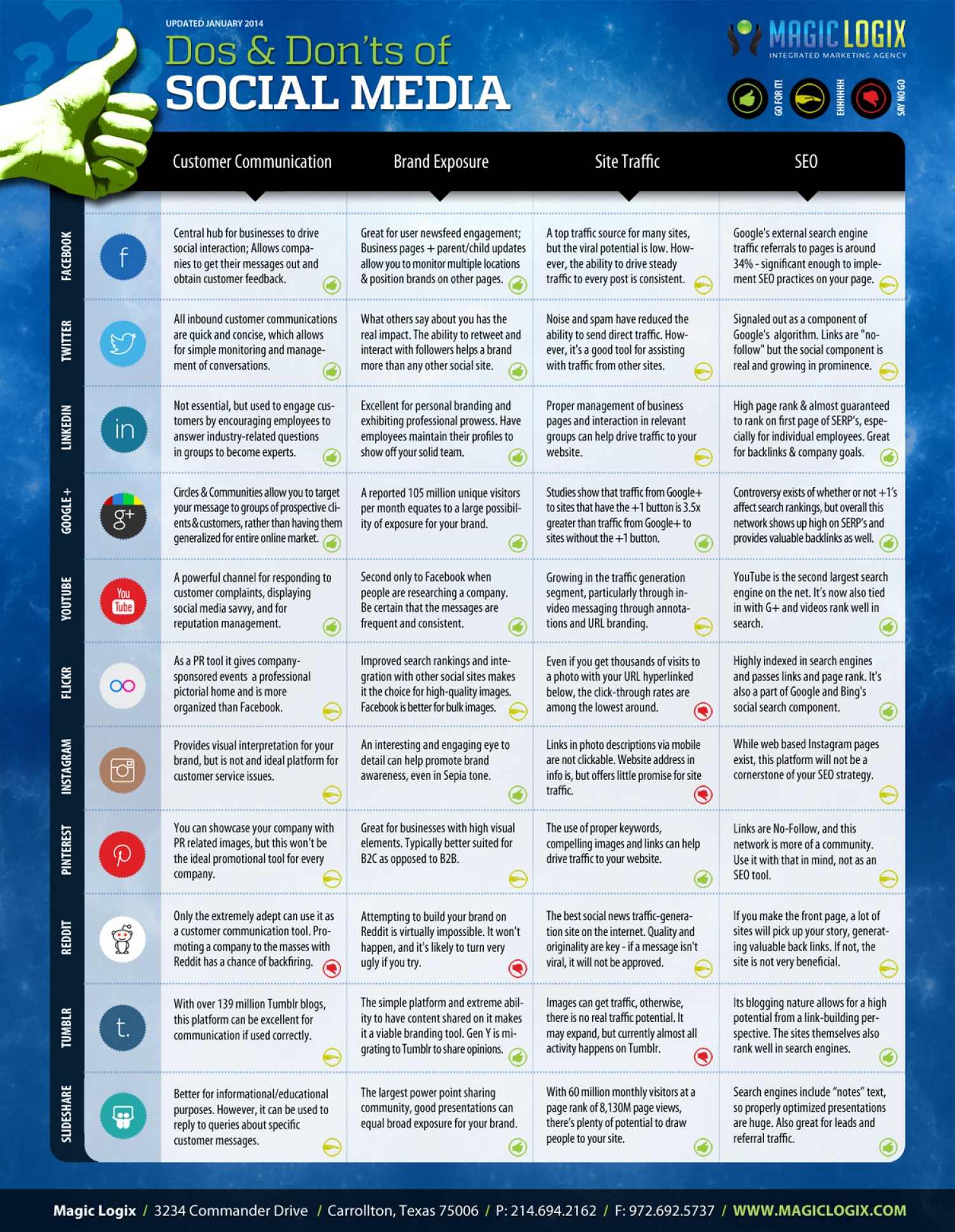
Social Media Do’s and Don’ts Every Business Should Know
Before looking at individual platforms, it helps to establish a few principles that apply across most social networks. These social media best practices keep the focus on audience value rather than chasing algorithms, posting for the sake of activity, or copying whatever another brand happened to make popular that week.
- Do choose platforms based on your audience. A smaller relevant audience is more useful than a huge group of people who have little connection to your business.
- Don’t publish identical content everywhere. Repurpose the central idea, but adapt the format, caption, tone, and presentation to the platform.
- Do respond to useful comments and questions. Social media works better as a conversation than as a one-way publishing feed.
- Don’t chase every trend. Join trends only when they fit your audience, brand voice, and marketing objectives.
- Do create content with a clear purpose. Decide whether a post is intended to educate, engage, drive traffic, demonstrate expertise, or support another goal.
- Don’t measure success by followers alone. Engagement quality, website traffic, leads, conversions, saves, watch time, and returning audiences can provide much more context.
- Do maintain a recognizable brand voice. Customers should feel that the same business is communicating across your website, social accounts, email, and advertising.
Facebook: Build Community Instead of Creating a Notice Board
Facebook remains useful for businesses that want a presence where customers can discover company information, interact with posts, view events, ask questions, and engage with communities. It can be particularly relevant for local businesses, consumer services, organizations, and companies with audiences that already use Facebook actively.
The common mistake is treating a Facebook Page like a bulletin board. A feed containing nothing except product promotions, company announcements, and links back to the website gives people little reason to interact regularly.
Mix promotional content with useful information, customer stories, questions, events, behind-the-scenes material, and content that makes sense within the customer’s everyday feed. When people comment or ask genuine questions, responding can make the Page feel like an active part of the business rather than an abandoned marketing profile.
Avoid assuming that every post needs to produce immediate website traffic. Some Facebook content can serve primarily to build familiarity and engagement before customers are ready to take another action.
Instagram: Create for Visual Attention and Brand Recognition
Instagram is strongly suited to visual storytelling, short-form video, product demonstrations, creator collaborations, educational carousels, and behind-the-scenes content. Businesses that can show rather than merely describe what they do often have more creative opportunities here.
Consistency matters, but that does not mean every post needs an identical design. Your photography, video style, tone, themes, and overall presentation should make the brand recognizable without turning the account into a repetitive collection of templates.
Instagram Stories and short-form videos can also make the brand feel more immediate, but posting volume should not replace quality. Flooding followers with a long sequence of low-value Stories can make the audience skip through them rather than engage with what you publish.
Businesses developing their Instagram content strategy should pay attention to how users respond to different formats and subjects instead of relying on outdated algorithm myths. Our guide to understanding the Instagram algorithm provides additional context for planning content around audience behavior.
LinkedIn: Share Expertise Rather Than Constant Sales Pitches
LinkedIn is particularly useful for B2B companies, professional services, recruitment, thought leadership, industry commentary, and businesses where individual expertise influences buying decisions.
A strong company presence should give people insight into what the organization knows and does. Educational posts, observations from real work, original research, useful documents, employee expertise, case studies, and thoughtful commentary can create more value than repeatedly announcing services.
LinkedIn itself describes Pages as places where members can learn about an organization, its products, services, brand, and job opportunities. The platform also recommends maintaining Page activity rather than leaving the presence dormant. (LinkedIn)
Businesses can also connect LinkedIn content with recruitment when employer visibility matters. A thoughtful social media recruitment strategy can help the organization communicate with potential candidates without turning every corporate post into a vacancy announcement.
YouTube: Focus on Viewer Value, Not Upload Volume
YouTube works differently from fast-moving social feeds because strong videos can continue attracting viewers through search, recommendations, and related content after the publication date.
Businesses can use YouTube for demonstrations, tutorials, interviews, customer education, product comparisons, thought leadership, FAQs, and detailed explanations that require more depth than a short social post can provide.
The biggest mistake is assuming that frequent uploads automatically create growth. YouTube states that it has not found channel view growth to be correlated with the time between uploads and encourages creators to prioritize quality rather than publishing simply to meet an arbitrary schedule. (Google Support)
Use YouTube Analytics to understand what happens after publication. Audience retention can show where viewers continue watching, skip sections, rewatch moments, or leave the video, providing useful clues for future content development.
Our guide to using YouTube Analytics explains how to connect those signals with titles, thumbnails, video structure, and content planning.
TikTok: Make Content That Feels Native to the Platform
TikTok can give businesses access to short-form discovery, creator-led content, demonstrations, storytelling, entertainment, and educational videos. It tends to work best when brands understand the platform’s creative style rather than treating it as another place to upload conventional advertisements.
Overly polished corporate material can feel disconnected from the surrounding content. Businesses often have more room to show personality, demonstrate products naturally, answer questions, participate in relevant conversations, and collaborate with creators whose audiences align with the brand.
TikTok’s current commercial-content quality guidance emphasizes authenticity, trustworthy communication, and content that helps users understand actual product experiences. (TikTok For Business)
That does not mean every business should imitate viral creators or participate in every meme. Content still needs to fit the company, and trends should be used selectively when there is a natural connection to the audience or product.
Pinterest: Think Discovery, Search, and Future Intent
Pinterest is less about real-time conversation and more about visual discovery. People use it to search, save, organize, and explore ideas, which can make it especially relevant for categories such as home, fashion, food, beauty, events, travel, ecommerce, and other visually driven subjects.
Pinterest explains that content can be discovered through the home feed, search, related Pins, and shopping experiences. It also recommends clear board names, regular original Pins, and adding URLs when the goal is to send users to a website. (Pinterest)
Businesses should therefore think beyond attractive images. Titles, descriptions, boards, product information, landing pages, and the relationship between the Pin and the destination all influence whether Pinterest becomes useful as part of the wider social media strategy.
For ecommerce brands, Pinterest can also connect with a broader social commerce strategy where product discovery and purchasing journeys increasingly overlap.
Reddit: Participate Before You Promote
Reddit is built around communities rather than traditional brand pages, which means normal promotional tactics can easily backfire.
People join subreddits because they care about a subject, want information, exchange opinions, or participate in a community. A company entering those conversations only to drop links and promote products is unlikely to create much goodwill.
Businesses that use Reddit should first understand the rules and culture of the specific community. When participation is appropriate, contribute genuinely useful information and be transparent about your relationship to the company.
Reddit can also be valuable as a research environment. Discussions can reveal customer questions, frustrations, terminology, comparisons, and attitudes that may influence content strategy elsewhere, even when the business never directly promotes itself in those conversations.
X and Threads: Use Conversation When Real-Time Interaction Matters
Conversation-focused platforms such as X and Threads can be useful when your audience follows industry developments, events, culture, news, commentary, or fast-moving discussions.
These networks reward timely participation more than carefully scheduled evergreen posts alone. Businesses can share opinions, respond to relevant developments, interact with customers, and join conversations where they have something useful to contribute.
Speed should not come at the expense of judgment. Posting quickly during controversial or sensitive situations without enough context can create problems that extend far beyond the original social post.
Brands should establish who is responsible for real-time publishing and when a post requires additional approval, particularly when multiple employees manage the same account.
Choose Platforms Based on What Your Business Can Sustain
Being present on eight social networks is not automatically better than maintaining two or three strong accounts.
Every active platform requires ideas, creative work, responses, analysis, and ongoing management. When resources are spread too thin, businesses often end up with multiple neglected profiles and repetitive posts that produce little value.
Start by examining where your customers already spend time and what type of content your business can create well. A B2B consultancy may gain more from LinkedIn and YouTube than from maintaining daily Pinterest and TikTok accounts, while a visual ecommerce brand could reach exactly the opposite conclusion.
Businesses still developing their foundations can review how to get started with social media before committing resources to additional networks.
Repurpose Ideas Without Copying and Pasting Posts
Creating separate original ideas for every platform can consume a huge amount of time, but publishing the identical asset everywhere is not the only alternative.
Start with one strong idea and adapt it.
A detailed blog article could become a LinkedIn document, a short TikTok explanation, an Instagram carousel, several Facebook posts, a YouTube discussion, and a Pinterest graphic. The information stays connected while the presentation changes according to how people use each platform.
This is a more sustainable approach to social media content creation because one strong asset can support several channels without making them feel identical.
Scheduling tools can also reduce administrative work once the creative strategy is clear. Our comparison of social media scheduling tools can help businesses organize publishing without confusing automation with strategy.
Social Media Should Support Your Website, Not Replace It
Social media accounts are valuable marketing assets, but businesses do not fully control the platforms on which they operate. Features, visibility, policies, formats, and algorithms can change.
Your website gives the business a more stable place to explain products and services, publish in-depth resources, capture leads, and create conversion paths. Social content can then introduce the brand and send interested users toward those owned experiences when it makes sense.
Not every post requires a link, but traffic-driving content should lead somewhere useful. Sending people to a generic homepage after promising a specific guide or product creates unnecessary friction.
Social media and website strategy work best when they support one another rather than competing for attention.
Does Social Media Help SEO?
Social media activity and traditional search rankings should not be treated as the same thing. Posting a link on a social network does not automatically make a page rank higher in Google.
However, social media can contribute indirectly to search and content performance. It can increase content discovery, introduce resources to people who may later reference or link to them, generate branded searches, reveal audience questions, and send relevant visitors to website content.
Pinterest also functions strongly around search and visual discovery within its own platform, while YouTube has its own search and recommendation environment. Social media SEO therefore includes optimizing content for discovery within the platform, not merely hoping that social activity will improve Google rankings.
The better objective is to create useful content that can earn visibility across several channels rather than treating social sharing as a shortcut to search performance.
Measure Results Based on the Role of Each Platform
Social media analytics become confusing when every network is judged by exactly the same metric.
A LinkedIn campaign designed to generate B2B leads should not be evaluated like an Instagram brand-awareness campaign. A YouTube tutorial may generate value through long-term watch time and website visits, while a Pinterest Pin could continue sending product-discovery traffic well after publication.
Set measurements according to the purpose of the channel. Relevant indicators can include engagement, saves, video retention, qualified website traffic, inquiries, leads, purchases, audience growth, and returning viewers.
Connecting social activity with website traffic and conversion tracking can help distinguish content that simply attracts reactions from content that contributes to meaningful customer behavior.
Build a Social Media Strategy Around People, Not Platforms
Social platforms will continue to change, and individual features will come and go. A strategy built entirely around one algorithm trick or popular format can become outdated quickly.
Audience understanding lasts longer.
Know what your customers care about, which questions they regularly ask, what type of information helps them make decisions, and how they prefer to consume that information. Platform choices then become distribution decisions rather than the entire strategy.
This also prevents businesses from joining every new network simply because it is attracting attention. A platform becomes commercially relevant when it gives your business a credible way to connect with the audience you actually want to reach.
Final Thoughts
Successful social media marketing is no longer about maintaining as many accounts as possible. Businesses get more value when they choose platforms deliberately, create content suited to each environment, communicate consistently, and measure results according to real marketing objectives.
Facebook, Instagram, LinkedIn, YouTube, TikTok, Pinterest, Reddit, X, and Threads each offer different opportunities. None of them is automatically the “best” social network for every company, and using more platforms does not guarantee better performance.
Focus first on audience relevance and the content your business can produce consistently. Adapt strong ideas instead of copying identical posts, respond to genuine interactions, and connect social activity with your website, content, brand, and conversion strategy.
With a focused approach, social media can support brand awareness, customer communication, content distribution, traffic, lead generation, and long-term business growth without becoming an endless race to keep up with every trend.
About The Author