Why content triage is different from content creation
When traffic drops, teams default to the same reflex:
“We need more content.”
Most of the time, you don’t need more content.
You need fewer pages competing for the same intent, and one page that is clearly the best answer.
Step 6 is how you stop publishing your way into cannibalization.
See Also : Authority Triage (Lost Links/Mentions and E-E-A-T Gaps)
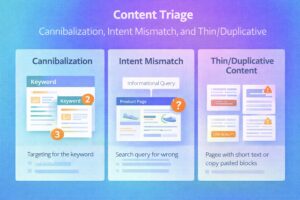
Three content problems that cause traffic drops
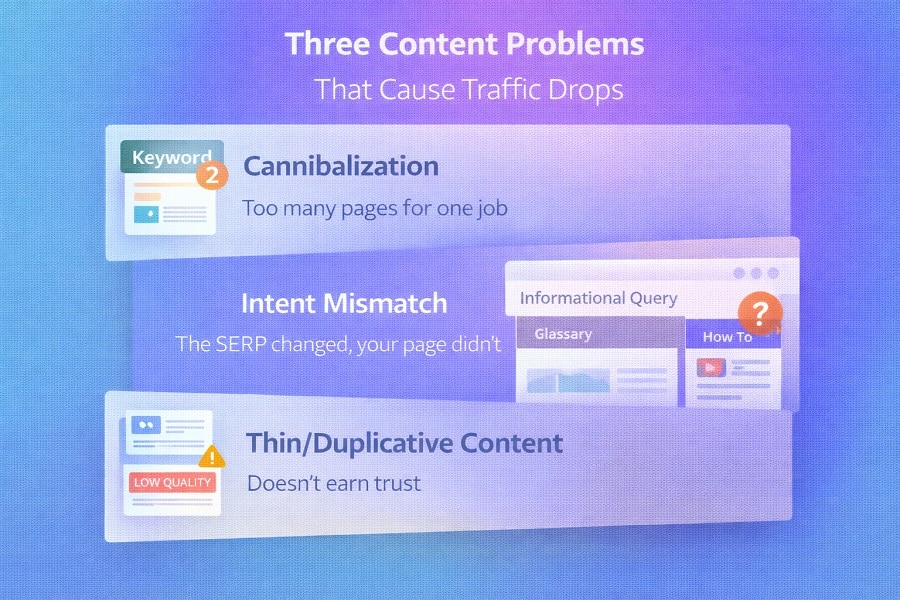
1) Cannibalization (too many pages for one job)
Cannibalization is when multiple URLs compete for the same query intent.
Google gets confused about which page is the ‘best’ answer, so none of them win consistently.
2) Intent mismatch (the SERP changed and your page didn’t)
Intent mismatch happens when you still rank ‘kind of,’ but the page format doesn’t match what the query expects now.
Example: the SERP shifts from ‘definitions’ to ‘step-by-step troubleshooting’ and your page is still a 400-word glossary entry.
3) Thin/duplicative content (pages that don’t earn trust)
Thin content isn’t just short content. It’s content that doesn’t add value.
Duplicative content isn’t just copy/paste. It’s pages that feel interchangeable.
See also : Traffic Drop Recovery Framework
Cannibalization diagnosis (fast, practical)
Use Search Console like a detective:
- Pick a priority query from the loss segments (Step 2).
- In Search Console, view ‘Pages’ for that query.
- If you see multiple URLs swapping clicks/impressions, you have cannibalization risk.
- Repeat for 10–20 queries. Patterns will emerge (usually a template or a topic cluster).
Other quick signals:
- Two similar posts targeting the same keyword variation.
- A category page and a blog post both trying to rank for the same commercial term.
- Programmatic pages (city/service, glossary, SKU) that overlap heavily with editorial pages.
Cannibalization fixes that actually work
Pick one ‘best page’ for the intent. Then eliminate the ambiguity.
- Consolidate: merge overlapping content into the best page, then 301 redirect the weaker page(s).
- Differentiate: if you truly need multiple pages, make intent boundaries obvious (different H1, different purpose, different internal link anchors).
- Canonicalize carefully: only when pages are truly duplicates or you cannot redirect (avoid canonicals as a lazy fix).
- Fix internal links: stop linking with the same anchors to different URLs for the same topic.
Intent mismatch diagnosis (SERP-first, not keyword-first)
Intent is not what you want the query to mean. Intent is what Google is rewarding today.
So you diagnose intent mismatch by looking at the SERP for your target queries:
- What formats dominate? (how-to guides, listicles, tools, forums, videos, product pages).
- What subtopics show up repeatedly across top results?
- What questions appear in PAA?
- Is there an AI Overview summarizing the topic? What angles does it cover?
If your page is the wrong format, you can’t ‘optimize’ your way out with a few paragraphs. You need a structural fix.
See Also : Algorithm Signals (Core Updates, Manual Actions, and Link Trends)
Upgrading thin or duplicative pages without rewriting the whole site
You don’t have time to rewrite everything in a recovery sprint.
So you use a scorecard and only fix what matters.
The ‘should we keep this page?’ scorecard
- Business value: does this page drive qualified leads/sales or support critical journeys?
- Search value: does it have meaningful impressions or rank potential?
- Uniqueness: does it add evidence, examples, or perspective that competitors don’t?
- Trust: does it have clear authorship, sources, and updates?
- Experience: is it readable, skimmable, and not buried in UX clutter?
If a page fails the scorecard, you consolidate or remove it. Keeping weak pages ‘just in case’ is how sites decay.
Make content AI-readable (without writing for bots)
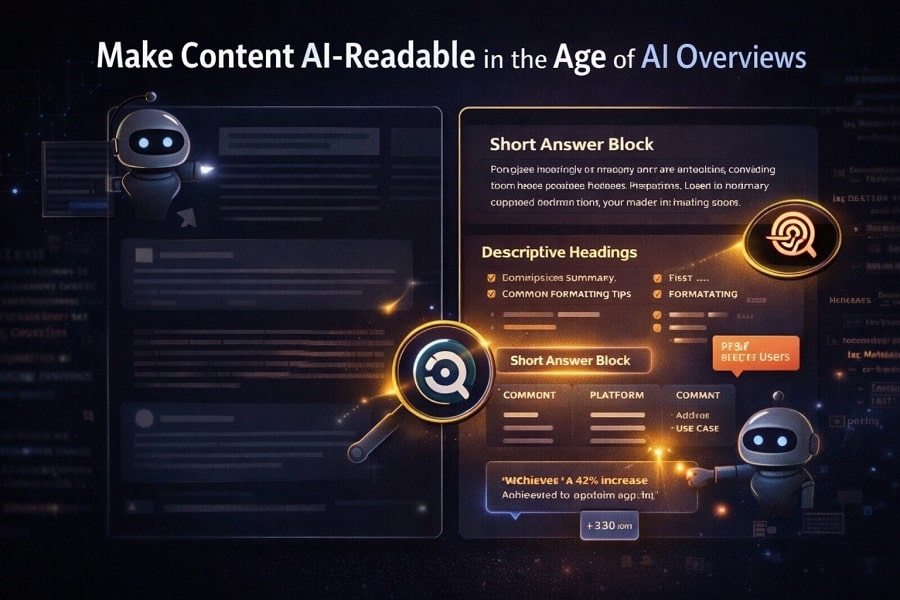
If Step 3 showed AI Overviews stealing clicks, formatting becomes strategy.
Your content needs to be easy to excerpt, cite, and understand.
- Lead with a short answer block (2–4 sentences) for definition-style queries.
- Use descriptive headings that match the questions people ask.
- Use lists and tables for comparisons and steps.
- Add ‘proof’: data, screenshots, quotes, examples, and real-world constraints.
- Clarify entity relationships: product names, categories, alternatives, and use cases.
The deliverable: Content triage backlog
By the end of Step 6 you should have a backlog with three buckets:
- Consolidate: pages to merge + redirect (highest priority for cannibalization).
- Upgrade: pages to expand with intent alignment + evidence.
- Retire: pages to noindex/remove if they add no value and create noise.
About The Author