Stop Fighting Over Acronyms: A KPI Dashboard for SEO vs AEO vs GEO vs AIO
Most marketing arguments aren’t about strategy. They’re about scoreboards.
If one person is tracking rankings and another person is tracking citations, you’re not disagreeing, you’re watching different sports.
This cluster article gives you a practical KPI dashboard so you can measure each acronym without turning your reporting into alphabet soup.

See Also: AIO operating system guide
The scoreboard table (print this and end the debate)
| Discipline | What you’re optimizing for | Where you win | Core KPIs |
| SEO | Ranking + relevance | Organic listings | Rankings, clicks, organic conversions |
| AEO | Extractable answers | Snippets, direct answers, voice, AI summaries | Answer ownership, qualified impressions, snippet visibility |
| GEO | Being cited/used in generated responses | AI answer engines and AI summaries with sources | Mentions/citations, assisted conversions |
| AIO | Coordinated AI visibility + brand accuracy | All AI surfaces (search + assistants) | Share of voice in AI, brand accuracy, pipeline influence |
The goal isn’t to pick one scoreboard. The goal is to pick the scoreboard that matches the outcome you need right now.
How to track SEO without pretending it’s 2016
- Keep rankings, but tie them to business outcomes (qualified traffic, leads, sales).
- Track non-brand vs brand separately (AI summaries can shift this mix).
- Watch cannibalization: when multiple pages compete, you lose clarity and citations.
See Also: SEO vs GEO vs AEO vs AIO: Same Mission, Different Scoreboards
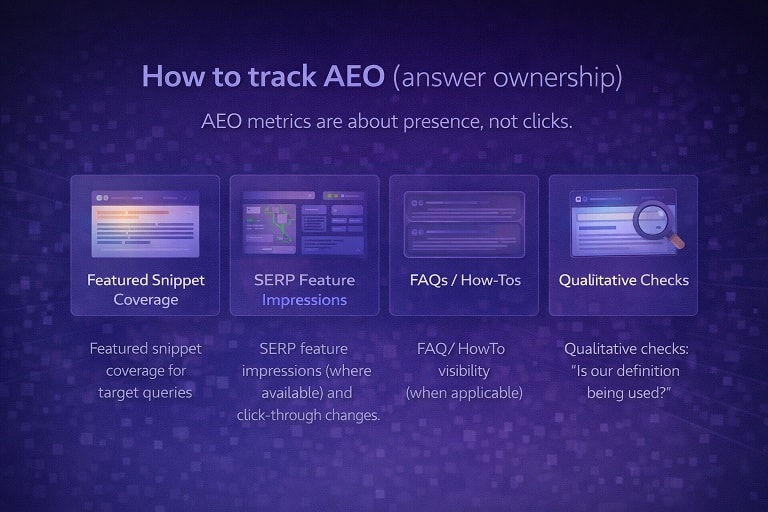
How to track AEO (answer ownership)
AEO metrics are about presence, not clicks.
- Featured snippet coverage for target queries.
- SERP feature impressions (where available) and click-through changes.
- FAQ/HowTo visibility (when applicable).
- Qualitative checks: “Is our definition being used?”
How to track GEO (citations and assisted influence)
- Mentions/citations in AI answers for your target topics (log manually if tools aren’t available).
- Which pages get cited most (these become your “citation hubs”).
- Assisted conversions: users who return later via branded search, direct, or referral.
- Topic coverage: number of distinct queries where you’re cited, not just one.
How to track AIO (system health)
AIO is where you measure accuracy and consistency across the whole footprint.
- Brand accuracy score: % of canonical facts stated correctly across AI surfaces.
- Share of voice in AI answers: how often you’re mentioned/cited vs competitors.
- Message consistency: does your positioning match across site + listings + press?
- Risk flags: incorrect claims, wrong categories, outdated leadership info.
See Also: GEO citable content guide
A simple reporting cadence
- Weekly: SEO trend checks (traffic, conversions, major ranking shifts).
- Monthly: AEO/GEO query log (same 20–50 queries, tracked consistently).
- Quarterly: AIO footprint audit (site, profiles, reviews, key references).
KPI dashboard checklist
- ✅ One shared dashboard with four sections (SEO / AEO / GEO / AIO)
- ✅ A fixed query set for monthly AI visibility checks
- ✅ A brand facts list for accuracy scoring
- ✅ Assisted conversion tracking (where possible)
- ✅ A quarterly audit cycle to fix drift
FAQ
Do I need special tools to track GEO/AIO?
Not to start. A manual query log plus analytics attribution beats no measurement. Tools can automate later.
What if my boss only cares about clicks?
Report clicks—but add a second line: presence (snippets/citations) and assisted impact. Over time, that’s where the story will go.
How do I prove AI visibility influences pipeline?
Use assisted conversions and branded search lift as proxies, and tie spikes to periods when you earned citations or mentions.
Other Related Articles
- SEO vs AEO vs GEO vs AIO “fast comparison” section (scoreboard framing).
About The Author