You can talk about AI search all day.
Or you can run prompts that tell you, in 5 minutes, whether you’re winning or invisible (or you can use a tool like LLMtel.com to summarize this for you).
This article gives you a prompt library you can reuse every week.
If you’re new to the overall system, start with How To Get Found In AI Search. Prompt results are how you measure the success of your system.

How to use these prompts (so your results are real)?
- Pick 3-5 AI engines you care about (ChatGPT Search, Google, Copilot, Perplexity, Gemini, etc.).
- Use the same prompts across engines. Do not rewrite them. Consistency is the point.
- Replace placeholders like [BRAND], [CITY], [INDUSTRY], and [COMPETITOR].
- Ask for sources/citations when the tool supports it. Save screenshots or links.
- Track the output weekly (mention yes/no, citations yes/no, sentiment, accuracy).
Note: AI can be wrong. It can hallucinate. So your first real win is not being mentioned, it’s being mentioned accurately with sources.
Pro move: force citations
When an engine supports citations, tell it to show its work. Use one of these add-ons at the end of any prompt:
- Include 5-10 clickable sources and cite each claim.
- Only use sources from the last 24 months.
- If you’re not sure, say you are not sure (do not guess).
- Give me the sources first, then the summary.
Your weekly AI Visibility scorecard
Copy this into a spreadsheet. Yes, a spreadsheet. (We love spreadsheets.)
Columns:
– Date
– Engine (ChatGPT Search / Google / Copilot / Perplexity / Gemini)
– Prompt category
– Prompt text
– Brand mentioned? (Y/N)
– Cited with link? (Y/N)
– Which URL(s) cited?
– Positioning (Top pick / In list / Not recommended)
– Accuracy issues (notes)
– Next action (page to create, edit, PR target, schema fix)
If you want AOK to set this up and run it, that’s the purpose of our implementation work under SEO for AI.
Prompt pack #1: Category discovery (non-branded)

These are the prompts that matter most. They mimic real buyers who do not know you yet.
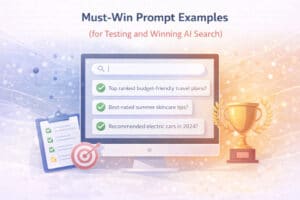
You’re helping a [TYPE OF CUSTOMER] choose a [PRODUCT/SERVICE CATEGORY]. List the top 7 options and explain why each is a fit. Include sources.
What’s the best [PRODUCT/SERVICE CATEGORY] for a small [INDUSTRY] business with a budget under [X]? Give your top 5 picks with pros/cons and sources.
I’m switching from [COMPETITOR] to something better. What are the best alternatives and why? Cite sources.
Rank the best [PRODUCT/SERVICE CATEGORY] for [USE CASE]. Use a decision table and cite sources.
What should I look for when choosing a [PRODUCT/SERVICE CATEGORY]? Then recommend 5 vendors that match the criteria. Cite sources.
Prompt pack #2: Problem-to-solution prompts
These prompts target pain. They are where AI engines often recommend solutions by name.
My [THING] is broken: [DESCRIBE PROBLEM]. What are the top 3 ways to fix it, and which companies can help? Cite sources.
I need to accomplish [GOAL] in [TIMEFRAME]. What is the fastest path, and who should I talk to? Include sources.
What are the common mistakes people make when trying to [TASK]? Recommend tools or services that help avoid them. Cite sources.
I’m a beginner. Explain [TOPIC] in plain language and recommend 3 reputable providers or resources. Cite sources.
Prompt pack #3: Comparison prompts (where you want to show up)
Buyers compare. If you are not in the comparison set, you do not exist.
Compare [BRAND] vs [COMPETITOR] for [USE CASE]. Include a table and cite sources.
Which is better for [USE CASE]: [BRAND] or [COMPETITOR]? Explain tradeoffs and cite sources.
List 5 competitors to [BRAND] and explain how each is different. Cite sources.
Create a decision framework for choosing between [BRAND], [COMPETITOR A], and [COMPETITOR B]. Cite sources.
Prompt pack #4: Local and near-me prompts
If you sell locally, run these. If you don’t sell locally, skip them.
I’m in [CITY] and I need a [SERVICE CATEGORY]. Who are the best 5 local options and why? Include sources and phone numbers if available.
Find me a [SERVICE CATEGORY] near [NEIGHBORHOOD] that can handle [SPECIALTY]. Cite sources.
Which [SERVICE CATEGORY] in [CITY] has the best reviews for [USE CASE]? Cite sources.
Prompt pack #5: Trust and legitimacy prompts (reputation tests)
These are the prompts customers run when they’re about to buy, but something feels risky.
Is [BRAND] legit? Summarize what they do, who they serve, and what third-party sources say. Cite sources.
What do people complain about with [BRAND] or [PRODUCT]? Cite sources.
Summarize [BRAND]’s pricing model and contract terms. Cite sources.
Who founded [BRAND], and when? What is their official website and contact info? Cite sources.
Prompt pack #6: Entity and Knowledge Graph prompts
These test whether the engine can resolve your brand as a distinct entity (not a vague guess).
Give me the key facts about [BRAND] as a company (official name, website, location, founders, what they do). Cite sources.
List the top 10 facts an AI system should know about [BRAND] to recommend them accurately. Cite sources.
What categories does [BRAND] belong to, and what categories should it NOT be placed in? Explain and cite sources.
Show me [BRAND]’s main competitors and how each is positioned. Cite sources.
Prompt pack #7: Content gap prompts (what pages you should create)
These prompts help you generate an editorial roadmap based on what the engines think is missing.
What are the top 20 questions people ask before buying [PRODUCT/SERVICE CATEGORY]? Group them by buyer stage.
If a company wanted to rank and be cited for [TOPIC], what pages would it need? List page titles and what each should contain.
What are the top misconceptions about [TOPIC]? Provide corrections with sources.
Create an FAQ for [PRODUCT/SERVICE CATEGORY] that answers real objections. Include suggested sources.
Prompt pack #8: The citation magnet prompt (make engines want your page)
This one is sneaky. It tells you the exact format engines prefer when they cite sources.
You’re writing an answer that will be used as a cited source.
Topic: [TOPIC]
Audience: [BEGINNER / EXPERT]
Requirements:
- Start with a 2-3 sentence summary.
- Include a definition.
- Include 5 selection criteria.
- Include 3 examples.
- Include a short FAQ.
- Include 5 authoritative references.
Now write it.
How to interpret results (so you don’t fool yourself)?
Not all wins are equal. Use this rubric:
- Level 0: You’re not mentioned at all.
- Level 1: You’re mentioned, but not recommended (or the info is wrong).
- Level 2: You’re recommended in a list, but no citation to your site.
- Level 3: You’re recommended and your site is cited.
- Level 4: You’re the top recommendation and multiple pages are cited.
Your goal is Level 3+ for the prompts that drive revenue.
Where to go next?
Prompts are measurement. Measurement tells you what to fix.
Fixes usually fall into one of these buckets:
- Signals fix: technical SEO, schema, internal linking, crawl issues.
- Content fix: create the missing page, rewrite for clarity, add references, add Q&A.
- Authority fix: earn a credible mention/backlink, improve consistency across profiles.
- Measurement fix: tighten your prompt set, track more consistently, review monthly.
Those buckets map directly to SEO for AI, AI Readable SEO, Knowledge Graph, and AI Visibility.
Glossary note
If you bumped into a term in this article and thought, “Wait, what does that mean?” start here: Glossary.
References
[1] AOK Marketing. “How To Get Found In AI Search.” (accessed January 11, 2026).
[2] AOK Marketing. “SEO for AI.” (accessed January 11, 2026).
[3] OpenAI. “Introducing ChatGPT search.” (accessed January 11, 2026).
[4] OpenAI Help Center. “ChatGPT search.” (accessed January 11, 2026).
[5] Microsoft. “Copilot Search in Bing.” (accessed January 11, 2026).
[6] Perplexity Help Center. “How does Perplexity work?” (accessed January 11, 2026).
[7] Google Search Central. “AI features and your website.” (accessed January 11, 2026).
[8] Glossary. AOK Marketing.(accessed January 11, 2026).
About The Author