January 3, 2026.
Yesterday I wrote an article.
Today I was found in AI Search (Google Gemini and Perplexity).
This is how I did it.
Two days ago, on January 1, I’m in a ChatGPT conversation, scanning a response, and I see something that made me stop mid-scroll:
A company name, Google, was highlighted like a search result. Faint underline. Clickable.

So I clicked it.
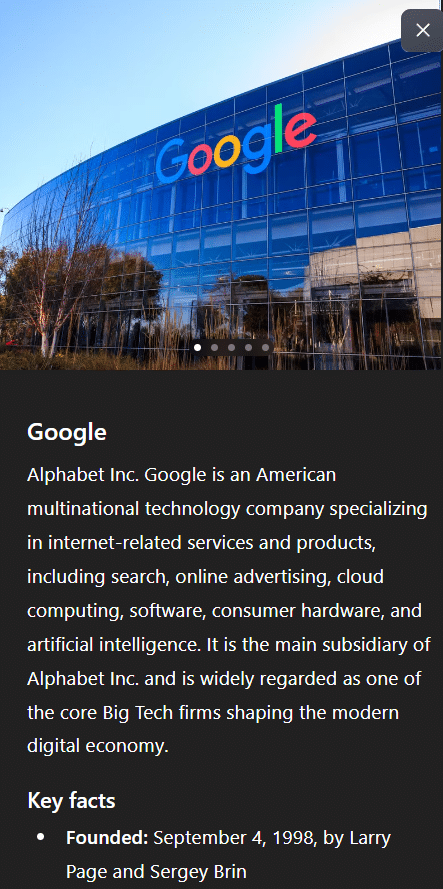
And a right-side panel opened that looked an awful lot like a Google Knowledge Panel… inside ChatGPT.
If you’ve ever had that “wait… is this new?” feeling, you know what happened next.
I went digging.
What I saw: a Knowledge Panel… in ChatGPT?!?
This panel (screenshot above) wasn’t just a little tooltip. It was structured:
-
Image
-
Summary
-
Key facts
-
Related info
-
Sources

And it wasn’t only Google. I saw it for other brands too (Tesla, Rocket Lab, OpenAI).
Here’s the part that matters for marketers:
This is not “ranking a blog post.” This is entity resolution happening in real time.
ChatGPT is trying to confidently answer: “What is this thing?” and then it’s constructing a summary panel from what it trusts.
Where is the panel getting its information?
The panel included images that were… weirdly specific.

So I tried to find them with old-school Google image search.
And I found the origins:
-
A Medium post
-
An arXiv paper (DeepMind Flamingo)
-
Wikipedia
-
A building’s website (office space)
That tells us something important:
This panel is stitched together from third-party sources across the web, not just your homepage copy.
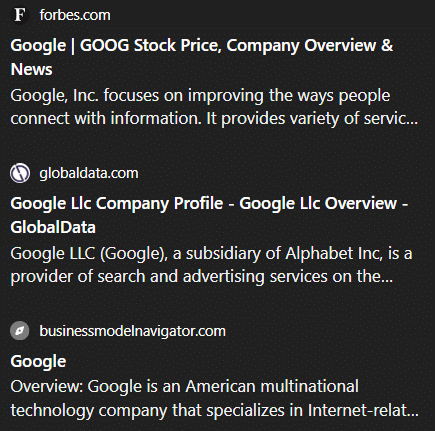
And yes… it also lists sources right below the panel (so you can see what it’s using to build the story about the entity).
The experiment: can I get found in AI in less than 24 hours?
At this point, I had a very practical marketer question:
If I publish something useful, optimized, and properly structured about this… how fast will AI systems pick it up and use it?
So I ran an experiment.
Here’s what I did, step by step.
Step by step: exactly what I did
-
Wrote an SEO-optimized blog post on the ChatGPT Entity Panel
-
screenshots
-
references
-
clear explanation of what to look for
-
links out to supporting resources
-
“make it as helpful as possible” mindset
-
-
Published it on my site (AOKMarketing.com)
-
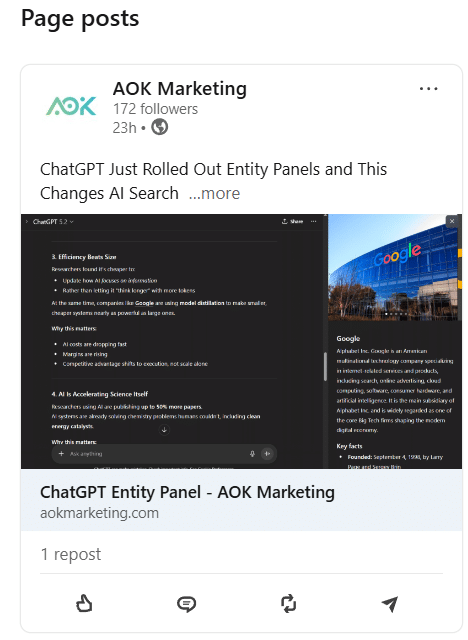
Distributed it on LinkedIn twice
-
Posted it on the AOK Marketing LinkedIn company page
-
Wrote a full LinkedIn article under my personal profile
-
Checked indexing immediately
-
-
Verified in Search Console
-
Verified using Google’s rich results / snippet testing tools
-
Confirmed it was indexed within minutes
-
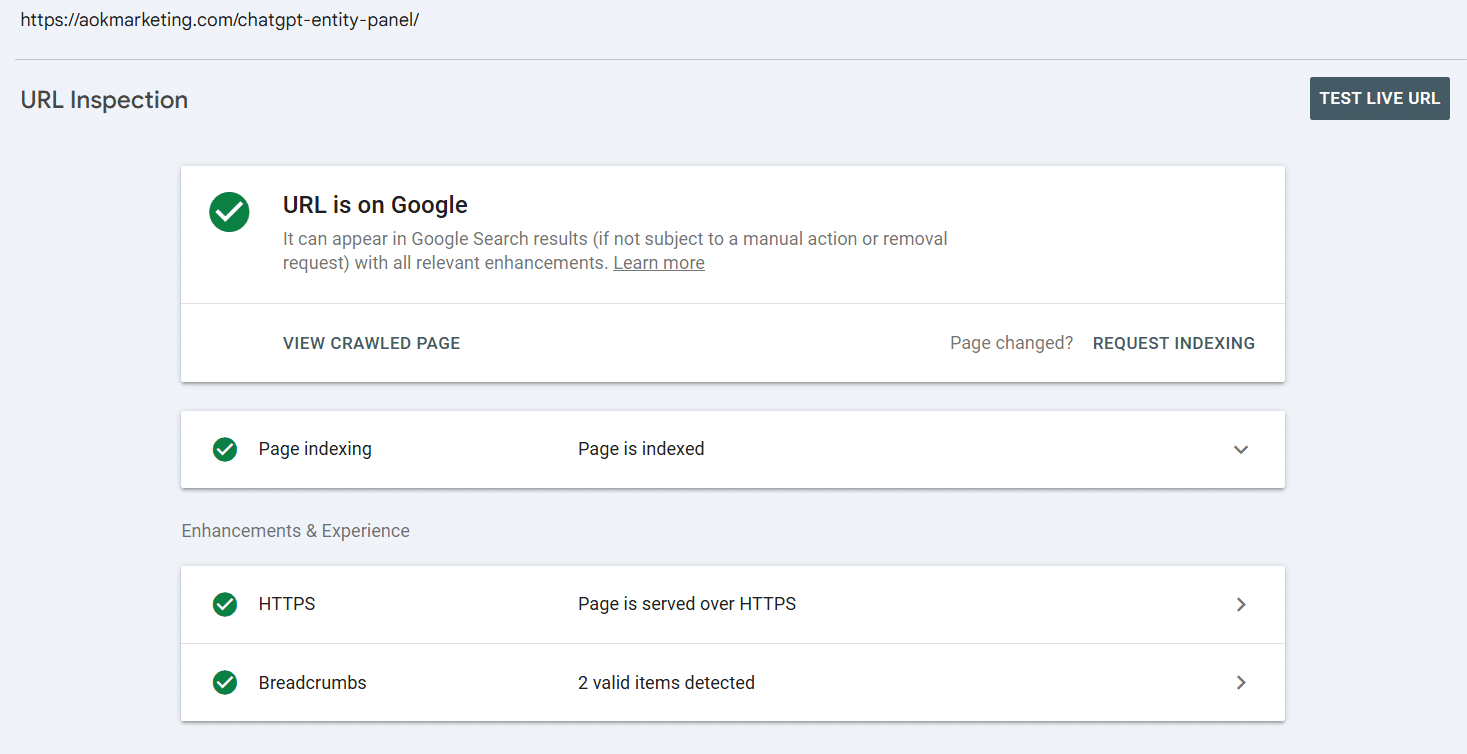
Then I waited.
Less than 24 hours.
The result: it worked
The next morning (Jan 3, around 9:45 AM), I tested to see if ChatGPT was already picking it up.
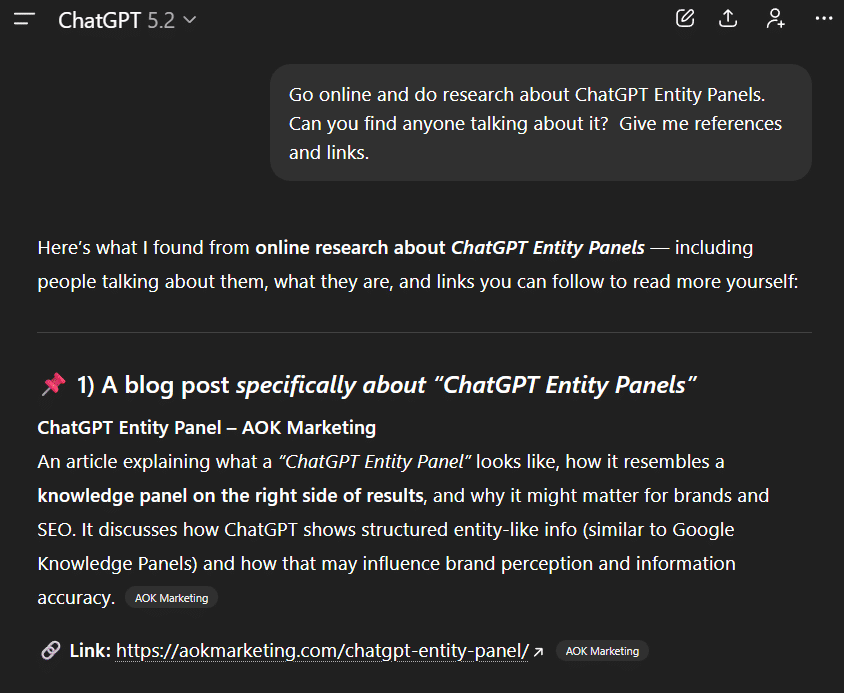
Now, I know what you’re thinking…
“Dave… come on. If you search in ChatGPT, it might be biased. History. Personalization. Cookies. Vibes.”
Exactly.
So I didn’t just trust a manual prompt.
I checked using LLMtel, which shows what different models are pulling at the API/retrieval layer.
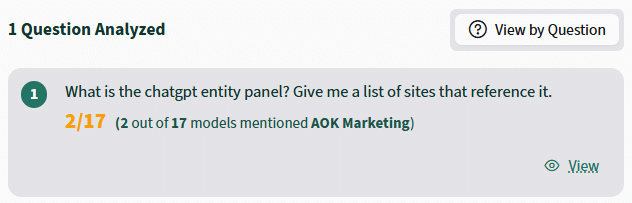
And here’s what happened:
-
Gemini had it
-
Perplexity had it
-
Both were quoting directly from the post in their responses (Full report here)
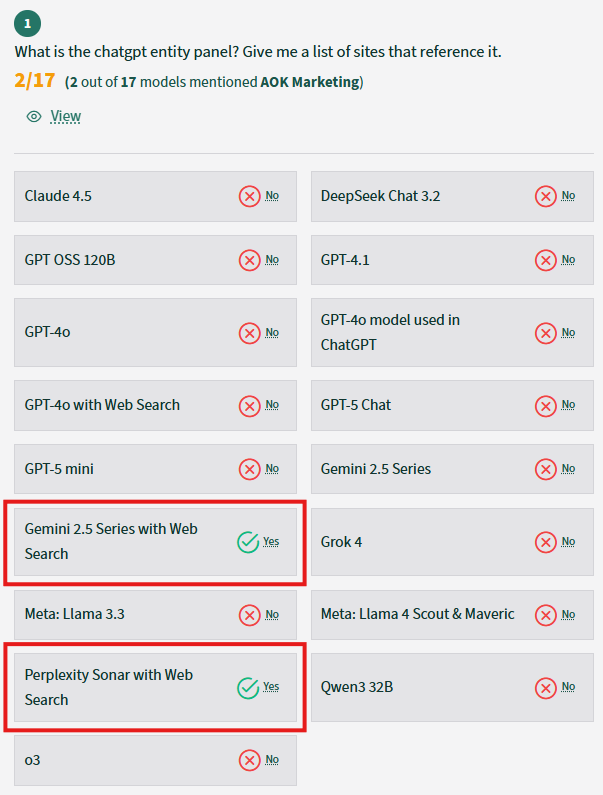
This was not the first time I ran this report. I also ran it yesterday to set a baseline right after I published the article, and AOK wasn’t showing up. But today it is!

Then I was wondering, what did they say about AOK? Was it actually about AOK Marketing and the article I wrote? Or was it something different? Here is a screen capture from the report showing what Gemini with Web Search showed for it’s full response:

Yes! Not only was it about AOK, but we were showing up first and the article was being quoted almost exactly word-for-word!
So, what about ChatGPT?
Interestingly, not yet (at least not at the API/retrieval level). But I’m going to keep checking.
So yes:
I got found in AI Search in less than 24 hours.
Not in theory. Not in a “maybe.” In practice.
My working hypothesis: why did it work?
This is one experiment. Not a universal law. But here’s what I think mattered and what I’m going to keep testing.
1) I was writing about something unique
This is the simplest explanation.
- I wasn’t writing “10 reasons AI matters.”
- I was writing about a newly surfaced feature, with screenshots, and a clear walkthrough.
If you publish something that’s genuinely new (or at least under-covered), the bar to becoming a primary source gets a lot lower.
2) Structured data and clean SEO fundamentals still matter
This is the part people want to skip because it’s not exciting.
But I made sure the post had:
-
keywords in the slug
-
keywords in the headline
-
keywords in the body
-
strong internal logic and clarity
-
helpful outbound references
-
structured data associated with the content
And that matters because AI is a machine and structured information about entities makes it easier for the machines to read, understand, and surface in the answers.
3) Distribution mattered more than people want to admit
I didn’t just hit “publish” and pray.
I pushed it through two channels that get crawled, referenced, and engaged with quickly:
-
My site
-
LinkedIn
- And for full disclosure, I also drafted a video to post on YouTube as part of the experiment, however it didn’t get done in time.
The bigger point to consider: SEO is becoming Entity Operations
This is where it stops being a fun trick and starts being strategy.
We’re moving from:
-
“How do I rank?”
to:
-
“How does the model understand what my entity is?”
To get shown in the AI search results. And that shift changes the job. This is Entity Ops.
It’s not just keywords, pages, and links.
It’s:
-
entity clarity
-
fact consistency
-
authoritative references
-
source control
-
narrative alignment
-
monitoring AI outputs using AI specific tools like we used to monitor SERPs
That’s why I said it bluntly in the original post:
“If you don’t define your brand for AI, AI will define it for you using whatever it finds.”
Practical takeaway: a playbook you can steal
If you want to run your own “get found in AI fast” experiment, here’s a clean version of the process.
1) Publish something that deserves to be cited
Not “content.”
A useful, specific, clarifying piece that answers a real question, ideally:
-
new discovery
-
original data
-
fresh angle
-
unique example
-
clear step-by-step explanation
Another way I like to think about it: Do cool stuff. Then talk about it. Then do more cool stuff. And talk about that too. Repeat.
2) Make your content machine-readable
At minimum:
-
clean page structure
-
good headings
-
clear definitions
-
structured data where appropriate
-
consistent entity naming (don’t call yourself three different things across pages)
3) Force fast discovery
-
LinkedIn distribution (especially if your network engages)
-
internal linking
-
sitemap health
-
Search Console indexing checks
4) Validate across models
- Don’t just ask ChatGPT and assume it’s “in AI.”
- Check multiple systems, because they ingest differently and at different speeds.
- And use tools that show exactly what the models are saying if you can. (I used LLMtel.)
5) Keep running experiments
Because the real question isn’t “can it happen once?”
The real question is:
-
How repeatable is it?
-
How predictable is it?
-
What types of content get picked up fastest?
-
How long does ChatGPT take compared to Gemini and Perplexity?
- Does the content show up anywhere else?
What I’m testing next
This article. It’s a much broader reference: “How to get found in AI Search in less than 24 hours.”
I’m going to apply the same principles, and see if it works and how long it takes.
I’m also continuing to dig into:
-
how long ChatGPT takes to surface content at the API/retrieval layer
-
which distribution channels accelerate AI pickup
-
whether entity panel presence correlates with being cited in AI answers
-
what happens when you update the source content (does AI refresh quickly or slowly?)
Because the “AI visibility” game is not going away.
It’s just getting started.
What to do now?
Next time you’re in ChatGPT, watch for those faint underlined entity links.
Click one.
Then ask yourself the only question that matters:
Would I be happy if that panel was the first impression of my company?
Because for a growing number of prospects… it will be.
Final note
I discovered something interesting. Not only did this strategy work to get found in AI search in less than 24 hours, but the article also ranking #1 in Bing search with a citation. How cool is that:

About The Author