Business directories still deserve a place in a practical SEO strategy. They help customers discover a company, confirm its contact information, read reviews, and reach the correct website. For local businesses, directory profiles also create a stronger presence across search engines, maps, review platforms, and industry websites.
The value, however, does not come from submitting a website to every directory available. A hundred weak listings will not outperform a smaller group of accurate profiles on websites that customers actually use.
A useful directories list for SEO focuses on relevance. The platform should fit the company’s location, industry, audience, or services. Every listing should contain accurate information and give customers a clear reason to visit the business website.
Do Directory Listings Still Help SEO?
Directory listings remain valuable when they support genuine business discovery. Google advises businesses to keep their profile information complete and accurate because those details help customers understand what the company does, where it operates, and when they can visit. (Google Help)
A well-managed listing supports three important goals:
- It gives customers another reliable way to find the business.
- It keeps the company’s name, address, phone number, and website consistent.
- It creates referral traffic from people already looking for a relevant service.
What no longer works is mass submission for the sole purpose of collecting links. Google identifies links created mainly to manipulate search rankings as link spam. That makes quality, relevance, and accuracy far more important than the number of directories used.
Directory work should support a complete SEO marketing strategy that also covers technical performance, useful content, on-page optimization, and conversion-focused landing pages.
The Most Important Directory Listings for SEO
Start with the platforms that already play a major role in search, maps, local discovery, and business reviews.
1. Google Business Profile
Google Business Profile belongs at the top of almost every local directory plan. A verified profile controls how a business appears across Google Search and Maps. Google provides the service at no charge. (Google Help)
The profile should contain the official business name, correct category, address or service area, phone number, website, opening hours, services, and recent photos.
Do not add promotional keywords to the company name unless they are part of the registered or publicly used business name. A clean and accurate profile is more credible than one filled with forced search terms.
Businesses working on both local and organic visibility should connect profile optimization with a broader Google SEO strategy.
2. Bing Places for Business
Bing Places gives companies another way to appear in search and map results. Microsoft promotes the platform as a free business-listing service.
Many business owners ignore Bing because Google receives more attention. That creates an easy opportunity to claim the listing, correct the information, and reach customers who use Bing or Microsoft products.
3. Apple Business Connect
Apple Business Connect lets a company manage how it appears across Apple services, including Maps. Businesses can update their place card with information such as opening hours, images, and location details. Apple offers access to the platform without charge.
This listing matters for customers searching through iPhones, Macs, Siri, and Apple Maps. An old phone number or incorrect map pin can cost a business a real customer, even when the company website is fully optimized.
4. Yelp
Yelp remains an important discovery and review platform for restaurants, home-service companies, healthcare practices, retailers, beauty businesses, automotive companies, and professional services.
Business owners can claim and manage a Yelp Business Page for free. Yelp also allows a company to add a new page when an existing listing cannot be found.
Before creating a listing, search for the business name, old addresses, and phone numbers. Claiming the correct profile is better than creating a duplicate page.
5. Better Business Bureau
The Better Business Bureau directory is particularly relevant to companies serving customers in the United States and Canada. Businesses can claim a free BBB Business Profile or request a new profile when no listing exists. Accreditation is a separate service and is not required simply to appear in the directory.
A BBB profile often appears in branded searches, so the company name, location, website, management information, and service details should remain current.
6. Facebook Business Page
A Facebook Business Page works as both a social profile and a searchable company listing. It often appears when someone searches directly for a business name.
Add the website, phone number, location, opening hours, business category, services, and a short description. Even a company that posts occasionally should keep its basic details accurate.
7. Nextdoor
Nextdoor is useful for businesses that rely on nearby customers, including contractors, cleaners, landscapers, restaurants, real estate agents, pet-care providers, and repair services.
The platform allows businesses to claim a free Business Page, publish local updates, and collect recommendations from customers.
Its value comes from local discovery and neighbourhood trust rather than from treating the page as another backlink.
8. Foursquare
Foursquare gives businesses a portal for finding, claiming, and managing location listings. It also allows companies to create a listing when one does not already exist.
Check the map pin, category, address, and website carefully. Location data becomes less useful when a listing points customers to the wrong entrance, building, or service area.
General List of Directories for SEO
After completing the major search and map profiles, move to reputable general and industry platforms. The right choices depend on the business model.
| Directory | Best suited for |
| Google Business Profile | Local businesses and service-area companies |
| Bing Places | Local search and map visibility |
| Apple Business Connect | Businesses serving Apple Maps users |
| Yelp | Local services, restaurants, retail, and healthcare |
| Better Business Bureau | US and Canadian businesses |
| Consumer and local business visibility | |
| Nextdoor | Neighbourhood and home-service businesses |
| Foursquare | Physical locations and local businesses |
| Yellow Pages | Local companies and professional services |
| Manta | Small and medium-sized businesses |
| ChamberofCommerce.com | Local and business-to-business companies |
| Hotfrog | General business listings |
| Brownbook | International and local company profiles |
| MerchantCircle | Local merchants and service providers |
| Alignable | Small-business networking and referrals |
| LinkedIn Company Pages | B2B companies and employers |
| Crunchbase | Startups, technology companies, and investors |
| Clutch | Agencies, consultants, and B2B providers |
| GoodFirms | Software, IT, and marketing companies |
| G2 | Software and technology products |
| Capterra | SaaS and business software |
| DesignRush | Creative, web, and digital agencies |
| UpCity | Marketing and professional services |
| Angi | Contractors and home services |
| Houzz | Builders, designers, and renovation companies |
| HomeStars | Canadian home-service businesses |
| Thumbtack | Local professionals and service providers |
| Avvo | Lawyers and law firms |
| FindLaw | Legal professionals |
| Justia | Attorneys and legal practices |
| Healthgrades | Doctors and healthcare providers |
| Zocdoc | Healthcare providers and appointments |
| Psychology Today | Therapists and treatment professionals |
| Tripadvisor | Hotels, restaurants, and attractions |
| OpenTable | Restaurants and reservations |
| The Knot | Wedding venues and professionals |
| WeddingWire | Wedding businesses and service providers |
This directory submission list for SEO is not a requirement to create every profile. A software company gains more from G2 and Capterra than from a home-service marketplace. A roofing contractor should focus on Google, BBB, Angi, Houzz, HomeStars, and strong local directories.
Relevance keeps the work focused and brings better visitors.
Industry Directories Often Bring Better Leads
General directories cover thousands of business categories. Industry platforms attract a narrower audience with a clearer need.
A person browsing Clutch is probably comparing agencies or consultants. Someone visiting Avvo is looking for legal information or an attorney. A homeowner on Houzz is researching a renovation, contractor, or designer.
That stronger intent makes a niche listing valuable even when the directory sends fewer visitors than a larger platform.
Review the first page of search results for your main services and location. Note which directories repeatedly appear. Those platforms have already earned visibility for searches that matter to the business.
A company managing several locations should also review its local listings strategy before opening new profiles. This prevents duplicate pages and keeps each location connected to the correct website page.
How to Create a Strong Directory Profile
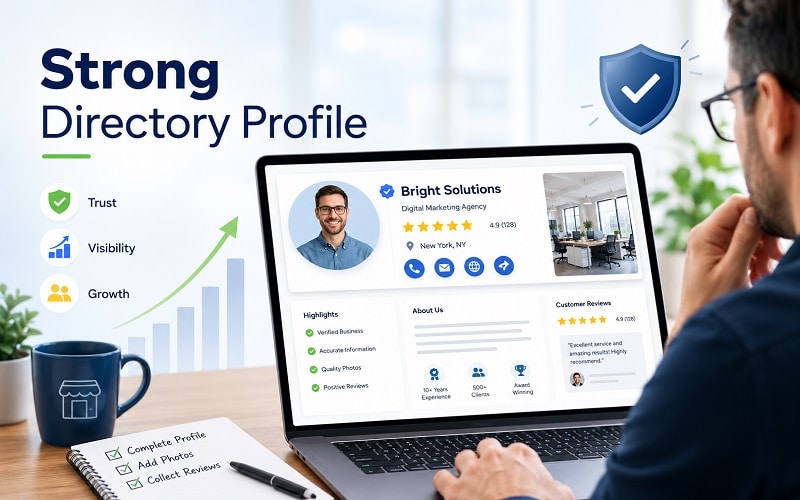
The best directory profiles feel complete and trustworthy. They do not read like keyword-filled advertisements.
Keep Core Information Consistent
Create a master business record before starting submissions. It should contain the approved company name, address, phone number, website, opening hours, categories, service areas, logo, and social profiles.
Use the same core details throughout every listing. Real conflicts cause problems. These include an old address, former company name, disconnected phone number, or incorrect website.
Minor differences such as “Street” and “St.” are less serious than sending customers to the wrong location.
Choose the Closest Category
Select the category that describes the company’s main service. Do not choose unrelated categories just to appear in more searches.
A family dentist should use an accurate dental category. A plumbing company should not add roofing, electrical work, and construction unless it genuinely provides those services.
Clear categorization helps the directory place the business in front of the right audience.
Write for the Customer
A directory description should explain what the company does, who it serves, where it works, and what makes the service useful.
Avoid writing a sentence like:
“Leading affordable SEO experts offering the best SEO services from a top SEO company.”
That language sounds forced and tells the customer very little.
Natural web content gives readers a clear picture of the service without repeating keywords.
Add Useful Details
Complete the fields that help someone make a decision. Include current hours, services, photographs, payment information, service areas, appointment details, accessibility information, and professional credentials where relevant.
A complete profile is more persuasive than a listing containing only a business name and phone number.
Common Directory Submission Mistakes
A free directory submission list for SEO becomes a problem when businesses chase quantity without checking quality.
Avoid creating duplicate profiles, using fake business names, selecting irrelevant categories, publishing old contact information, or paying for bulk submissions without knowing where the company will appear.
Ownership also matters. Directory profiles should stay under a company-controlled email address. An employee, freelancer, or agency should not remain the only person with access after the working relationship ends.
Google uses links to understand relevance and discover pages, but its policies draw a clear line between useful links and schemes designed to manipulate rankings. (Google for Developers)
Measure Which Listings Produce Results
A directory earns its place when it supports visibility, trust, or customer activity.
Track website visits, phone calls, contact forms, bookings, map requests, reviews, and profile views. Use tagged URLs on important listings when the platform allows them.
Some profiles will send direct enquiries. Others will strengthen branded search results or help customers verify the company before making contact. Review the results every few months and spend more time on the platforms producing genuine value.
A wider digital marketing strategy connects this data with website traffic, content performance, paid campaigns, and conversions. AOK Marketing’s case studies also show why individual marketing activities should be judged by business outcomes rather than surface-level numbers.
Build a Directory List Around Real Customers
A strong directories list for SEO is not the longest spreadsheet. It is a carefully selected group of search platforms, maps, review websites, local directories, and industry marketplaces that customers trust.
Begin with Google Business Profile, Bing Places, Apple Business Connect, Yelp, BBB, Facebook, Nextdoor, and Foursquare. Add general or niche directories only when they match the company’s services, location, and audience.
Keep every profile accurate, complete, and under company control. Remove duplicates, update old details, and track where calls, visits, reviews, and enquiries originate.
Directory listings work best when they lead real people toward a real business. For a clearer view of listing gaps, website issues, and organic search opportunities, request a free SEO report from AOK Marketing.
Read Also: Social Video Marketing for Brand Engagement
Read Also: Social Media Marketing for Small Business: A Complete Guide
Read Also: Content Shock: What It Means for Your Content Strategy
About The Author