Content marketing influences more buying decisions than many consumers realize. Before contacting a company or purchasing a product, people often read an article, watch a video, compare options, review customer experiences or search for an answer to a specific problem.
Consider your own behaviour as an online shopper. You may discover a product through a social media post, read a buying guide, watch a demonstration and compare reviews before deciding what to purchase. The advertisement may have introduced the product, but the supporting content helped you understand it and feel confident enough to act.
That is why the importance of content marketing goes far beyond publishing occasional blog posts. A successful content strategy helps a business become visible, answer customer questions, demonstrate expertise and remain present throughout the decision-making process.
In 2026, this role is becoming even more important as customers move between search engines, social media, email, video platforms and AI-generated search experiences before choosing a business.
What Is Content Marketing?
Content marketing is a strategic approach to creating and distributing useful, relevant and consistent information for a defined audience. Instead of leading with a direct sales pitch, it helps potential customers understand a problem, compare possible solutions and decide what action to take.
The Content Marketing Institute describes content marketing as an approach designed to attract and retain a clearly defined audience while ultimately encouraging profitable customer action. The emphasis is on providing value rather than simply promoting products or services.
Content marketing can include articles, research reports, case studies, videos, newsletters, social posts, webinars, podcasts, product guides and interactive tools. The format matters less than the purpose behind it.
A random blog post is content, but it does not automatically form part of a content marketing strategy. Strategic content has a defined audience, a clear objective and a role within the wider customer journey.
Why Is Content Marketing Important in 2026?
Customers have access to more information than ever, but they are also surrounded by more generic, repetitive and automatically generated material. Publishing more content does not guarantee that a business will attract attention.
The opportunity now lies in producing information that is genuinely useful, recognizable and connected to a real customer need.
HubSpot’s 2026 marketing research found that core channels such as websites, blogs, email and social media remain important, but businesses are adapting their content for personalization, AI search and channel-specific behaviour. Updating SEO for changing search experiences was identified as a priority by 40.6% of surveyed marketers, while repurposing content across channels was also among the year’s leading trends.
This does not mean every company needs to publish everywhere. It means businesses need a deliberate approach to creating information that can support several stages of the customer relationship.
Content marketing is important because it helps a business:
- Build visibility around the questions its customers are already asking
- Establish expertise before a sales conversation begins
- Explain complicated products or services more clearly
- Support organic search, social media, email and paid campaigns
- Guide prospective customers from awareness to action
- Give sales teams useful material for answering objections
- Strengthen relationships with existing customers
These benefits rarely come from one article. They develop when useful content is produced consistently and connected to a measurable business goal.
How Content Marketing Influences Buying Decisions
A customer does not always recognize that content has influenced a purchase.
Someone researching accounting software may read an article about reducing bookkeeping errors. A homeowner comparing contractors may study a guide explaining project costs. A marketing manager may download a report, subscribe to a newsletter and attend a webinar before requesting a proposal.
Each piece of content reduces uncertainty. It gives the prospective buyer information needed to move closer to a decision.
The influence becomes stronger when the content matches the customer’s current level of awareness. A person who has only just recognized a problem needs different information from someone who is already comparing vendors.
The five stages of awareness provide a useful structure for understanding this process. Early-stage content can explain the problem, while later-stage content can address comparisons, objections, implementation and expected outcomes.
The purpose is not to pressure every visitor into buying immediately. It is to help each person take the next logical step.
Content Marketing Builds Search Visibility Around Real Questions
Search engines remain an important route through which customers discover information, but modern SEO requires more than placing keywords into an article.
Google recommends creating helpful, reliable and people-first content that gives readers a complete and satisfying answer. Its guidance also warns against producing large volumes of content primarily to attract search traffic without adding meaningful value.
An effective SEO content strategy begins with the customer’s question.
A business selling project management software might create content about managing missed deadlines, coordinating remote teams or comparing project management methods. A law firm may explain legal processes, deadlines and available options. A local contractor may answer questions about cost, materials, planning and maintenance.
These topics are commercially relevant without turning every article into a service page.
This distinction also helps prevent keyword cannibalization. Instead of creating several pages that all target “content marketing,” this page focuses on why content marketing is important, while other pages can target separate intentions such as content strategy, content creation, blogging, SEO or marketing services.
Useful Content Builds Trust Before the First Conversation
Customers are more likely to trust a business that explains its subject clearly and honestly.
Helpful content gives a company an opportunity to demonstrate how it thinks, what it understands and how it approaches customer problems. It can show expertise before the customer speaks with a salesperson or submits an enquiry.
Trust is particularly important for products and services that involve cost, risk or a long-term commitment. Buyers want evidence that a business understands their situation and will not simply give them a generic solution.
Thought leadership can support this process when it offers a clear perspective rather than repeating familiar advice. The most effective approach often combines foundational information, timely commentary and original expertise. This balance is explored further in content that works through base content, news and thought leadership.
Strong content does not need to reveal every detail of a company’s process. It should provide enough clarity for the reader to recognize the business as informed, credible and relevant.
Content Supports Every Stage of the Buyer Journey
Content marketing is often associated with the beginning of the funnel, but its value extends throughout the complete customer journey.
At the awareness stage, educational content helps people understand a problem. During consideration, guides, webinars and comparisons help them evaluate possible approaches. At the decision stage, case studies, demonstrations and service explanations reduce uncertainty.
Content remains useful after the sale as well. Onboarding guides, tutorials, newsletters and support resources can improve adoption, reduce confusion and strengthen customer retention.
A business can organize this material around three practical categories:
Attract: Content designed to reach new audiences through search, social platforms, referrals and distribution.
Educate: Content that explains problems, possible solutions, processes and important considerations.
Convert and retain: Content that supports decisions, answers objections and helps customers gain more value after purchasing.
The three-buckets framework can help teams view their marketing activity more clearly and identify where content contributes to growth.
A Strong Strategy Begins With the Right Audience
Many content programs struggle because the business begins with topics rather than people.
Before deciding what to publish, a company needs to understand who it is trying to reach, what those people are attempting to accomplish and what prevents them from moving forward.
A useful audience profile should go beyond job titles and basic demographic information. It should identify customer priorities, challenges, triggers, objections, preferred information sources and decision criteria.
The guide to defining your ideal customer profile explains how a clearer understanding of the intended customer can improve positioning and communication.
Once the audience is understood, keyword research becomes more meaningful. Instead of choosing topics solely because they have search volume, the business can prioritize questions that connect customer needs with its own experience and commercial goals.
This produces content that is more likely to attract the right visitors rather than simply increasing traffic numbers.
Quality Matters More Than Publishing Volume
A crowded publishing calendar can create the appearance of activity without producing meaningful results.
Businesses frequently publish several similar articles that compete for the same search terms, repeat information already available elsewhere and receive little promotion after publication. This approach can create thin pages, internal competition and an increasingly difficult website to maintain.
A smaller number of focused, well-supported resources can often provide more value.
Each page should have a defined purpose and a distinct search intent. Before creating a new article, review whether an existing page already addresses the topic. In many cases, updating and expanding an established page is more useful than creating another overlapping URL.
A consistent blog can still play an important role when every article contributes to a recognizable subject area. These tips for building a blogging brand show why editorial consistency matters alongside individual page optimization.
Content quality also depends on originality. First-hand observations, examples, customer questions, internal data and informed opinions make an article more valuable than a generic summary assembled from competing pages.
Content Should Be Created for Distribution, Not Just Publication
Publishing is only one stage of content marketing.
An article may be transformed into a newsletter, a short video, a social post, a sales resource or a webinar discussion. A research report can generate several supporting articles and visuals. A customer question can become an FAQ, a video response and a future email topic.
This does not mean copying the same material onto every platform. Each version should reflect how people consume information in that environment.
The message may remain consistent, but its length, format, opening and call to action should change. A detailed guide may work on a website, while a short visual explanation may be more appropriate for social media.
Repurposing helps a business gain more value from its strongest ideas without constantly producing unrelated content. It also reinforces key messages across the different channels customers use during the buying process.
AI Can Improve Production, but It Cannot Replace Strategy
AI tools have made it easier to research, outline, edit and repurpose content. They can improve productivity, but faster production does not automatically create stronger marketing.
Content Marketing Institute’s 2026 B2B research found that among marketers using AI for content creation, 87% reported improved productivity and 80% reported greater operational efficiency. However, only 39% reported an improvement in content performance, illustrating the difference between producing content faster and producing content that creates better results.
Strategy still requires an understanding of the audience, market, brand and business objective. Human review is also essential for checking accuracy, improving examples and removing language that feels repetitive or disconnected from the brand.
The question is therefore not whether businesses should use AI. It is how AI should support the people responsible for judgment, experience and originality. The discussion around whether AI can replace strategic and creative thinking in marketing is especially relevant as more organizations adopt automated production tools.
Google’s current guidance for generative AI search also emphasizes unique, expert-led and non-commodity content rather than unnecessary optimization tricks.
How to Measure Content Marketing Effectiveness
Content marketing should be measured according to its intended purpose.
An awareness article may be evaluated through qualified organic visibility, engagement and assisted conversions. A decision-stage case study may be judged by sales usage, enquiries and influenced revenue. A customer guide may be assessed through product adoption, support reduction or retention.
Useful measures may include organic search visibility, engaged visits, email subscriptions, qualified leads, sales-assisted conversions, customer acquisition cost and revenue influenced by content.
The correct metric depends on what the content was created to achieve.
A business should avoid reporting only page views when its real objective is pipeline growth. The connection between marketing activity, conversion rates and revenue can be clarified through practical pipeline math that can be managed in a spreadsheet.
Measurement also helps teams decide what to improve. A page receiving impressions but few clicks may need a clearer title. A page receiving traffic but no enquiries may not match commercial intent. A high-performing article may deserve additional internal links, updated examples or repurposing into other formats.
Common Reasons Content Marketing Fails
Content marketing usually underperforms because of execution rather than because the approach itself is ineffective.
Common problems include:
- Publishing without a documented audience or objective
- Targeting the same keyword across several pages
- Choosing topics based only on search volume
- Creating generic AI content without expert review
- Promoting products before answering the customer’s question
- Measuring traffic without connecting it to leads or revenue
- Publishing once and providing no ongoing distribution
- Allowing useful content to become outdated
A successful program does not require constant publication. It requires useful ideas, clear ownership, realistic resources and a method for reviewing performance.
As content becomes more closely connected with search, sales, social media and customer experience, responsibility may also extend beyond one writer or department. The evolution of the marketing department reflects the growing need for coordination between content, strategy, analytics and commercial teams.
Is Content Marketing Still Effective in 2026?
Content marketing remains effective, but the standard required for success has risen.
Customers do not need more generic articles. They need accurate, relevant information that helps them understand a problem or make a better decision. Search engines and AI platforms also have more ways to evaluate and summarize what has already been published.
Businesses that simply increase publishing volume may struggle to stand out. Those that contribute experience, evidence, clarity and a recognizable point of view can still use content to build visibility and trust.
The greatest value comes from connecting content with the complete marketing system. SEO helps people discover it. Social media and email distribute it. Sales teams use it to support conversations. Analytics reveal how it contributes to growth.
Content marketing is not a temporary trend or a replacement for every other channel. It is the information foundation that makes many other marketing activities more effective.
How Important Is Content Marketing to Your Business?
The importance of content marketing lies in its ability to influence decisions before, during and after a purchase.
It can attract potential customers through search, introduce a brand through social media, answer questions during consideration and provide reassurance before a buyer commits. After the sale, it can improve customer understanding, engagement and loyalty.
The strongest results come from content that has a clear audience, a distinct purpose and a measurable role within the buyer journey.
When a business treats content as a strategic asset rather than a publishing task, it becomes more than something people read. It becomes part of how the company earns attention, communicates expertise and supports sustainable growth.
Frequently Asked Questions
Why is content marketing important for businesses?
Content marketing helps businesses answer customer questions, improve search visibility, establish expertise and support buying decisions. It can also strengthen email, social media, sales and customer-retention activities by giving each channel useful information to distribute.
How does content marketing support business growth?
Content marketing supports growth by attracting relevant audiences, increasing trust and helping potential customers move through the buyer journey. Its contribution can be measured through leads, assisted conversions, sales opportunities, customer retention and revenue influenced by content.
How does content marketing influence buying decisions?
Content can explain a problem, present possible solutions, answer objections and provide evidence that reduces purchasing risk. Customers may interact with several articles, videos, emails or case studies before contacting a company or completing a purchase.
How long does content marketing take to work?
The timeframe depends on the market, website authority, distribution strategy, content quality and intended objective. Some content can support sales immediately, while organic search visibility may build gradually as pages are crawled, evaluated and discovered.
What is the difference between content and content marketing?
Content is any information or creative material produced by a business. Content marketing is the strategic use of that material to reach a defined audience, support customer needs and contribute to a measurable marketing or business objective.
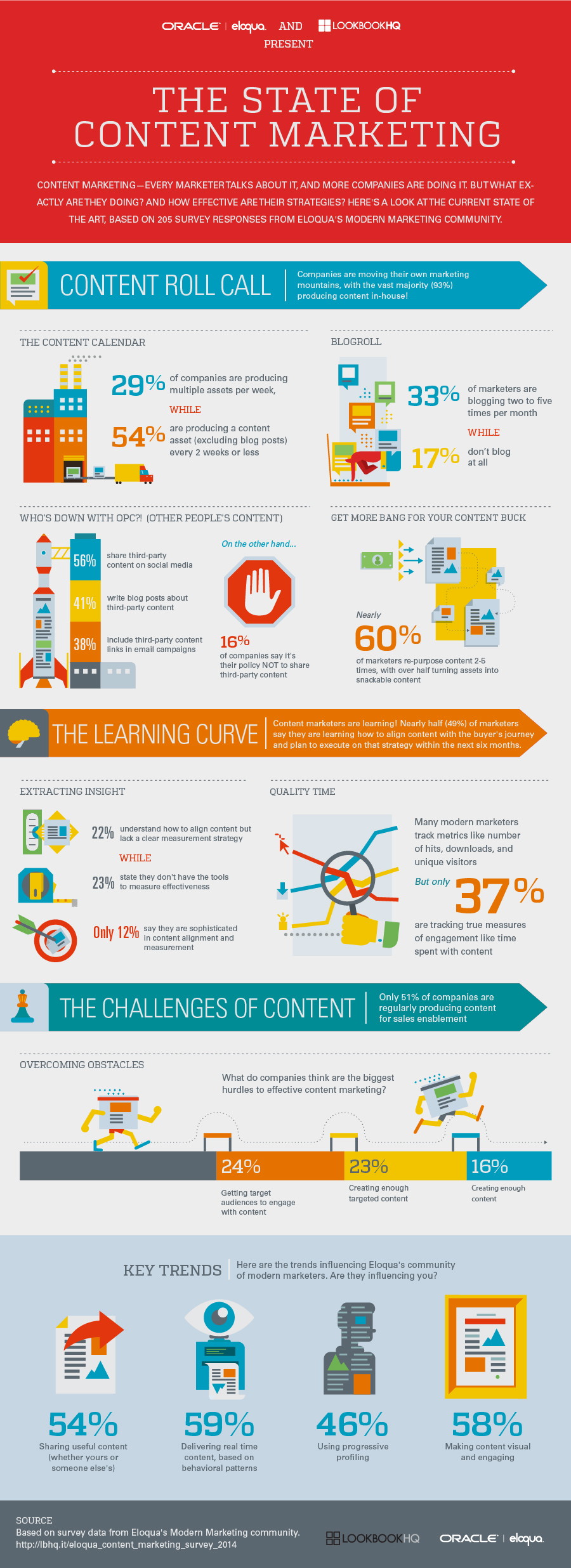
Source: www.eloqua.com
About The Author