Artificial intelligence may conjure images of chatbots, autonomous cars, humanoid robots, and powerful systems generating text or images in seconds.
But some of the most practical applications of AI are far less dramatic.
They are already sitting in our kitchens, laundry rooms, and living spaces.
Your washing machine can determine how aggressively it should clean a load. Your refrigerator may recognize some of the food placed inside it. Your air-conditioning system can adjust itself based on patterns in how a home is used. A robot vacuum can identify obstacles, map rooms, and decide where it should clean next.
None of these machines need to hold a conversation with you.
They simply need to make better decisions.
And that may be where one of the biggest shifts in artificial intelligence is quietly taking place: AI is moving from something we actively use to something that works in the background.
From programmable machines to adaptive machines
Household appliances have been automated for decades.
A traditional washing machine, for example, already performs a series of operations after someone selects a cycle. A rice cooker automatically regulates temperature. A refrigerator switches its compressor on and off to maintain a desired temperature.
Automation itself is not new.
What is changing is the ability of machines to respond to more information.
Instead of executing the exact same preset sequence every time, increasingly sophisticated appliances can use sensors, algorithms, connectivity, and, in some cases, machine learning to adjust what they do based on current conditions.
The difference sounds subtle, but it represents an important shift.
A conventional machine asks:
What program did the user select?
A smarter machine can ask:
What is happening right now, and what should I do about it?
That distinction is appearing across the home.
Your washing machine is starting to make decisions
Laundry provides one of the clearest examples.
For decades, washing clothes meant choosing settings such as normal, delicate, heavy-duty, cold, or hot. The user was essentially responsible for telling the machine what it was washing and how it should behave.
Newer washing machines are beginning to take over part of that decision-making.
Some machines can analyze factors such as load weight and fabric characteristics before adjusting the washing motion accordingly. LG, for example, says its AI Direct Drive technology can analyze characteristics such as the weight and softness or fabric type of a laundry load to determine an appropriate washing pattern.
The practical goal is not to make the washing machine feel futuristic.
It is to make laundry require fewer decisions.
Instead of asking a person to understand the ideal combination of water, movement, detergent, temperature, and cycle length for every load, the appliance increasingly determines some of those variables itself.
Over time, that could make the familiar row of buttons and cycle names less important.
The ideal washing machine interface might eventually be remarkably simple: put the clothes in and press start.
The intelligence happens elsewhere.
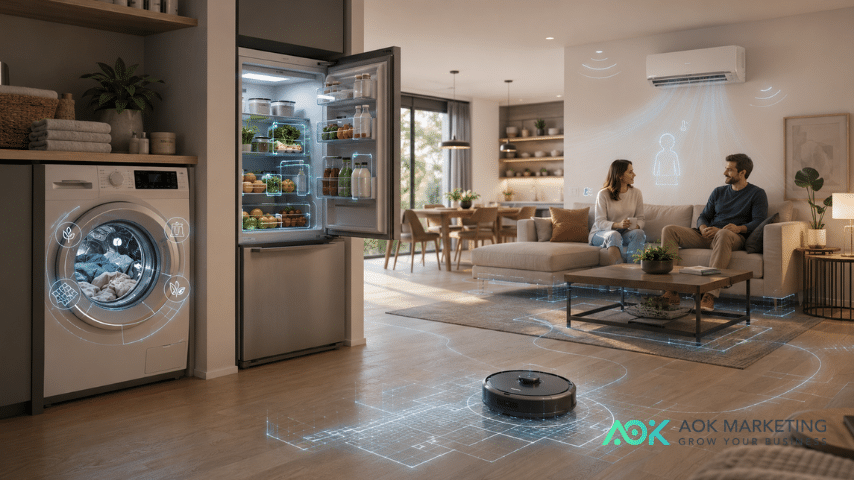
Refrigerators are becoming aware of what is inside them
The refrigerator has traditionally had one primary responsibility: keep things cold.
Smart refrigerators are expanding that job.
Internal cameras, connected sensors, food databases, and computer vision are creating appliances capable of maintaining some awareness of their contents.
Samsung’s current AI-enabled refrigerators, for instance, offer AI Vision features designed to recognize selected foods going into or out of the refrigerator. Some models can also help users record expiration dates and receive notifications as those dates approach.
This hints at a broader evolution of the appliance.
Imagine a refrigerator that doesn’t simply maintain temperature but understands household food patterns.
It could notice that certain ingredients are frequently purchased together. It could remind a household about food approaching its expiration date. It could help identify ingredients available for dinner or eventually adjust cooling behavior according to how and when different compartments are used.
Not every smart-fridge promise has reached that level yet, of course. Food recognition has limitations, households store thousands of differently packaged products, and manually entering information can undermine the convenience these systems are supposed to provide.
But the direction is clear.
The refrigerator is gradually evolving from a cold storage box into an information system for food.
That fits into the larger evolution of the connected smart home, where individual appliances become parts of a broader digital ecosystem rather than isolated machines.
Air conditioning that adapts instead of simply turning on
Heating and cooling represent another area where intelligent systems can make a noticeable difference.
Traditional thermostats maintain temperatures around a fixed setting.
Smart thermostats can incorporate schedules, occupancy patterns, weather conditions, remote controls, and behavioral data to manage heating and cooling more dynamically.
Some can learn when a household is typically occupied. Others can automatically reduce heating or cooling when nobody is home and bring the temperature back to a comfortable level before people return.
This is one area where smarter controls can have measurable energy benefits.
ENERGY STAR says certified smart thermostats must demonstrate energy savings based on real-world field data rather than simply offering internet connectivity or smartphone controls.
The important idea here is optimization.
A thermostat does not need to create content or answer complicated questions. It needs to make thousands of small decisions about when heating or cooling is necessary and when it isn’t.
Those small decisions can accumulate.
And as homes become more connected, air-conditioning systems could eventually coordinate with other information: room occupancy, electricity prices, weather forecasts, window sensors, solar generation, or household schedules.
The smartest machine in the house may therefore be the one you barely notice operating.
Robot vacuums show what happens when machines can perceive
Early robot vacuums were relatively straightforward.
They moved around until they hit something, changed direction, and continued cleaning.
Today’s more advanced models can build maps of rooms, identify surfaces, navigate between areas, recognize certain obstacles, and prioritize where cleaning should happen.
That makes robot vacuums a useful illustration of how AI changes ordinary machines.
Give a machine better perception and it can make better decisions.
Computer vision and object-recognition technologies can help a vacuum distinguish between an open floor and an obstacle such as furniture, cables, or other objects.
Samsung, for example, has demonstrated robot-vacuum systems using AI-based object recognition to identify different items in the home and determine whether to clean around or avoid them.
The vacuum’s basic purpose has not changed.
It still cleans floors.
What has changed is how much human supervision it needs to accomplish that job.
That is arguably one of the most important metrics for household AI: not how impressive the technology sounds, but how much friction it removes from ordinary life.
The most useful AI may be invisible
The current AI conversation is dominated by systems that interact directly with people.
We type prompts.
We ask questions.
We generate images.
We speak to assistants.
But household appliances represent a different kind of AI interface.
There may be no interface at all.
The machine senses something, interprets the information, makes an adjustment, and continues operating.
You may never know the decision happened.
That invisibility could become a defining characteristic of mature AI technology.
Consider previous technological revolutions.
Electric motors became embedded in everything from fans and refrigerators to toothbrushes. Microprocessors disappeared inside cars, microwaves, televisions, elevators, and children’s toys.
We rarely describe ourselves as “using a microprocessor” when we operate these products.
AI could follow the same trajectory.
Today, manufacturers advertise AI prominently because the technology is new and commercially attractive.
Eventually, consumers may stop caring whether a machine technically uses artificial intelligence.
They will simply expect the machine to behave intelligently.
Smarter homes could become more efficient homes
There is another reason this transition matters: efficiency.
Household appliances collectively consume significant amounts of electricity, which is why governments and organizations have spent decades developing efficiency standards and encouraging consumers to choose more efficient equipment.
The U.S. Department of Energy notes that appliance and equipment standards cover products representing a very large share of household energy use.
AI and adaptive controls introduce another potential layer of efficiency.
Instead of improving only the physical components of a machine—better motors, insulation, compressors, or heating elements—manufacturers can also improve when and how those components operate.
A washing machine can choose a cycle appropriate for the actual load rather than running unnecessarily long.
An air conditioner can reduce cooling in an empty house.
A refrigerator can dynamically manage cooling.
A dishwasher might adjust water and cycle length according to how dirty the dishes are.
A future home energy system could even coordinate these machines.
Imagine solar panels producing excess electricity during the afternoon. Instead of sending all of it back to the grid, a home management system could decide that it is an ideal moment to run the dishwasher, charge a vehicle, cool the house slightly ahead of the evening, or heat water.
Each appliance becomes part of a larger optimization problem.
This idea is explored further in our guide to how AI can improve household energy efficiency.
But does every appliance actually need AI?
There is an important caveat to the excitement.
Not everything labeled “AI” necessarily represents meaningful artificial intelligence.
As the term becomes commercially valuable, manufacturers have an incentive to attach it to increasingly ordinary features.
A sensor adjusting a machine’s cycle does not automatically mean sophisticated machine learning is involved. Some functions marketed as AI may simply be advanced automation, rules-based algorithms, fuzzy logic, or combinations of technologies that have existed for years.
That doesn’t make the feature useless.
It simply means consumers should ask a better question than, “Does this appliance have AI?”
Ask:
“What does the AI actually do for me?”
Does it save energy?
Does it reduce water consumption?
Does it protect clothes?
Does it prevent food waste?
Does it require less supervision?
Does it make the appliance easier to use?
If the answer is no, the AI label may be doing more work than the technology.

The trade-off: smarter machines collect more information
Greater intelligence can also require greater amounts of data.
An ordinary refrigerator does not need to know what food you buy.
An advanced smart refrigerator might.
A conventional thermostat does not need information about when people usually leave home.
A learning thermostat may benefit from it.
A basic vacuum cleaner does not need a map of your living room.
A robot vacuum does.
That creates legitimate questions about privacy, cybersecurity, software support, and ownership.
When appliances become connected computers, consumers are no longer buying purely mechanical products.
They may also be buying software platforms that depend on updates, cloud services, mobile apps, accounts, and manufacturer support.
That changes expectations around the lifespan of household machines.
People might reasonably expect a refrigerator to last for many years. But will its connected features receive security updates for just as long?
These questions will become increasingly important as intelligence migrates into more everyday objects.
The real AI revolution might look surprisingly ordinary
There may never be a dramatic moment when homes suddenly become “AI homes.”
The change is more likely to happen appliance by appliance.
One washing machine senses fabric.
One refrigerator recognizes groceries.
One air conditioner learns a schedule.
One vacuum maps a house.
Then those machines start sharing information.
Eventually, the house itself begins responding to patterns without requiring constant instructions from the people living inside it.
And that is what makes the quiet AI revolution interesting.
The most transformative technology does not always announce itself.
Sometimes it simply removes a small inconvenience.
Then another.
And another.
Until behavior that once seemed remarkable becomes something we expect from every machine we own.
The future of household AI may therefore be less about talking refrigerators or humanoid robot butlers and more about appliances that quietly understand what needs to happen next.
The washing machine chooses the right cycle.
The refrigerator keeps better track of food.
The air conditioner uses less energy when nobody is home.
The vacuum avoids the cable you forgot to pick up.
No prompts.
No complicated commands.
No science-fiction spectacle.
Just ordinary machines becoming slightly better at their jobs—and gradually changing what we expect the word “smart” to mean.
About The Author