Attribution, Opt-Outs, and Brand Risk: The Part of AI Search Nobody Puts on the Slide
AI search isn’t only a distribution channel. It’s also a repackaging layer.
And whenever your content is repackaged, two questions show up: (1) Do you get attribution? (2) Do you still control the message?
The real risk isn’t “losing clicks.” It’s losing accuracy.
Fewer clicks hurts. But incorrect summaries hurt in a quieter, longer way: users act on the wrong information, your brand gets associated with claims you didn’t make, and support tickets become your new content strategy.
See Also: AIO operating system guide
Three categories of AI visibility risk
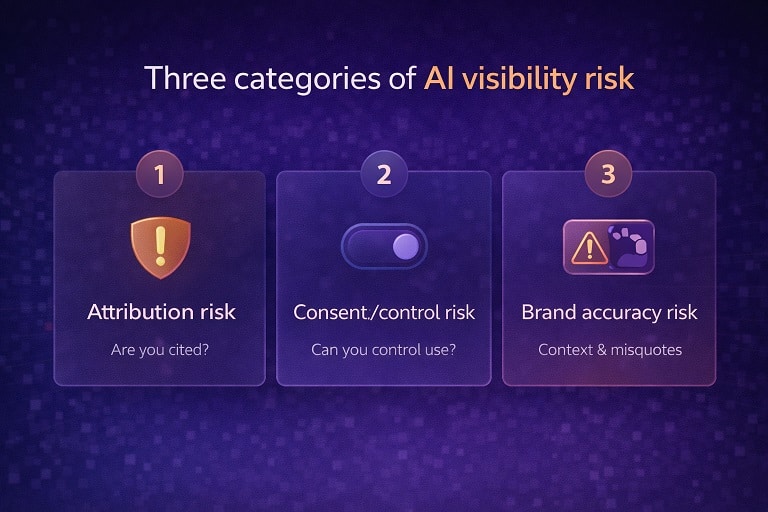
1) Attribution risk
- You’re used as a source but not clearly credited.
- Your ideas spread without the link that turns exposure into business value.
2) Consent/control risk
- Your content is summarized in contexts you didn’t intend.
- You want limits on how content is reused, but your settings/controls aren’t clear.
3) Brand accuracy risk
- Incorrect descriptions of your offerings, pricing, geography, or policies.
- Competitors’ positioning bleeds into your brand profile (“you’re basically the same as…”).
- Outdated facts persist because they were repeated elsewhere.
Practical controls (non-legal, operational guidance)
You can’t control every summary, but you can reduce risk and increase accuracy with operational moves:
- Publish canonical facts in obvious places (About, product pages, press kit).
- Add sources and dates to time-sensitive claims (GEO reduces repeatability risk).
- Use clear disclaimers for sensitive topics (health/finance/legal).
- Monitor AI summaries and assistants for incorrect claims and document examples.
- Create a correction workflow: identify → publish a clearer source → update listings → seek reputable references that echo the correction.
See Also: GEO citable content guide
When to consider limiting exposure
Some businesses want maximum reach. Others want maximum control. High-stakes categories (medical, financial, legal, safety) often lean toward tighter controls and stronger review processes.
- If a wrong answer can cause harm, prioritize accuracy and governance over pure visibility.
- If your content is proprietary (research, paywalled analysis), weigh the tradeoff between reach and leakage.
- If attribution is consistently missing, focus on building citable assets and off-site validation.
AIO governance: the unsexy layer that saves you later

AIO isn’t only “how to get found.” It’s also “how to manage exposure, attribution, and brand risk.”
- Assign ownership (who is responsible for brand facts and corrections?).
- Keep a Brand Factbook and update it with dates.
- Maintain a list of “high-risk claims” that require review before publishing.
- Run quarterly audits of top AI answers in your category.
See Also: SEO vs GEO vs AEO vs AIO: Same Mission, Different Scoreboards
Risk & control checklist
- ✅ Canonical facts are published and consistent across site + profiles
- ✅ Time-sensitive claims include dates and sources
- ✅ High-stakes content has clear disclaimers and review steps
- ✅ Monthly monitoring catches inaccuracies early
- ✅ Correction workflow exists (and someone owns it)
FAQ
Can I fully control whether AI uses my content?
Control varies by platform and settings, and it can change. Operationally, your best leverage is clarity (canonical sources), consistency, and reputable third‑party validation.
What’s the best defense against misrepresentation?
Consistency + citations + monitoring. If the web tells one clean story about you, systems repeat it.
Should I worry if I’m not in a high-stakes category?
Yes, but for different reasons. Even in low-stakes niches, incorrect pricing, features, or positioning can quietly reduce conversions.
Suggested sources (for citations)
About The Author