The Marketer’s Map to Showing Up in AI
What prompts you need to win, where the answer comes from, and how to make sure your brand is the one AI recommends.
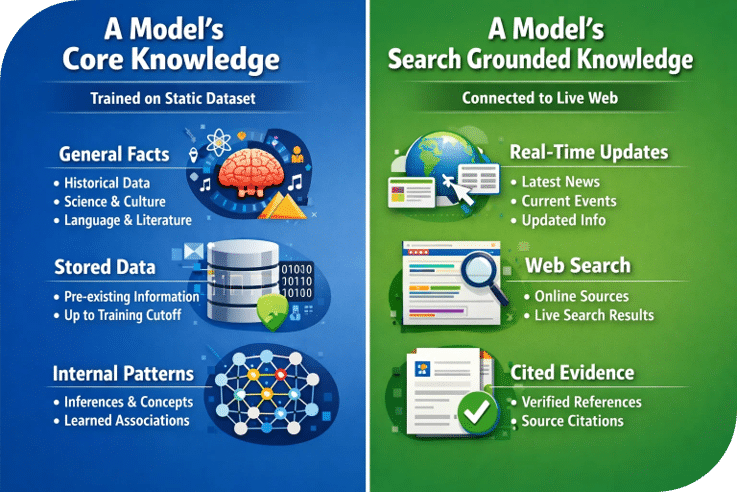
Figure 1. Two ways AI answers questions: core (trained) knowledge vs. search-grounded (live web) knowledge.
If you’re a marketer, you don’t just want traffic. You want to be the answer.
Not in the feel-good brand awareness way. In the very practical, money-on-the-table way:
- • When someone asks an AI “What’s the best option for X?”, your name shows up.
- • When they ask “Alternatives to Y?”, you’re in the shortlist.
- • When they ask “How do I solve Z?”, your framework is the one it repeats.
Here’s the catch: AI doesn’t answer from one place. It answers from two. And if you don’t know which one your target prompt is pulling from, you’ll build the wrong assets, on the wrong timelines, with the wrong expectations.
Step 1: Understand the two “engines” behind AI answers
When a model responds, it’s usually drawing from one (or both) of these buckets:
A) Core knowledge (trained on a static dataset)
- • The model’s built-in memory: concepts, associations, and general facts learned during training.
- • It stops at a training cutoff. Anything after that may be missing or fuzzy.
- • If your brand isn’t widely mentioned in what the model saw, it may not “know” you, or it may know you poorly.
B) Search-grounded knowledge (connected to the live web)
- • This is when the assistant goes and checks the internet in real time.
- • It powers “what’s happening now?” questions: pricing, policies, releases, news.
- • This mode often comes with sources. If you want to show up here, you need to be citable.
Step 2: Build your “Prompt Portfolio” (the queries you want to own)
SEO taught marketers to think in keywords. AI taught everyone to think in questions.
Your job is to list the prompts that create revenue, then build assets that make your brand the safest, simplest answer.
- 1) Category + best: “Best CRM for real estate teams” / “Best payroll software for contractors”
- 2) Alternatives: “Alternatives to HubSpot” / “Competitors to [Brand]”
- 3) Comparison: “[You] vs [Competitor]” / “Which is better: X or Y for Z?”
- 4) Problem-solution how-to: “How do I reduce churn in SaaS?” / “How to track job costs accurately”
- 5) Use-case fit: “What should I use if I need [constraint]?” (budget, compliance, integrations, team size)
- 6) Pricing + specs: “How much does X cost?” / “Does X integrate with Y?”
- 7) Proof + trust: “Is X legit?” / “Reviews of X” / “Case studies for X in [industry]”
Step 3: Sort each prompt by where AI will pull the answer from
This is the part most marketers skip. They create content… without asking where the AI will look.
Simple rule: if the answer changes often, AI has to browse. If it doesn’t, AI can lean on core knowledge.
| Prompt to win | Example query | Likely source | Training data matters? | What to publish / improve |
| Definition / “what is” | “What is job costing?” | Core (often) | High | Definition page + glossary + FAQs; earn mentions that repeat the same wording |
| Category + best | “Best time tracking app for agencies” | Both | Medium | “Best for…” pages + real reviews; make sure pages are crawlable |
| Alternatives | “Alternatives to Asana” | Browse-heavy | Low | An “alternatives” page + listings on neutral directories/review sites |
| Comparison | “[You] vs [Competitor]” | Browse-heavy | Low/Med | A fair comparison page with tables, use-cases, proof; keep it updated |
| Pricing / specs | “How much does [Brand] cost?” | Browse (fresh) | Low | Canonical pricing/specs page; clear “last updated”; don’t hide key info behind scripts |
| Integrations | “Does [Tool] integrate with Slack?” | Browse (fresh) | Low | Integration pages that match the question; docs + changelog; status easy to confirm |
| Trust / legitimacy | “Is [Brand] legit?” | Both | Medium | Case studies + policies + credible 3rd-party coverage + consistent brand/entity info |
| News / policy changes | “What changed in Google’s policy this week?” | Browse (required) | N/A | Timely explainers that others can quote and link to |
Step 4: The “Browse or Core?” decision tree (use this before you write anything)
When you’re trying to show up in AI, you’re really trying to show up in one of two pipelines.
So before you create an asset, ask the same question the assistant should ask:
Does this query depend on information that changes? If yes, your content needs to win in search-grounded mode. If no, you have a shot at being repeated as “core knowledge.”
- • If the question is fast-changing, niche, easily misremembered, or “latest/today”… Assume AI will browse. Build an asset that’s easy to cite and verify.
- • If the user wants a rewrite, translation, or summary of text they already have… Browsing won’t help. The value is clarity and structure, not freshness.
- • If the user explicitly says “don’t browse”… Only core knowledge applies. That’s when brand/entity signals matter most.
Step 5: How to become “core knowledge” (aka: build the entity)
You can’t force your way into a model’s training data. But you can do the marketer version of stacking the deck: make it easy for the internet to describe you the same way, everywhere.
Core-knowledge plays:
- One-sentence definition (what you are + who you’re for) repeated across your site and profiles.
- An About page that reads like an encyclopedia entry: clear, factual, consistent.
- Structured data (Organization/Product/FAQ schema where appropriate).
- Third-party mentions that match your positioning (partners, directories, press).
- A glossary/library of category definitions (the stuff people ask AIs all day).
Step 6: How to win search-grounded answers (become the cited source)
When AI browses, it behaves like a speed-researcher. It grabs what’s crawlable, clear, recent, and reputable.
So your content can’t just exist. It has to be a good “quote.”
- • Use headings that match prompts (not clever headlines).
- • Put the answer high on the page (summary first, detail later).
- • Use tables for comparisons, lists for steps, and FAQs for objections.
- • Add “last updated” dates on time-sensitive pages (pricing, policies, specs).
- • Keep key info accessible (avoid hiding the answer behind widgets or gated PDFs).
Citation magnets (assets others want to reference):
- • Original data (benchmarks, surveys, industry stats)
- • Templates + calculators (linkable utility)
- • Neutral explainers (“what changed and what it means”)
- • Visuals that clarify (diagrams, checklists, examples)
Step 7: Don’t ignore images (sometimes AI answers with visuals)
If your category is visual (products, places, before/after), images aren’t decoration they’re evidence. Treat them like content assets: name them well, describe them well, connect them to the page topic.
- Use original images where possible (unique beats generic).
- Write alt text like a marketer who wants to rank: what it is and why it matters.
- Include images on comparison and how-to pages (clarity increases “quotability”).
Step 8: Test like a marketer (build an AI visibility scorecard)
Run your Prompt Portfolio across a few assistants, or do it all in one place at LLMtel.com. For each prompt, record:
- • Do you appear?
- • Are you cited (when browsing is on)?
- • Who is cited instead?
- • What pages are being used to describe you?
That becomes your roadmap. Not vibes. Evidence.
Copy/paste worksheet:
| Prompt | Assistant/model | Browsing on/off | Did we show up? | Who was cited? | Next action |
Not sure what to do next? Check out our AI Awareness Framework.
The Takeaway:
Stop asking, “How do I rank in AI?” Start asking:
- 1) What prompt do I want to be the answer for?
- 2) Does that prompt pull from core knowledge, the live web, or both?
- 3) What asset would make my brand the easiest, safest thing to repeat or cite?
Do that consistently and you won’t just show up. You’ll start owning the conversation.
About The Author