GEO vs SEO: what changes, what stays the same (and what is just hype)
If you have been in marketing for more than ten minutes, you have seen this movie: someone takes a familiar acronym, adds one new letter, and sells it like it was discovered on a mountain.

That is how a lot of people are treating GEO.
So here is the clean answer you can use with clients, your boss, or procurement:
GEO is SEO plus the work required to earn and protect mentions and citations in AI-generated answers.
If SEO is ‘get found and clicked,’ GEO is ‘get retrieved, quoted, and trusted – even when no one clicks.’
What stays the same?
If your SEO foundation is broken, your GEO plan is basically a PowerPoint with feelings.
These still do most of the heavy lifting:
- Crawlability and indexation (if Google cannot reliably fetch and index your pages, you do not get a seat at the table).
- Information architecture (clear navigation, internal links that make important pages easy to find).
- Content quality (helpful, specific, accurate, and written for humans first).
- Authority signals (credible links, mentions, and reviews where relevant).
- Speed and UX basics (do not sabotage your own conversions).
See Also: On-site GEO: Make Pages Crawlable, Clear, and Quotable
What changes in a generative world
AI answers change the game in three ways:
1) The engine is not only ranking pages – it is assembling answers
Traditional search rewards the best match for a query. Generative answers often pull from multiple sources and stitch the response together. That makes your ‘quotability’ a real asset.
- You need clean, extractable sections (definitions, steps, pros/cons, boundaries).
- You need pages that answer the follow-up questions, not just the headline keyword.
- You need content that is easy to cite without rewriting the whole page.
2) Mentions and citations become a KPI (not a vanity metric)
When an AI overview or assistant gives the full answer, the click can disappear. That does not mean the brand impact disappears.
Your new outcomes look like this:
- You are named as a recommended option (‘X is a good choice for…’).
- Your page is cited/linked as a source.
- You are compared fairly (and not mischaracterized).
- Competitors stop owning the narrative for your category.
3) Entity clarity and narrative control matter more
AI systems are constantly trying to answer: ‘Who are you, and why should anyone trust you?’
If your website is vague, inconsistent, or missing proof, the model fills in the gaps. Sometimes incorrectly.
See Also: Entity Clarity for GEO: Make AI Recognize Your Brand
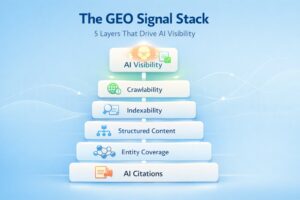
The five-part GEO stack (simple and actionable)
When someone asks what GEO includes, you can break it into five buckets:
- SEO fundamentals (crawl, index, performance, structure).
- Entity clarity (make it obvious who you are, what you do, and who you serve).
- Citation readiness (make pages easy to extract and quote).
- Off-site authority (third-party echoes that confirm your story).
- Monitoring and iteration (because the outputs change).
How to explain GEO to a stakeholder in 20 seconds?
Use this if you need a one-liner for a meeting:
SEO gets you ranked.
GEO gets you referenced.
We still do the SEO basics. GEO adds the work that makes AI systems confident enough to mention and cite us.
Red flags when you are hiring a done-for-you GEO provider
GEO is new enough that there is plenty of nonsense in the market. Watch for these:
- Guarantees like ‘We will get you into ChatGPT responses’ (no one controls that).
- A plan that is only content production (without technical fixes, entity clarity, or off-site authority).
- No baseline prompt set, no visibility scan, no reporting framework.
- They cannot tell you which pages are being cited today, or why.
- They talk about ‘optimizing prompts’ more than they talk about optimizing your site and brand footprint.
Quick checklist: are you ready for GEO?
If you can answer ‘yes’ to most of these, you are ready to invest:
- Your site is indexable and technically stable.
- You have clear ‘source of truth’ pages (About, Services, Pricing/Process).
- You can publish updates at least 2-4 times per month.
- You have someone who can approve content fast (GEO dies in approval purgatory).
- You are willing to measure mentions/citations, not just clicks.
If you cannot, start there. GEO does not replace the basics. It punishes you for skipping them.
Related reading
- Main related article: Done-for-you GEO services: deliverables, timeline, reporting.
- Next article: Setup and baselining (building a prompt set you can actually track).
About The Author