GEO as an Add-On to SEO: What You Really Get for +$1.5k-$6k/Month
A lot of teams are asking the same question right now:
“Do we need a whole new GEO program… or can we just bolt it onto our existing SEO retainer?”
Answer: sometimes yes. Sometimes absolutely not.
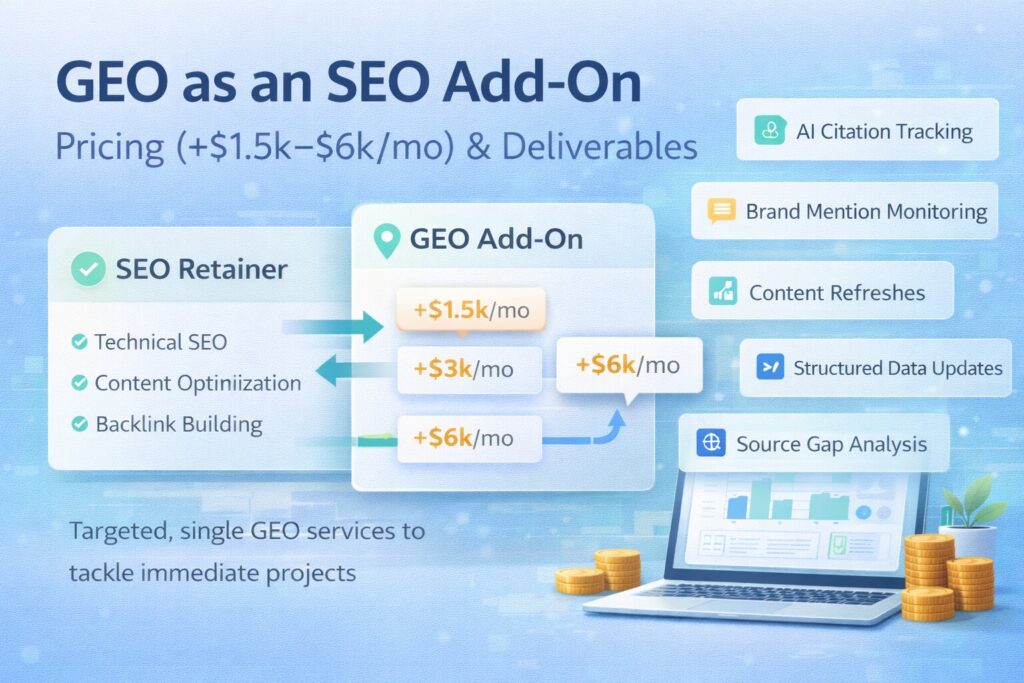
From the pricing benchmark in the pillar article, common add-on bands look like this:
- SMB add-on: +$1,500-$3,000/month (≈ +$9k-$18k over 6 months).
- Enterprise add-on: +$4,000-$6,000/month (≈ +$24k-$36k over 6 months).
For the full 6-month pricing ranges (including standalone programs), see: “GEO Pricing Benchmark: 6-Month GEO Costs (SMB vs Enterprise).”
What a GEO add-on should actually include?
If the add-on is real, it’s not just “we’ll write a few FAQs.” It should add capabilities you don’t currently have.
Core add-on deliverables (the non-negotiables)
- AI answer monitoring: a recurring QA process for your key questions (what’s being said, who is cited, what changed).
- Entity accuracy work: tightening brand descriptors, org/entity markup, ‘sameAs’ signals, and correcting wrong web facts.
- Answer formatting upgrades: restructuring priority pages so they’re easier to extract and cite (definitions, steps, comparisons).
- Citation/trust plan: a short list of credible places you need to be referenced, plus a plan to earn those references.
- Measurement: a dashboard that connects AI visibility signals to real business outcomes.
Optional (but common) add-on components
- Schema implementation support beyond basic SEO markup.
- Content refresh cycles for top-performing pages (because staleness is a silent killer).
- One linkable asset per quarter (benchmark, data study, original framework) to earn citations.
- Internal enablement (templates, briefs, publishing checklists) so your team can keep shipping.
When a GEO add-on is enough?
An add-on works when the foundation is already solid.
- Your site is technically healthy (indexing, speed, templates, internal linking).
- You already publish consistently (even if it’s not ‘AI-optimized’ yet).
- Your brand/entity info is mostly accurate across the web.
- You mainly need restructuring + monitoring + a light trust plan.
In other words: you’re already running. GEO is just tightening your form and adding a pace plan.
When a GEO add-on is NOT enough?
If any of these are true, a bolt-on will feel like pushing a shopping cart with one bad wheel:
- Your site needs major technical work (templates, architecture, migrations, indexing cleanup).
- You have multiple brands/regions and no governance (publishing is slow and inconsistent).
- You’re not being cited anywhere credible in your category (trust deficit).
- AI systems repeatedly describe you incorrectly (entity problems).
- You have no content velocity and no SME plan (nothing to ship).
See Also: GEO Tooling Costs: What to Track in 6 Months (Without Tool Bloat)
How to run GEO alongside an existing SEO agency (without turf wars)?
If you have two partners, define the lanes.
Here’s a clean division of responsibilities that works:
SEO agency typically owns:
- Technical SEO maintenance (crawl/index, sitemaps, core on-page).
- Standard content optimization (titles, internal links, search intent).
- Reporting for organic search performance.
GEO layer (or GEO partner) typically owns:
- AI answer QA and prompt-based monitoring.
- Entity credibility and ‘source of truth’ work.
- Structured answer formatting (definitions, comparisons, FAQs).
- Citation strategy and linkable asset planning.
- AI visibility reporting and corrections workflow.
The most important line in the sand
One team owns the roadmap. Otherwise, you’ll get two backlogs and zero shipping.
Add-on budgeting tip: tie it to outputs
If you’re paying an add-on fee, the contract should state what you get monthly.
- Number of priority pages restructured/updated per month.
- Number of new answer pages per month (if any).
- Number of QA checks/prompts monitored (and how often).
- Number of citation targets pursued (and what counts as ‘done’).
A GEO add-on should feel like a production line, not a mystery box.
See Also: Enterprise GEO Budgeting: The Two-Lane Model
About The Author