Crawled Doesn’t Mean Indexed
You can get crawled all day long and still not show up anywhere that matters. That’s not a cosmic injustice. That’s indexability.
Indexing is where engines decide what your page is about, whether it’s worth storing, and which version is the “real one.” If you want to be eligible for AI answers, you need your best version indexed, not one of the weird duplicates your CMS invents at 2 a.m.
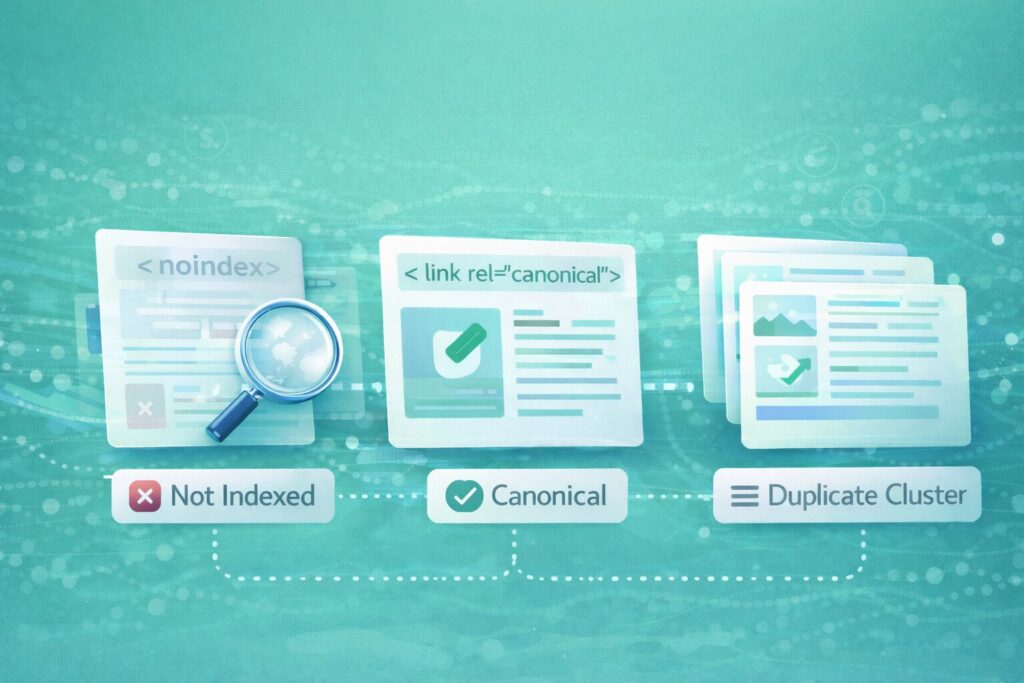
The three most common indexability failures
1) Accidental noindex (aka: the silent killer)
Noindex can come from a meta tag, an HTTP header, or a CMS setting that was meant for staging and “somehow” shipped to production.
- Meta robots tag in the <head>: noindex, nofollow, nosnippet, max-snippet.
- X-Robots-Tag HTTP header (often added by proxies, CDNs, or security layers).
- CMS defaults or plugins that mark whole content types as noindex.
- Templates that vary by language/region and accidentally noindex one variant.
| <!– Meta tag example –> <meta name=”robots” content=”index,follow,max-snippet:-1″> # HTTP header example X-Robots-Tag: noindex |
2) Canonicals that point to the wrong place
Canonical tags are suggestions, not commandments, but engines take them seriously when the evidence aligns. If you canonical everything to the homepage, congrats: you just told the index your entire site is one page.
Healthy canonical behavior:
- Self-referential canonicals on clean URLs (the page points to itself).
- Parameter variants canonicalize back to the clean version.
- HTTP/HTTPS and www/non-www are consolidated with redirects + consistent canonicals.
- Paginated series use consistent strategy (don’t canonical every page to page 1 unless that’s truly the same content).
Canonical red flags:
- Canonical points to a different topic or category (wrong URL mapping).
- Canonical points to a 404, redirect chain, or blocked URL.
- Canonicals vary across templates for the same URL (inconsistent rendering).
- Localized pages all canonicalize to the same default language page.
3) Duplicate clusters you didn’t mean to create
Engines cluster duplicates. Your job is to make the cluster obvious and the winner undeniable.
- HTTP vs HTTPS, www vs non-www, trailing slash variants.
- UTM and tracking parameters that create “new” URLs.
- Printer-friendly versions and “share” versions.
- Sort/filter parameters that don’t change the core content.
How to tame duplicates (practical playbook):
- Pick the canonical format (HTTPS, preferred host, trailing slash policy).
- 301 redirect everything else to the canonical.
- Use consistent canonicals on-page (self-referential for the canonical URL).
- Noindex true duplicates that must exist (printer pages, internal search results).
- Stop linking internally to non-canonical variants.
Indexability debugging: a simple workflow that actually works
- Check the HTTP status: 200 is the goal. Redirect chains are friction. 404/410 is a hard no.
- Check indexing directives: meta robots + X-Robots-Tag.
- Check canonical: does it point where you think it points?
- Check content parity: is the important content present in rendered HTML, not just after clicks?
- Check internal links: are you consistently linking to the canonical URL?
The ‘AI era’ twist: index the supporting pages, not just the hero page
AI-style retrieval often fans out across subtopics. That means the pages you used to ignore, glossaries, supporting guides, implementation steps, become the pages engines cite.
- Make supporting pages indexable (don’t accidentally noindex your own help content).
- Keep the ‘definition’ and ‘how-to’ pages clean, canonical, and text-forward.
- Link from the pillar to the cluster pages and back (so crawlers and humans can follow the trail).
See Also: Measuring AI Visibility: Crawls, Indexing & AI Citations
Indexability checklist (print this, tape it to someone’s monitor)
- No accidental noindex in meta tags or HTTP headers.
- Canonicals are self-referential on canonical URLs and point to valid, indexable pages.
- Duplicates are consolidated (redirects + canonicals + internal link consistency).
- Important content is present as text and visible in rendered output.
- Thin/empty pages aren’t being mass-produced by your CMS.
Next up: if your pages are indexed but feel ‘stale,’ it’s time to talk freshness and fast discovery (hello, IndexNow).
Further reading (links referenced in the pillar):
- Google Search Central: How Search works
- Google Search Central: AI features and your website
About The Author