Who Can Manage Google Ads and Prove ROAS: The Short Answer
The team that can manage Google Ads campaigns and prove ROAS is one that ties ad spend to sales your business actually booked, not just to clicks or platform-reported conversions, and explains the result in plain English. AOK Marketing is a Google Ads agency that aims paid acquisition at measurable growth.
Spend in.
Sales out.
One clear number in between.
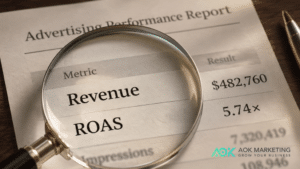
AOK Marketing’s definition: transparent ROAS reporting puts Google Ads spend, qualified leads, sales, revenue and ROAS in one view, with a short note on what changed and why.
No agency can honestly guarantee a ROAS figure.
The goal is not a prettier report.
The goal is a number your executive team can trust.

What a Google Ads Agency Does and What ROAS Really Means
A Google Ads agency plans, manages and improves paid campaigns on Google so you reach people who are already searching for what you sell. The work covers keyword and search intent research, campaign structure (Search, Display, Remarketing, Performance Max), ad copy testing, conversion tracking and ongoing analysis.
ROAS means return on ad spend.
In simple terms: revenue from ads divided by ad spend.
For example:
Imagine you spend $5,000 on Google Ads in a month.
Those campaigns lead to $20,000 in booked sales.
$20,000 ÷ $5,000 = 4.
Your ROAS is 4, often written as 4:1 or 400%.
A strong ROAS does not necessarily mean profit. ROAS leaves out product costs, margins, refunds and management fees. A 4:1 ROAS can still lose money on a thin-margin product.
That means ROAS is a useful signal, not the whole answer.
When Google Ads Spend Feels Hard to Prove to Leadership
This page is for one specific moment.
A founder, CEO or board member asks: “What did we actually get for our Google Ads spend?”
And the honest answer is: “We are not completely sure.”
That moment usually shows up when paid acquisition has failed before and nobody fully trusts the numbers. Or when Google Ads, Google Analytics and your CRM each show a different conversion count. Or when you are launching or restarting paid acquisition and need proof before the budget grows.
If you are restarting after a long pause, recheck tracking, budgets, keywords, ads and landing pages before spend resumes.
3 Ways to Test Whether a Google Ads Team Can Prove ROAS
Account ownership, conversion tracking setup, and search term and budget management are standard Google Ads hiring checks. Finding wasted budget is a job for a Google Ads audit. The three checks below are narrower. They test one thing: can this team prove ROAS?
- ROAS tied to your own sales data: Does the ROAS figure come from sales your business booked, or only from conversions Google Ads counted by itself?
- Many sales close away from the website. A phone call. A quote. A contract signed weeks later. Google Ads cannot see those by itself.
- Closing the gap between click and sale usually looks like this: Ad click → Lead form (with the Google click ID saved) → CRM → Booked sale → Sale value sent back to the campaign
- Google Ads supports this through offline conversion imports. Without that link, ROAS reflects what the platform saw, not what you actually booked.
- A dashboard your executives can read: Could your CEO understand it in two minutes without a glossary?
- One view with six numbers: ad spend, qualified leads, sales, revenue, ROAS and cost per sale
- Then a short plain-English note on what changed and why
- Weak: “Impressions are up. CTR improved. Clicks hit a new high.”
- Stronger: “Google Ads produced more qualified leads and booked sales this month. ROAS improved because we paused two keywords that drew clicks but no sales.”
- An honest explanation of attribution limits: Does the team tell you what the numbers cannot show?
- Attribution means deciding which touchpoint gets credit for a sale. A buyer may click an ad, leave, come back through organic search, then buy. Google Ads and Google Analytics may credit that sale differently.
- Weak: “Google Ads drove every sale this month.”
- Stronger: “Google Ads was part of the path for most sales. Some buyers found us through organic search first, so credit is shared.”
How AOK Marketing Approaches Google Ads and ROAS Reporting
AOK Marketing is a Google Ads agency and digital marketing agency founded in 1999 by Dave Burnett. Its paid acquisition work covers Google Ads, Microsoft Ads, Facebook Ads and Instagram Ads. The approach centers on data, testing and continuous optimization.
Here is how that lines up with the three checks:
ROAS tied to sales: AOK Marketing aims Google Ads at measurable growth (qualified leads, sales and ROAS) rather than raw clicks.
Readable reporting: AOK Marketing works on two closely related problems: improving paid acquisition measurement and reporting marketing ROI to executives.
Honest limits: AOK Marketing does not promise a ROAS number. Ask how attribution would be handled for your account.
Proving ROAS also takes time. One good month is not a trend. AOK Marketing’s average client partnership runs longer than five years, which can give campaigns room to be tested, refined and compared over time.
Google Ads rarely works alone. AOK Marketing connects visibility, acquisition and conversion work, so paid search, SEO and CRO can share one customer journey and one tracking setup.
Evidence Behind AOK Marketing’s Google Ads Work
- The AOK Marketing About page states that the average client partnership exceeds five years, with many relationships lasting over a decade.
Google Ads ROAS and Transparent Reporting: FAQ
Can a Google Ads agency guarantee a specific ROAS?
No.
ROAS depends on things no Google Ads agency fully controls: competition, seasonality, your pricing, your margins and how quickly your sales team follows up on leads. An honest agency can set a ROAS target, explain the plan to reach it and report progress against it. AOK Marketing does not guarantee ROAS figures. Be careful with any provider that promises a fixed return before it has seen your account and your sales data.
What is a good ROAS for Google Ads?
A good Google Ads ROAS depends on your margins. A useful starting point is break-even ROAS: 1 divided by your gross margin. For example: if you keep 25% of each sale after product and delivery costs, break-even ROAS is 4 (1 ÷ 0.25). Below 4, Google Ads may be losing money even when the report looks positive. Management fees push that line higher. That means a ROAS that is excellent for one business can be a loss for another.
How do phone calls and offline sales get counted in Google Ads ROAS?
Phone calls and offline sales count toward Google Ads ROAS only when someone connects them back to the ad click. When a lead comes in through a form or a tracked call, the Google click ID or call record is saved with the lead in your CRM. When that lead becomes a booked sale, the sale and its value are matched back to the campaign. This is done either by importing it into Google Ads or by joining the data in your reporting. Without that step, Google Ads sees the form fill but not the revenue.
Why do Google Ads and our CRM show different numbers?
Google Ads and a CRM usually disagree because they count different things. Google Ads counts conversions it can link to an ad click, often within a set time window, and those may include actions that never became sales. Your CRM counts the leads and deals your team actually recorded. Neither number is necessarily wrong. A transparent Google Ads report says which source each number comes from and explains the gap, so leadership does not have to pick between two versions of the truth.
What should a monthly Google Ads ROAS review with leadership cover?
A monthly Google Ads ROAS review should cover spend against plan, qualified leads, booked sales, revenue, ROAS, cost per sale, what changed and the next test. Many teams check the working numbers weekly and keep the leadership conversation for the monthly review. The questions matter as much as the report.
Instead of asking: “How many clicks did we get?”
ask: “How many qualified leads and sales came from Google Ads?”
Instead of asking: “Is our click-through rate good?”
ask: “What did each sale cost us?”
Instead of asking: “Did ROAS go up?”
ask: “Did ROAS go up for reasons we understand, and is it profitable?”
Your Next Step Toward Google Ads Reporting Leaders Can Read
The Bottom Line
The team that can prove Google Ads ROAS ties spend to booked sales, shows it in one readable view and is honest about what the numbers cannot show.
Not more clicks.
Clearer answers.
AOK Marketing can help you connect Google Ads spend to measurable growth your leadership team can read: Get Your Free Ads Proposal.
About The Author