A sudden drop in website traffic can make any business owner nervous. When keyword rankings shift, organic leads slow down, or competitors begin appearing higher in search results, it is natural to question whether your SEO strategy is still working.
However, during a Google core update, making immediate changes to your website may do more harm than good.
The Google November 2026 core update serves as another reminder that search visibility is constantly evolving. Businesses that approach these changes with patience, reliable data, and a long-term strategy are better positioned to protect their organic performance than those that react to every ranking fluctuation.
So, what should businesses do when Google updates its algorithm, and which mistakes should they avoid?
What Is the Google November 2026 Core Update?
The November 2026 core update is a broad adjustment to Google’s search ranking systems designed to improve the relevance and quality of search results.
According to the Google Search Status Dashboard, the update began rolling out on November 10, 2026, and officially concluded on November 24, 2026. It applies globally across all languages.
Google Search Status Dashboard
Google also preannounced its December 2026 core update on November 24, outlining upcoming improvements to content relevance, complex search queries, and personalised search experiences. The next update is scheduled for release in December.
Google Search Status Dashboard
| Update milestone | Date |
|---|---|
| November core update begins | November 10, 2026 |
| November core update completes | November 24, 2026 |
| December core update preannounced | November 24, 2026 |
| Earliest recommended November post-update assessment | December 1, 2026 |
| December core update rollout | Scheduled for December 2026 |
For businesses, this creates an especially important period for monitoring search performance rather than rushing into unnecessary changes.
Why Do Google Rankings Fluctuate During Core Updates?
Google’s search results are not static. Search rankings evolve as new content becomes available, user expectations change, and Google’s systems improve their understanding of information.
During a core update, these adjustments can become more noticeable.
Businesses may experience:
-
Changes in keyword rankings.
-
Increases or decreases in organic website traffic.
-
Changes in search impressions and click-through rates.
-
Competitors gaining visibility for shared keywords.
-
Previously underperforming pages receiving more traffic.
-
Fluctuations in organic enquiries and conversions.
A ranking decline does not automatically mean your website has violated Google’s guidelines. It may simply mean that Google’s systems now consider other available content more relevant to particular searches.
The important distinction is whether your website is experiencing temporary volatility or a sustained decline that requires intervention.
What Businesses Should Do After Google’s November Core Update
1. Wait Before Making Major SEO Decisions
One of the biggest mistakes businesses make following an algorithm update is assuming that immediate ranking changes represent permanent outcomes.
Google’s official guidance on core updates recommends allowing at least seven days after the rollout ends before conducting a comparative performance assessment.
Google for Developers
With the November update completed on November 24, businesses should generally wait until at least December 1, 2026, before drawing conclusions.
Waiting does not mean ignoring your website. It means gathering enough evidence to make informed decisions.
2. Monitor Google Search Console
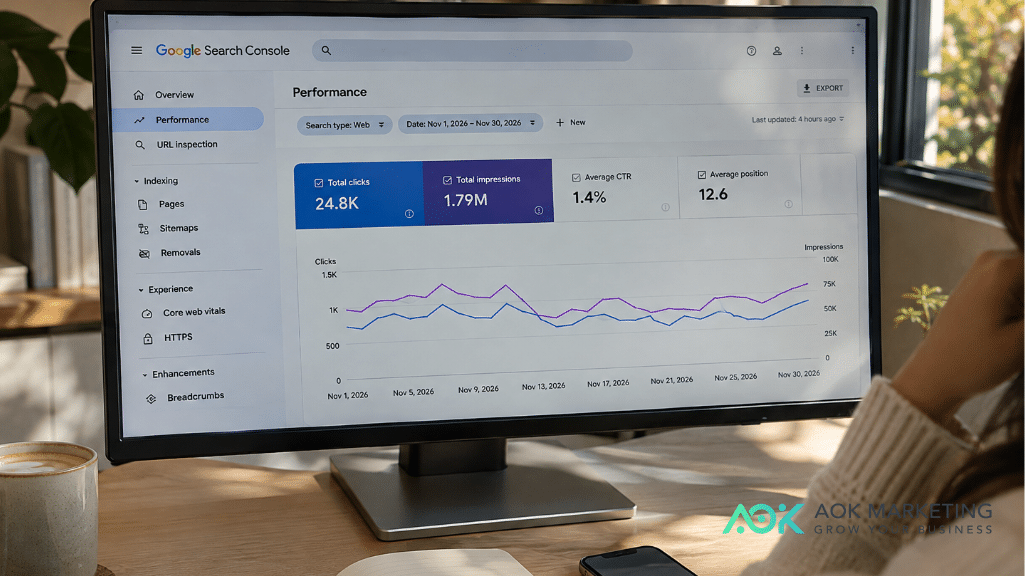
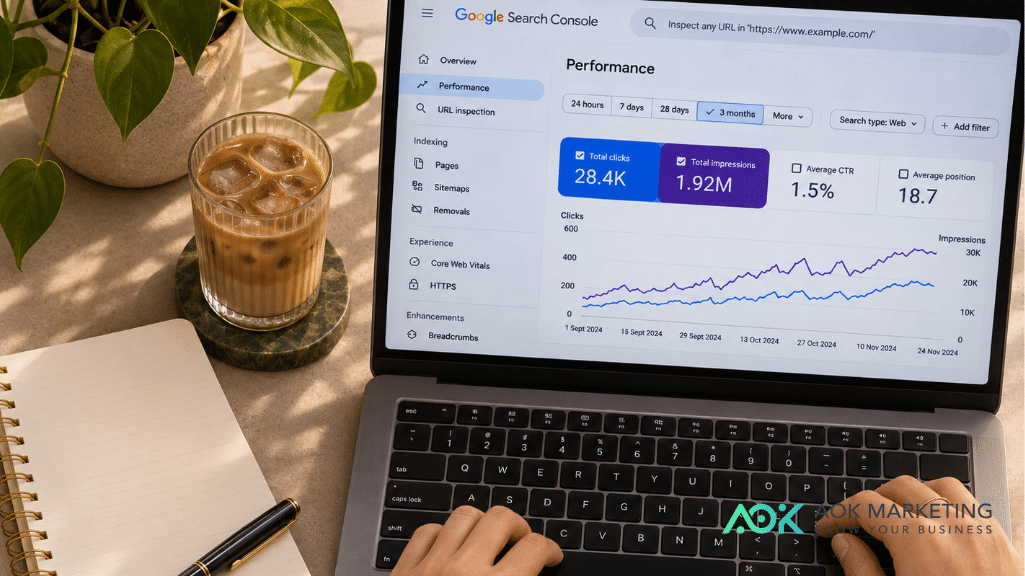
Google Search Console should be one of your primary resources for understanding how an algorithm update has affected your website.
Pay particular attention to:
-
Total organic clicks
-
Search impressions
-
Average keyword positions
-
Organic click-through rates
-
Individual page performance
-
High-value search queries
-
Page indexing status
Avoid relying exclusively on sitewide averages. Your homepage may remain stable while several important service pages experience declining visibility.
Understanding which pages have changed makes it easier to identify meaningful patterns.
3. Compare the Right Performance Periods
Comparing yesterday’s traffic with today’s traffic rarely provides enough information to evaluate an algorithm update.
Instead, establish a consistent comparison period.
| Comparison period | Recommended dates |
|---|---|
| Pre-update baseline | November 3–9, 2026 |
| Core update rollout | November 10–24, 2026 |
| Post-update monitoring | November 25–December 1, 2026 |
Once the post-update data becomes available, compare it against your pre-update baseline.
Businesses should also account for seasonal changes, Thanksgiving, Black Friday, holiday shopping behaviour, and shifts in consumer demand. These factors can influence organic performance independently of Google’s algorithm.
If the December update begins during your assessment period, document its timing and account for the additional uncertainty.
4. Prioritise Business-Critical Pages
Not every ranking change deserves the same level of attention.
A decline in traffic to an informational blog post may have a very different business impact from a decline affecting your primary service page.
Prioritise pages that directly contribute to your business objectives, including service pages, product categories, local landing pages, lead-generation pages, and high-converting educational content.
For example, a marketing agency losing visibility for a commercially valuable search such as “SEO services in Toronto” may warrant closer investigation than a small decline for a general marketing definition.
Your SEO priorities should reflect business value, not just search volume.
5. Evaluate Content Quality and Search Intent
If ranking losses persist, review whether your content continues to meet the expectations of your target audience.
Ask yourself:
-
Does the page answer the user’s primary question?
-
Is the information accurate and up to date?
-
Does the content demonstrate genuine expertise?
-
Does it provide original insights or practical recommendations?
-
Can visitors easily find the information they need?
-
Is the content meaningfully different from other available resources?
-
Does the page match the intent behind its target keyword?
Publishing more content is not necessarily the solution. Improving the usefulness of existing content may deliver greater long-term value.
6. Continue Monitoring Technical SEO
Although core updates are broad ranking changes, technical website problems can occur at the same time.
Continue monitoring broken links, accidental noindex directives, incorrect canonical tags, server errors, mobile usability, page speed, and crawlability.
Do not postpone fixing a confirmed technical issue simply because Google has recently completed an update.
For example, if an important service page has accidentally been removed from Google’s index because of a technical configuration error, that issue requires attention regardless of algorithm activity.
7. Measure Leads and Conversions, Not Just Rankings
Higher rankings are valuable, but they are not the ultimate objective of SEO.
A website can experience lower organic traffic while continuing to generate the same number of qualified enquiries. Similarly, increased traffic does not necessarily translate into increased revenue.
Businesses should evaluate organic leads, conversion rates, sales enquiries, booked appointments, organic revenue, and engagement with key landing pages.
A successful SEO strategy should connect search visibility with measurable business outcomes.
What Businesses Should Avoid After a Google Core Update
1. Rewriting Your Entire Website
A temporary decline in rankings does not justify rewriting every page on your website.
Large-scale changes make it harder to isolate the underlying cause of performance shifts. They can also introduce new problems or weaken content that was already performing well.
Make targeted improvements based on specific findings rather than broad assumptions.
2. Deleting Content Based on Temporary Traffic Losses
Removing a page because its traffic declined during an algorithm update can eliminate content that still provides value to customers.
Before deleting a page, assess its relevance, backlinks, historical performance, conversion contribution, and usefulness to your audience.
Consider updating, consolidating, or improving the page before deciding whether removal is necessary.
3. Increasing Keyword Density to Recover Rankings
Adding more target keywords is not a reliable response to ranking declines.
Excessive keyword repetition can make content difficult to read and reduce its overall quality.
Instead, focus on answering relevant questions naturally, addressing related topics, and providing information that supports the user’s decision-making process.
4. Publishing Large Volumes of Generic AI Content
Artificial intelligence can support research, content development, and editorial workflows. However, producing large quantities of generic content without meaningful human oversight is unlikely to resolve underlying quality issues.
Every article should have a clear purpose, an intended audience, accurate information, and a meaningful contribution to the topic.
Whether content is created by a person, supported by AI, or developed through a combination of both, its value to the reader should remain the priority.
5. Making Unnecessary URL and Website Structure Changes
Changing URLs, navigation structures, and internal linking patterns without a clear reason can create additional SEO risks.
Unless your analysis identifies a genuine structural problem, avoid major website migrations or extensive URL changes solely in response to ranking fluctuations.
Preserve the elements of your website that are already supporting visibility and conversions.
6. Chasing Every New SEO Theory
Major Google updates often generate speculation about which ranking factors have changed.
You may encounter recommendations suggesting that businesses should immediately change their article length, remove certain content formats, adjust keyword density, or adopt a particular publishing frequency.
Without reliable evidence, these recommendations can lead to unnecessary work.
Build your decisions around your website’s actual performance, Google’s published guidance, and the needs of your customers.
When Should Businesses Take Action After a Core Update?
Not every change requires intervention. The severity, duration, and business impact of the decline should determine your next steps.
| Situation | Recommended action |
|---|---|
| Minor daily ranking fluctuations | Continue monitoring |
| Small ranking decline on an otherwise successful page | Avoid unnecessary changes |
| Sustained organic traffic decline | Conduct a detailed SEO audit |
| Major ranking losses across important pages | Investigate content quality, search intent, and technical performance |
| Confirmed indexing or technical error | Address immediately |
| Stable rankings but declining conversions | Review user experience and conversion performance |
| Improved organic visibility | Identify successful content patterns |
The objective is not to react faster than everyone else. It is to respond with better information.
How Long Does Google Core Update Recovery Take?
There is no universal recovery timeline following a Google core update.
The time required depends on the nature of the performance decline, the competitiveness of the industry, the quality of the website, and the improvements implemented.
Businesses should avoid SEO strategies that promise immediate ranking recovery. Meaningful improvements require careful analysis, implementation, and ongoing measurement.
Recovery should be viewed as part of a continuous optimisation process rather than a one-time fix.
How Businesses Can Build a More Resilient SEO Strategy
Google will continue updating its search systems. Businesses cannot prevent algorithm changes, but they can reduce their dependence on short-term ranking tactics.
A resilient SEO strategy should focus on:
-
Creating original, genuinely useful content.
-
Demonstrating industry expertise through first-hand insights.
-
Maintaining accurate and trustworthy information.
-
Building topical authority around relevant services.
-
Improving website accessibility and user experience.
-
Maintaining strong technical SEO foundations.
-
Earning relevant, credible backlinks naturally.
-
Optimising for qualified leads and conversions.
-
Building brand visibility beyond traditional search rankings.
As search increasingly incorporates AI-generated answers, conversational queries, and personalised experiences, businesses should also consider how clearly their content communicates expertise, answers customer questions, and supports purchasing decisions.
Read more: 5 SEO Predictions for 2027: What Businesses Need to Prepare For.
Frequently Asked Questions About Google’s November 2026 Core Update
Is the November 2026 Google core update complete?
Yes. Google confirmed that the November 2026 core update completed on November 24, 2026, following a rollout that began on November 10.
When should I analyse my website after the November 2026 core update?
Businesses should generally begin their comparative analysis on or after December 1, 2026, once sufficient post-update performance data becomes available.
Does losing rankings after a Google core update mean my website was penalised?
No. A decline following a core update does not necessarily indicate a penalty or violation of Google’s policies. Ranking changes can occur as Google reassesses the relevance and usefulness of available content.
Should I stop publishing content during a Google core update?
No. Businesses can continue publishing useful, accurate, and strategically planned content. There is no need to suspend normal marketing activities because of an algorithm update.
Has the December 2026 Google core update started?
As of November 25, 2026, Google has preannounced the December core update, with its release scheduled for December. The preannouncement should not be confused with confirmation that the rollout has started.
Can a website recover without waiting for another core update?
Yes. Improvements can influence search performance between major updates, although recovery timelines vary and ranking improvements are never guaranteed.
Final Thoughts: Don’t Let Algorithm Updates Dictate Your Entire Marketing Strategy
The Google November 2026 core update is another reminder that sustainable search visibility requires more than targeting keywords and monitoring ranking positions.
Businesses that consistently invest in useful content, technical website health, customer experience, and genuine expertise are better equipped to navigate an evolving search landscape.
Rather than reacting to every fluctuation, focus on understanding what has changed, why it matters, and whether it is affecting your business objectives.
At AOK Marketing, we help businesses navigate changing search algorithms through data-driven SEO strategies, comprehensive website analysis, content optimisation, and performance monitoring.
Whether your website has experienced declining organic traffic or you want to strengthen your search visibility heading into 2027, our team can help you identify meaningful opportunities for improvement.
Contact AOK Marketing today to build an SEO strategy designed for long-term growth, not just the next algorithm update.
About The Author