Content shock is a term that’s been circling content marketing conversations for years, and it isn’t going away. If anything, it’s become more relevant as the volume of content published every single day continues to climb into the billions of blog posts, videos, social updates, and AI-generated pages.
Some marketers argue that content marketing as a model is quietly falling apart under the sheer weight of its own output. Others call content shock a myth, pointing out that content has always evolved alongside changing consumer habits and that the format simply adapts rather than collapses. Both sides make fair points, and the truth, as usual, sits somewhere in between.
This article breaks down what content shock actually is, why it happens, what the data says about its real-world impact, and, most importantly, how a smart content marketing strategy can still cut through the noise even in a content-saturated, AI-influenced search landscape.
What Is Content Shock, Exactly?
Content shock describes a tipping point where the amount of content available to consumers grows faster than their capacity, or willingness, to consume it. As more brands, creators, and now AI tools flood every platform with articles, videos, and posts, audiences reach a point of fatigue. Instead of engaging more, they start tuning out entirely.
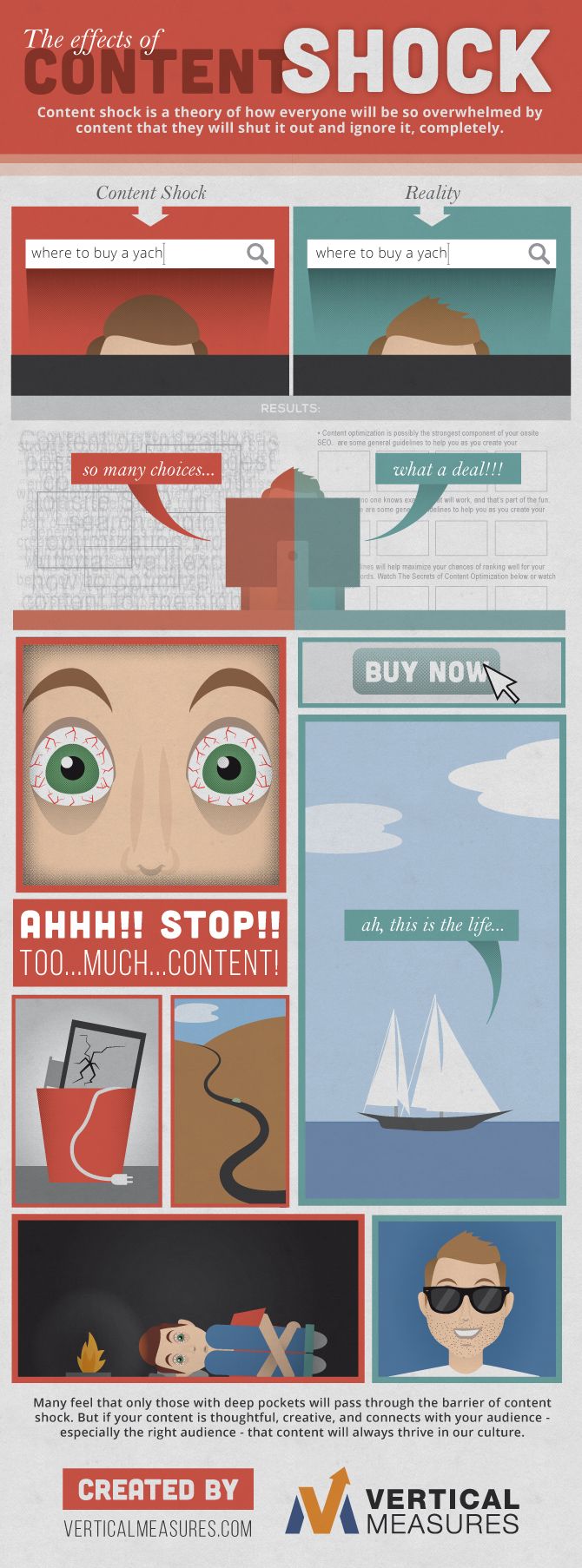
Picture two people searching for the exact same thing: “where to buy a yacht.” One person is buried under a wall of competing articles, pop-ups, and generic guides, so overwhelmed by choice that they simply give up and close the tab. The other finds a single, clear, trustworthy answer and takes action immediately. That’s the core tension behind content shock. It isn’t that content stops working. It’s that low-value, repetitive content stops working, while clear, focused, genuinely useful content still gets attention and drives real results.
The theory isn’t about content marketing failing as a discipline. It’s a warning about what happens when brands compete purely on volume instead of value.
Why Content Shock Happens
A few forces combine to create the conditions for content shock:
- Falling production costs. AI writing tools and templated content production have made it cheaper than ever to publish at scale, which means more content enters the market every day than audiences can realistically absorb.
- More platforms competing for attention. Search engines, social feeds, video platforms, email inboxes, and now AI chat assistants are all competing for the same limited pool of human attention.
- Repetition without differentiation. When dozens of articles cover the same keyword using the same statistics from the same sources, none of them stand out, and audiences start ignoring the entire category.
- Shrinking attention spans. With so many options available at any given moment, people are quicker to abandon content that doesn’t immediately deliver value.
Put simply, content shock isn’t caused by content itself. It’s caused by sameness. When everyone is shouting the same message in the same format, the audience stops listening to all of it.
What the Data Says About Content Saturation
The concern behind content shock isn’t just theoretical anymore. Recent industry reporting shows that mass, low-effort publishing is losing ground quickly. Brands that scaled up blog output using AI at high volume have seen strong early gains fade within a few months, followed by falling engagement and disappearing rankings, as audiences and search engines alike began treating that content as interchangeable and easy to ignore.
At the same time, brands willing to invest in original research, proprietary data, and genuinely useful tools have seen the opposite effect. A single well-researched report or original survey can generate hundreds of backlinks, thousands of social shares, and meaningful increases in demand, precisely because it offers something no other page can copy.
This is the real lesson buried inside the content shock theory: audiences and algorithms are both getting better at filtering out noise. Volume alone no longer guarantees visibility. Differentiated, trustworthy content is what actually survives the flood.
Content Shock and the Rise of GEO (Generative Engine Optimization)
Traditional content marketing strategy used to focus almost entirely on ranking for search engine keywords. That’s no longer the full picture. A growing share of research and buying decisions now start inside AI chat tools and AI-generated search summaries rather than a traditional list of blue links. This shift has given rise to Generative Engine Optimization (GEO), the practice of structuring and positioning content so that AI systems are more likely to cite, reference, or recommend your brand directly.
Content shock and GEO are closely connected. As AI systems get better at filtering through the flood of generic, repetitive content, they naturally favor sources that demonstrate real expertise, clear structure, and original insight. That means the same principles that help a brand rise above content shock, originality, clarity, and depth, are exactly what also earns visibility inside AI-generated answers.
A few practical ways to align your content with both audience expectations and GEO best practices:
- Answer the actual question first, then provide supporting context and detail, rather than burying the answer under filler paragraphs.
- Include original statistics, examples, or perspectives that AI systems and human readers can’t find copied elsewhere.
- Use clear structure, with descriptive headings, short paragraphs, and organized lists, so both readers and AI crawlers can quickly understand what your content covers.
- Build topical authority by connecting related pages together instead of publishing isolated, disconnected articles.
Brands that treat GEO as an extension of good content practice, rather than a separate technical trick, are the ones most likely to stay visible as search behavior continues to shift.
Quality Over Quantity: The Real Antidote to Content Shock
If content shock has one clear lesson, it’s this: publishing more content isn’t the same as publishing content that matters. A content calendar packed with rushed, repetitive posts might look productive on paper, but it does little to build trust, authority, or long-term traffic.
Instead, a content marketing strategy built to survive content shock focuses on a few core principles:
- Depth over frequency. One thorough, well-researched piece that fully answers a reader’s question will consistently outperform five shallow posts covering the same ground. Readers, and increasingly AI systems, reward content that goes further than the competition.
- Original perspective over recycled information. If your content simply restates what’s already ranking on page one, there’s no reason for anyone, human or algorithm, to choose it over the existing options. Original research, case studies, and first-hand expertise create content nothing else can replicate.
- Real audience understanding over guesswork. Content built around actual customer questions, pain points, and language performs far better than content built purely around keyword volume. Understanding why someone is searching matters more than simply matching the words they typed.
- Consistent brand voice over generic tone. In a sea of AI-assisted content that increasingly sounds the same, a distinct, human, recognizable voice becomes a genuine competitive advantage. Readers remember brands that sound like real people, not templates.
- Multimedia over text-only. Pairing written content with visuals, video, or interactive elements helps content stand out across both search results and social feeds, where competition for attention is fiercest.
How to Build a Content Strategy That Survives Content Shock
Putting these principles into practice doesn’t require an enormous budget or team. It requires intention. Here’s a practical framework small and mid-sized brands can use:
Audit before you create. Before publishing anything new, review what already exists on the topic. If ten other articles already say the same thing in the same way, don’t add an eleventh. Find the angle, data point, or perspective that’s missing and lead with that instead.
Prioritize evergreen, high-value topics. Rather than chasing every trending keyword, focus on the questions your actual customers ask repeatedly. These pages compound in value over time instead of fading after a short traffic spike.
Build topic clusters, not isolated posts. Connect your content together through thoughtful internal linking. A strong content marketing strategy links a core, authoritative page to related supporting content, helping both readers and search engines understand the full depth of your expertise. For example, a page like this one on content shock and content strategy naturally connects to a broader resource on building a strong content foundation with a content pyramid.
Repurpose strategically. Instead of creating five separate mediocre pieces, take one strong piece of content and repurpose it thoughtfully across formats, a blog post that becomes a short video, a social carousel, and an email feature. This keeps your message consistent without contributing to the noise.
Measure impact, not just output. Track engagement, time on page, return visits, and actual leads or sales generated, not just how many pieces you published this month. Reviewing content marketing ROI regularly ensures a single high-performing page gets more investment than a dozen forgettable ones.
Give AI a clear signal. Structure your content with concise summaries, clear headings, and direct answers near the top of the page. This benefits human readers scanning quickly and increases the likelihood that AI tools cite your content directly when answering related questions.
Common Mistakes That Feed Content Shock
Even well-meaning content teams can accidentally contribute to the very problem they’re trying to escape. Watch for these habits:
- Publishing purely to hit a quota, regardless of whether the topic adds genuine value
- Copying competitor structure and statistics instead of bringing something new to the conversation
- Ignoring existing content and creating overlapping pages that compete with each other for the same keywords
- Skipping internal linking, leaving strong content isolated instead of reinforcing a broader topic cluster
- Measuring success by word count or post frequency instead of engagement, trust, and conversions
Avoiding these habits alone puts a brand ahead of a large share of competitors still publishing on autopilot.
The Bigger Picture: Content Shock Isn’t the End of Content Marketing
Content shock doesn’t mean content marketing is dying. It means the easy version of content marketing, publish frequently, target a keyword, hope for traffic, is dying. What’s replacing it is a more demanding, more rewarding version of the discipline: fewer pieces, built with more care, grounded in real expertise, and connected through a deliberate strategy.
Many people assume that only large brands with deep marketing budgets can break through content shock. That’s not entirely true. Thoughtful, creative content that genuinely connects with the right audience continues to thrive, regardless of budget size, because trust and originality can’t simply be bought at scale. A small business with real expertise and a clear voice can absolutely out-perform a much larger competitor publishing generic, AI-assisted volume content.
The brands that will feel the sharpest effects of content shock are the ones still measuring success by how much they publish. The brands that will keep growing are the ones measuring success by how much value each piece of content actually delivers, to readers, and increasingly, to the AI systems now standing between brands and their audiences.
Content Shock Across Different Industries
Content shock doesn’t hit every industry the same way. Some markets are far more saturated than others, and understanding where your industry sits helps shape how aggressively you need to differentiate.
Highly saturated industries like personal finance, general marketing advice, weight loss, and basic technology tutorials are flooded with content covering nearly identical ground. In these spaces, generic advice articles rarely rank or get cited by AI tools anymore, because there are simply too many nearly identical versions already published. Brands in these industries need original data, strong personal experience, or a genuinely unique angle just to get noticed.
Moderately saturated industries, such as local services, niche B2B software, and specialized professional services, still have room for well-crafted content to perform, but competitors are catching on quickly. A content marketing strategy here benefits enormously from local expertise, case studies, and real customer stories that generic competitors haven’t captured yet.
Less saturated industries, including highly specialized trades, emerging technology niches, and hyper-local businesses, still have meaningful opportunity to build authority with straightforward, well-organized content. Even so, the window for easy wins is shrinking every year as more competitors adopt AI-assisted publishing.
Knowing where your industry falls on this spectrum helps set realistic expectations. A brand competing in a heavily saturated space needs a sharper, more original strategy from day one, while a brand in a less crowded niche has more room to build authority through consistency and clarity.
Frequently Asked Questions About Content Shock
Is content shock a proven theory or just a marketing buzzword? Content shock started as a theory, but the underlying pattern, diminishing returns from generic, high-volume content, is now well documented across industry reporting. Whether or not you call it “content shock,” the data consistently shows that low-effort, repetitive content is losing visibility while original, well-researched content is gaining it.
Does content shock mean businesses should publish less content? Not necessarily less, but more intentionally. The goal isn’t to shrink your content calendar for its own sake. It’s to make sure every piece you publish earns its place, either by answering a real question better than anything else available, or by offering data, insight, or perspective nobody else has.
How does AI-generated content relate to content shock? AI tools have made it far easier to produce large volumes of content quickly, which has accelerated content shock rather than solved it. When many brands use similar AI tools to generate similar content, the result is more sameness, not more value. The brands that combine AI efficiency with genuine human expertise and original insight are the ones still standing out.
Can small businesses still compete despite content shock? Yes. Content shock actually favors authenticity and specificity, both of which small businesses can offer more naturally than large, templated content operations. A small business with real local expertise, genuine customer relationships, and a clear voice can outperform a much larger competitor publishing generic content at scale.
What’s the difference between SEO and GEO? Traditional SEO focuses on ranking content within search engine results pages, driven largely by keywords, backlinks, and technical site health. GEO, or Generative Engine Optimization, focuses on making content more likely to be cited or referenced directly inside AI-generated answers and summaries. The two overlap significantly, since both reward clear structure, genuine expertise, and original content, but GEO places extra weight on being quotable, well-organized, and easy for AI systems to parse and trust.
Final Thoughts
Content shock is real, but it isn’t a death sentence for content marketing. It’s a filter. It rewards brands willing to slow down, dig deeper, and create something genuinely useful instead of chasing volume for its own sake.
Pair that mindset with a connected internal linking structure, a clear content marketing strategy, and an eye toward how AI systems now discover and cite content, and content shock becomes far less of a threat and far more of an opportunity to stand out while competitors keep adding to the noise.
About The Author