SEO vs. paid ads is one of the most important comparisons small-business owners must make when deciding how to invest their marketing budgets. Both strategies can increase online visibility, attract potential customers, and generate sales, but they produce results in very different ways.
Paid advertising can put a business in front of prospective customers almost immediately. Once a campaign is approved and activated, advertisements may begin appearing in search results, on websites, or across social media platforms. However, that visibility usually depends on the business continuing to fund the campaign.
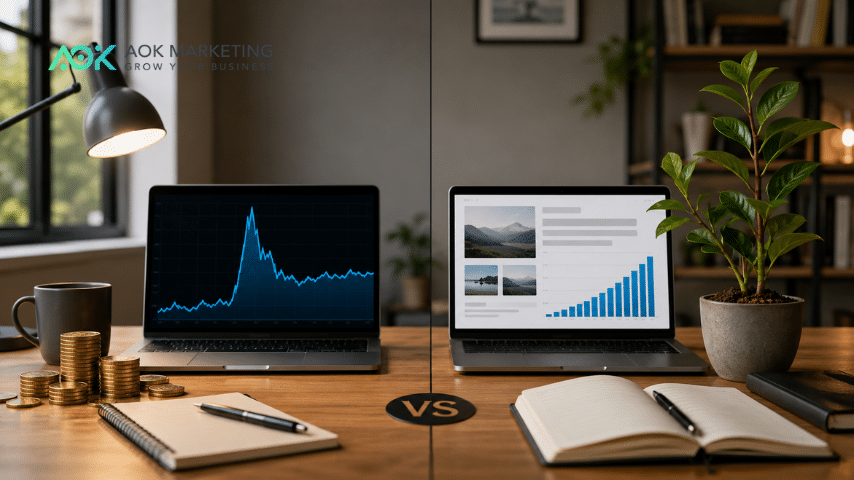
Search engine optimization, or SEO, generally takes longer to produce meaningful results. Instead of paying for every visit, a business improves its website, creates useful content, and builds organic search visibility over time. A well-optimized page may continue generating traffic and leads long after it is published.
So, which is better for a small business?
The answer depends on the company’s goals, budget, timeline, competition, and current online presence. Paid advertising is often more effective when immediate results are needed, while SEO can provide greater long-term value and sustainability. In many cases, the strongest approach is not choosing one and ignoring the other, but understanding how each strategy can support different stages of business growth.
What Is SEO?
SEO, or search engine optimization, is the process of improving a website so that search engines can understand its content and present it to relevant users.
Google describes SEO as helping search engines understand website content while also helping users find a site and decide whether to visit it. Following SEO best practices does not guarantee a specific ranking, but it can make a website more accessible, useful, and eligible to appear in relevant search results.
An SEO strategy may include:
- Researching the words and phrases customers search for
- Improving product and service pages
- Publishing useful articles and guides
- Making the website faster and mobile-friendly
- Improving page titles and meta descriptions
- Creating internal links between related pages
- Earning links and mentions from reputable websites
- Optimizing a Google Business Profile
- Creating location-specific content
- Monitoring organic traffic and conversions
SEO focuses on earning visibility in the unpaid or organic section of search results.
For example, a local roofing company might optimize a service page for searches such as “commercial roofing contractor in Toronto.” A dental practice could publish an article answering a common patient question. A business consultant might create a guide explaining how small companies can improve cash flow.
These pages can attract people who are already looking for information or services related to the business.
Companies that want to build sustainable organic visibility can explore AOK Marketing’s SEO services.
What Are Paid Ads?
Paid advertising allows businesses to pay for their message to appear in specific online locations.
Google Ads, for example, can show advertisements when someone searches for words related to a company’s products or services. Businesses select keywords, create advertisements, choose targeting settings, and establish a budget.
With cost-per-click advertising, a business is generally charged when someone clicks the advertisement and visits its website. Advertisers can control their average daily budgets and set bidding limits, although campaign costs and results depend on factors such as competition, targeting, ad quality, and landing-page relevance.
Paid advertising can include:
- Search advertisements
- Display advertisements
- Shopping advertisements
- Video advertisements
- Paid social media campaigns
- Retargeting campaigns
- Sponsored content
- Local service advertisements
The main advantage is speed. A small business does not necessarily have to wait months to appear in front of potential customers. With the right setup, it can begin buying targeted visibility quickly.
A company launching a new service, promoting a seasonal offer, or trying to generate leads immediately may benefit from paid advertising.
AOK Marketing provides paid search advertising services designed to help businesses reach customers who are actively searching for their products or services.
The Main Difference: Speed Versus Sustainability
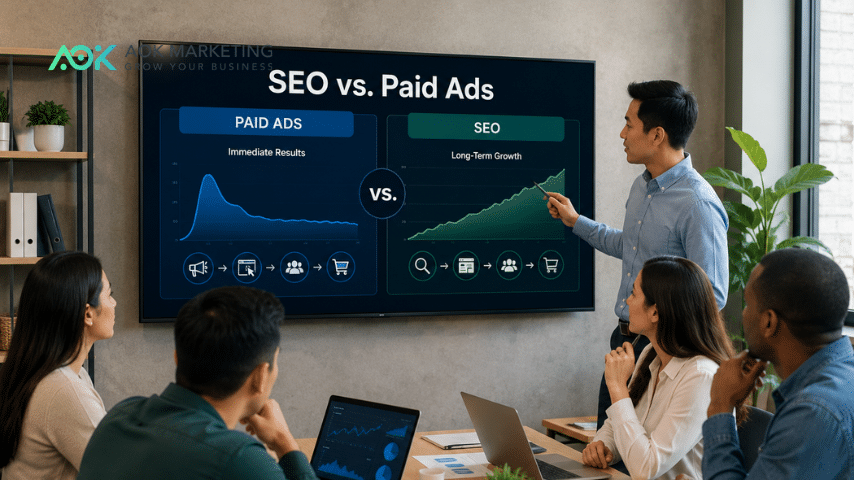
The clearest distinction in the SEO vs. paid ads comparison is how the two strategies create traffic.
Paid advertising purchases visibility.
SEO builds visibility.
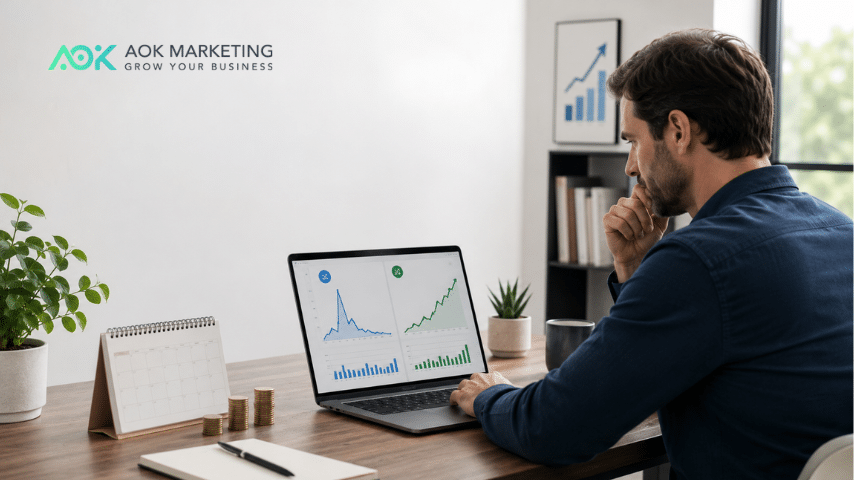
When a paid campaign is active and sufficiently funded, it can drive traffic quickly. When the campaign is paused or the budget runs out, the traffic generated by those advertisements will usually decline immediately.
SEO takes more time because search engines need to discover, understand, index, and evaluate website pages. A business may also need to improve technical performance, publish stronger content, earn authority, and establish relevance for competitive searches.
However, once a page begins performing well organically, it may continue attracting visitors without requiring the business to pay each time someone clicks it.
This does not mean organic traffic is free. SEO requires investment in strategy, research, writing, website improvements, technical support, and ongoing monitoring. The difference is that the work creates a digital asset that can continue generating value.
An advertisement rents attention for as long as the company pays for placement. SEO can help a business build an owned source of visibility.
When Paid Ads Are Better for Small Businesses
Paid advertising can be the better choice when a business needs immediate exposure.
Launching a new business or service
A new website may have little organic authority and few search rankings. Paid ads can help the company appear for valuable searches while its SEO foundation is still being developed.
For example, a new physiotherapy clinic could use search ads to promote appointments immediately rather than waiting for its service and location pages to gain organic visibility.
Promoting a limited-time offer
SEO is not always ideal for a campaign that will end within a few days or weeks.
Paid advertising can be more suitable for:
- Holiday sales
- Seasonal promotions
- Event registrations
- Product launches
- Short-term discounts
- Limited appointment availability
- Time-sensitive announcements
The campaign can be activated when the promotion begins and paused when it ends.
Testing a new market
Paid campaigns can help businesses test demand before committing to a larger marketing investment.
A company could advertise a new service, location, product category, or audience and monitor how people respond. Campaign data may reveal which offers, messages, keywords, and landing pages generate the most interest.
Reaching a precise audience
Advertising platforms allow businesses to control factors such as location, search terms, device, schedule, audience characteristics, and previous website activity.
This can make paid ads useful for companies that want to reach a specific group quickly.
Generating leads while SEO develops
SEO rarely produces its full potential immediately. Paid advertising can help bridge the gap by creating traffic and leads while organic visibility is being built.
This is one reason SEO and paid advertising often work better together than they do as isolated strategies.
When SEO Is Better for Small Businesses
SEO is generally the stronger option when a business wants to develop sustainable visibility and reduce its long-term dependence on advertising.
Building an ongoing source of traffic
A useful article or optimized service page can continue appearing in search results after the initial work is complete.
For example, an accountant’s guide to small-business tax planning could attract readers throughout the year. A landscaping company’s service page could generate local enquiries each season. A software provider’s tutorial could bring qualified users to its website for several years.
The content may require updates, but it does not disappear automatically when a daily advertising budget is paused.
Creating long-term marketing assets
SEO work improves pages that the business owns.
These assets may include:
- Service pages
- Product pages
- Location pages
- Blog articles
- Case studies
- Frequently asked questions
- Industry guides
- Comparison pages
- Videos and visual resources
Each useful page creates another opportunity to be discovered.
Over time, these resources can form a connected content library that educates prospective customers and guides them toward a purchase.
Building credibility and authority
People often research a business before contacting it. They may search for the company’s name, read articles, review service pages, compare options, and look for evidence of expertise.
A website with detailed, helpful, and well-organized content can strengthen trust before the first sales conversation.
SEO content can demonstrate that the business understands its customers’ problems and has experience solving them.
Reducing reliance on cost-per-click traffic
Paid ads can become expensive in competitive industries. A company may need to bid against multiple advertisers for the same valuable searches.
Google notes that higher bids can potentially produce more traffic but may also increase spending, while lower bids may result in fewer clicks and conversions.
SEO can create an additional customer-acquisition channel. The business may continue running advertising, but it is no longer relying entirely on paying for every website visit.
Reaching customers throughout their research
Not every customer searches for a company when they are ready to buy.
Some people begin with informational questions, such as:
- How much does commercial cleaning cost?
- When should a roof be replaced?
- What should I look for in an accountant?
- How can I improve my website traffic?
- What promotional products work for trade shows?
SEO allows businesses to answer these early-stage questions.
A reader who discovers the company through an educational article may later visit a service page, subscribe to an email list, request a consultation, or make a purchase.
Comparing the Costs of SEO and Paid Ads
SEO and paid advertising both require a budget, but the money is spent differently.
With paid advertising, the budget may cover:
- Advertising clicks or impressions
- Campaign management
- Keyword research
- Ad copy
- Creative development
- Landing-page creation
- Conversion tracking
- Testing and optimization
Advertising platforms provide direct control over campaign spending. However, continued visibility generally requires continued investment.
SEO spending may cover:
- Website audits
- Keyword and customer research
- Content strategy
- Copywriting
- Technical improvements
- Local SEO
- Link acquisition
- Reporting and measurement
- Content updates
- Conversion optimization
SEO can require a greater upfront commitment before results become visible. The potential advantage is that the website improvements and published content remain with the business.
The better investment should not be determined by cost alone. Small businesses need to compare the cost with the quality and value of the results generated.
A campaign that delivers inexpensive clicks but no qualified leads is not effective. An article that attracts thousands of visitors but no relevant customers may also provide limited business value.
The most important measurements include:
- Qualified leads
- Sales
- Booked appointments
- Customer acquisition cost
- Conversion rate
- Revenue generated
- Customer lifetime value
- Return on marketing investment
SEO and Paid Ads Have Different Risks
Neither strategy is guaranteed to succeed.
Paid advertising can waste money when:
- The targeting is too broad
- The wrong keywords are selected
- The advertisement does not match the search
- The landing page is confusing
- Conversion tracking is incomplete
- Leads are not followed up quickly
- Campaigns are not regularly optimized
SEO can underperform when:
- Content is thin or generic
- The website has technical problems
- Search intent is misunderstood
- Keywords are selected without business relevance
- Pages are not updated
- The website provides a poor user experience
- There is no clear conversion path
- Results are expected too quickly
Businesses should be cautious of anyone promising guaranteed organic rankings or guaranteed advertising returns. Both channels require research, testing, measurement, and improvement.
Why SEO and Paid Ads Often Work Best Together
The SEO vs. paid ads decision does not need to have a single winner.
A combined strategy can give a small business both immediate visibility and long-term growth.
Paid ads can generate traffic while SEO is gaining momentum. They can also provide faster data about which search terms, offers, and landing pages lead to conversions.
That information can support SEO decisions. If a paid campaign reveals that a certain keyword consistently produces valuable leads, the business may decide to create a stronger organic page around that topic.
SEO can also improve paid advertising performance. Clearer service pages, better website navigation, stronger content, and faster landing pages can help visitors understand the offer and take action.
A practical combined strategy might look like this:
- Use paid ads to generate immediate leads.
- Track which keywords and offers convert.
- Build SEO pages around proven customer demand.
- Publish useful content that supports the sales journey.
- Improve landing pages and conversion paths.
- Gradually develop organic visibility.
- Continue paid campaigns for valuable or time-sensitive opportunities.
AOK Marketing combines SEO, paid media, AI search visibility, and conversion optimization to help each channel support measurable business growth.
How to Decide Which Strategy Your Business Needs
Choose paid advertising first when:
- You need leads or sales immediately
- You are launching a new offer
- You have a time-sensitive promotion
- Your website has little organic visibility
- You want to test a product or market
- You have a defined advertising budget
- You can respond quickly to new leads
Prioritize SEO when:
- You want sustainable website traffic
- Customers regularly search for your services
- You want to build long-term authority
- You have useful expertise to share
- You want to reduce reliance on paid traffic
- You can invest consistently over time
- Your website needs stronger content and structure
Use both when:
- You need short-term leads and long-term growth
- You operate in a competitive market
- Search is an important customer-acquisition channel
- You want to test paid data and apply it to SEO
- You want broader visibility across search results
The right balance will depend on the business’s financial position and growth stage. A new company may initially allocate more resources to paid advertising while building its organic foundation. An established company with strong rankings may rely more heavily on SEO while using paid campaigns for strategic opportunities.
Which Is Better: SEO or Paid Ads?
Paid ads are generally better for speed, control, and short-term campaigns. SEO is generally better for sustainability, authority, and long-term value.
For most small businesses, relying entirely on paid advertising can create an expensive dependency. Every new visit may require more advertising spend. On the other hand, relying entirely on SEO may leave the business waiting too long for leads when immediate revenue is needed.
The strongest marketing strategy often uses paid advertising to capture demand now while SEO builds visibility for the future.
SEO creates valuable content and website assets that can continue generating traffic. Paid advertising provides the speed and targeting needed to reach potential customers at important moments.
Rather than asking which channel is universally better, small-business owners should ask what they need each channel to accomplish.
Do you need customers today? Paid advertising may provide the fastest path.
Do you want a stronger and more sustainable source of traffic over the next several years? SEO should be a priority.
Do you want immediate opportunities without sacrificing long-term growth? A coordinated SEO and paid advertising strategy may deliver the best overall value.
AOK Marketing helps businesses determine where SEO and paid advertising fit within their growth strategy. Request a free growth plan to identify opportunities to generate immediate leads while building sustainable online visibility.
About The Author