Why chat-based discovery is not classic search
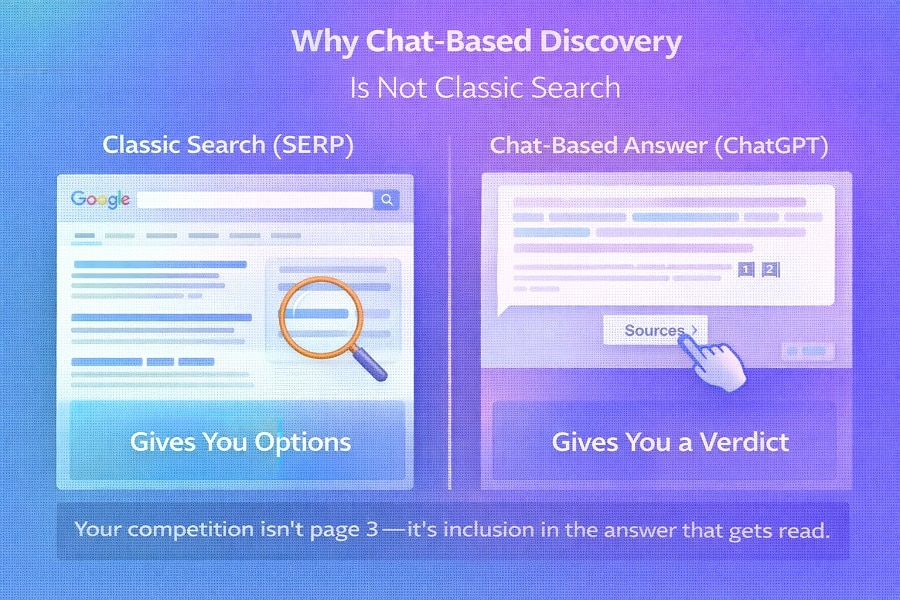
Search gives you options. Chat gives you a verdict.
In a SERP, users scan 10 blue links. In chat, they read one answer and maybe click two sources.
OpenAI describes ChatGPT search as returning answers with inline citations and a Sources button that lists references. [1]
It also notes that ChatGPT may rewrite your prompt into one or more targeted queries (sometimes using general location) to improve results. [1]
So your competition isn’t “rank above page 3.” It’s “be included in the answer that gets read.”
See also : AI Search Engine Optimization Strategies for Businesses 2026 Edition
The model: Entity + Content + Citations
| Layer | What it means | What you do |
| Entity | Unambiguous identity | Canonical name, aliases, leadership, locations, sameAs identifiers |
| Content | Quotable claims | Answer-first sections, explicit definitions, comparison tables, evidence links |
| Citations | Corroborated authority | Earned media, co-citations, reviews, partner validation, clean profiles |
If you’re missing one layer, you get the common failure modes:
- Entity missing: the assistant confuses you with someone else (or describes you vaguely).
- Content missing: the assistant can’t quote you safely, so it quotes someone else.
- Citations missing: the assistant avoids recommending you because it can’t verify you.
See also : Knowledge Graph Optimization and Entity Authority
What “being citable” actually means
Being citable is not about flattering the model.
It’s about lowering the risk of the assistant repeating something wrong.
OpenAI’s web search tooling explicitly frames web search as producing answers with sourced citations. [2]
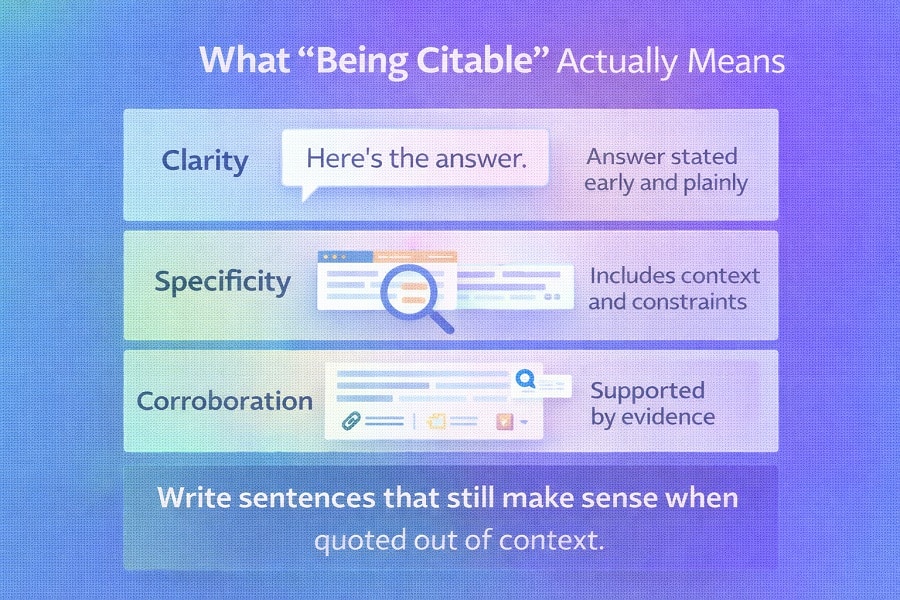
Citable content has three properties:
- Clarity: the answer is stated early and plainly.
- Specificity: constraints are included so the meaning can’t be warped.
- Corroboration: the claim is supported by evidence (links, data, sources).
If you want one rule to follow: write sentences that still make sense when quoted out of context.
Entity footprint essentials
If you want to be recommended, you need to be a clean entity – not a fuzzy string.
Your entity footprint is your brand’s ID card. It should be boringly consistent:
- Canonical name + aliases: one official name, documented variants.
- Leadership and authors: stable bios with consistent titles and timelines.
- Locations and NAP: address and contact details that match everywhere.
- Identifiers: URLs that unambiguously point to you (sameAs).
Schema markup helps reduce ambiguity. Google frames Organization structured data as a way to disambiguate an organization. [3]
And Schema.org defines sameAs as a URL that unambiguously indicates identity. [4]
See also : AI-Readable SEO: Schema and Technical Signals
On-site patterns that make you easy to quote
When your page gets retrieved, the model still has to extract something usable.
Make it easy. Use patterns that survive summarization:
- Answer-first sections: 1-2 sentences that directly answer the query.
- Definitions with scope: “X is Y, in the context of Z… it does not include…”
- Comparison tables: best for / not for / assumptions.
- Evidence links: primary sources, not just internal opinions.
This is not just “good writing.” It’s retrieval-friendly writing.
Authority layer: PR, co-citations, reviews
Assistants trust what the web agrees on.
OpenAI’s own framing of ChatGPT search emphasizes highlighting and attributing information from trustworthy sources, with links to sources. [5]
So don’t rely on your own site alone. Build corroboration:
- Earned media that states what you are, who you serve, and why you’re distinct.
- Partner listings and directories that place you in the right category.
- Reviews that include specifics (use case + outcome).
- Third-party validation: certifications, awards, memberships.
If the internet describes you inconsistently, the assistant will too.
See Also : Earned Authority for AI: PR, Co-Citations and GEO Strategy (2026)
Technical layer: crawlability, schema, structured signals
This part is boring. It’s also where a lot of brands fail silently.
Two key points from OpenAI’s own documentation:
- To show up in ChatGPT search results, allow OAI-SearchBot to crawl your site. [1]
- OAI-SearchBot (search) and GPTBot (training) are separate controls in robots.txt. [6]
If you want search visibility without training usage, configure that intentionally.
Also: if you don’t want a page surfaced, use noindex – and remember the crawler must be allowed to crawl the page to see that directive. [7]
Measurement: build a prompt library + scorecard
If you can’t measure it, you can’t improve it.
Measurement is straightforward:
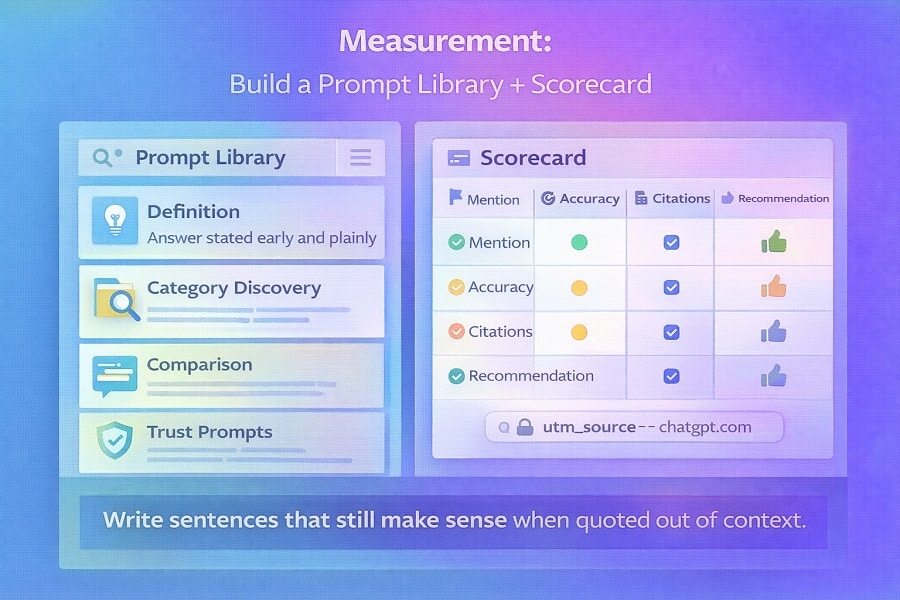
- Define a prompt set (definition, category discovery, comparisons, trust prompts).
- Score outputs (mention, accuracy, citations, recommendation).
- Run a baseline now. Re-test monthly.
- Track referral traffic: OpenAI notes utm_source=chatgpt.com is included in referral URLs for publishers who allow OAI-SearchBot. [7]
This is how you turn “AI visibility” into an operating rhythm.
30-day checklist
Use this as your sequence. Don’t freestyle it.
| Week | Focus | Key deliverables |
| 1 | Entity clarity | Canonical naming, updated About, leadership bios, Organization schema + sameAs |
| 2 | Citable content | Answer-first blocks, definitions, comparisons, evidence sections |
| 3 | Authority | PR targets, partner listings, reviews, validation assets |
| 4 | Technical + measurement | Robots/noindex verification, prompt library, analytics tracking |
FAQ
Q: Can I guarantee I’ll be the #1 recommendation in ChatGPT?
A: No. OpenAI states there’s no way to guarantee top placement in ChatGPT search. Your job is to increase the odds by improving identity, quotability, and corroboration. [1]
Q: Do I need to allow GPTBot to show up in ChatGPT Search?
A: Not necessarily. OpenAI documents that OAI-SearchBot is for search and GPTBot is for training, and each setting is independent. [6]
Q: If I block OAI-SearchBot, can I still appear?
A: OpenAI’s crawler documentation notes that sites opted out of OAI-SearchBot won’t be shown in ChatGPT search answers, though they can still appear as navigational links. [6]
Q: What’s the fastest on-site change that improves quotability?
A: Add an answer-first block at the top of your key pages, then back it with definitions, a comparison table, and evidence links.
Q: How do I track traffic from ChatGPT?
A: If your site is eligible and cited/linked, OpenAI notes ChatGPT includes utm_source=chatgpt.com in referral URLs for tracking. [7]
References
[1] OpenAI Help Center. “ChatGPT search.” (accessed Feb 1, 2026).
[2] OpenAI API Platform Docs. “Web search.” (accessed Feb 1, 2026).
[3] Google Search Central. “Organization structured data.” (accessed Feb 1, 2026).
[4] Schema.org. “sameAs.” (accessed Feb 1, 2026).
[5] OpenAI. “Introducing ChatGPT search.” (accessed Feb 1, 2026).
[6] OpenAI API Platform Docs. “Overview of OpenAI Crawlers.” (accessed Feb 1, 2026).
[7] OpenAI Help Center. “Publishers and Developers – FAQ.” (accessed Feb 1, 2026).
[8] Aggarwal, Murahari, Rajpurohit, et al. “GEO: Generative Engine Optimization.” arXiv:2311.09735. (accessed Feb 1, 2026).
[9] AOK Marketing. “ChatGPT Entity Panel – Do you own an AI-resolved entity?” (accessed Feb 1, 2026).
About The Author