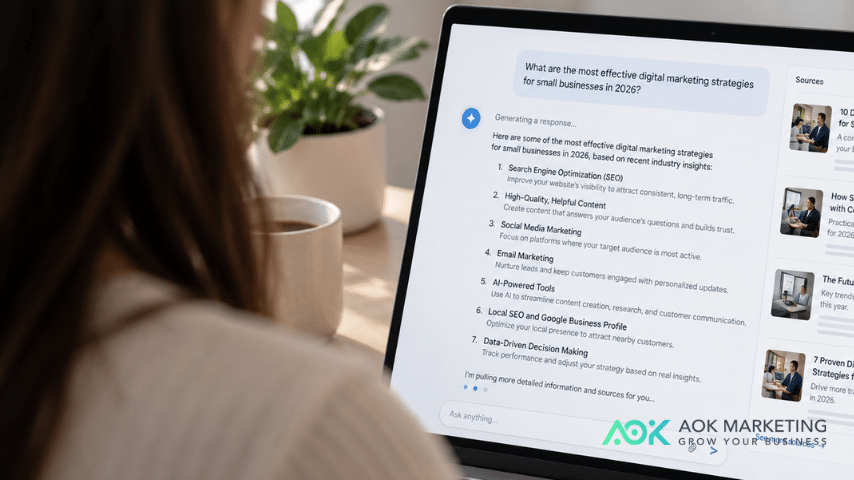
You ask ChatGPT a question.
Within seconds, it gives you an answer and, in some cases, includes links or citations to websites where the information came from.
That creates two new questions for businesses:
Why did ChatGPT cite those websites instead of yours? How Does ChatGPT Decide Which Websites to Cite?
There is no public checklist that guarantees a website will be cited by ChatGPT. OpenAI says ChatGPT Search ranks results using multiple factors intended to help users find relevant and reliable information, and placement is not guaranteed.
However, we do know quite a bit about how the process works.
ChatGPT can search the web when current information would improve an answer. It may transform a user’s question into one or more targeted searches, retrieve relevant information, evaluate those results, and then use selected sources to construct its response.
That means being visible in AI search is not simply about repeating keywords.
Your website has to be accessible, relevant, understandable, useful, and trustworthy enough to support the answer ChatGPT is trying to give.
Here is what that means in practice.
First, ChatGPT Has to Be Able to Find Your Website
Before worrying about citations, start with the most basic requirement:
Can OpenAI access your website?
OpenAI uses a crawler called OAI-SearchBot for its search features. According to OpenAI, websites that allow OAI-SearchBot can be surfaced in ChatGPT search results, while websites that opt out will generally not appear in ChatGPT search answers, although navigational links may still sometimes appear.
For businesses that want visibility in ChatGPT Search, this means checking:
- your
robots.txtfile - firewall rules
- CDN settings
- bot protection
- server permissions
- pages accidentally marked
noindex
OpenAI specifically recommends allowing OAI-SearchBot if you want your site’s content to be discoverable, surfaced, cited, and linked within ChatGPT Search.
This is the technical foundation.
A brilliant article cannot become a useful source if the system cannot properly access it.
ChatGPT Starts With the User’s Question
AI search is highly dependent on context.
Someone searching Google might type:
best CRM for small business
But someone using ChatGPT might ask:
What CRM would work for a five-person accounting firm that mainly needs lead tracking and email follow-ups?
That is a much more specific request.
ChatGPT Search can rewrite a user’s request into one or more more targeted searches before retrieving information. OpenAI gives the example of a complex research question being transformed into specific queries and then refined with additional searches as needed.
This matters for your content strategy.
If your article only broadly discusses:
CRM software is important for businesses.
it may not be particularly useful for answering that detailed question.
An article covering:
- CRM options for small teams
- email follow-up capabilities
- pricing
- advantages and disadvantages
- ideal business types
- setup considerations
provides far more information that could potentially support an answer.
That is why depth and specificity matter in AI search.
Relevance Comes Before Everything Else
If someone asks:
How often should a small business post on Instagram?
ChatGPT needs sources that directly help answer that question.
A 4,000-word article about the history of Instagram may be authoritative, but it is not necessarily the best source for that particular answer.
A focused section titled:
How Often Should Small Businesses Post on Instagram?
followed by a clear explanation is much easier to use.
This is one reason good SEO fundamentals still matter.
Use descriptive:
- page titles
- headings
- subheadings
- FAQs
- topic sections
- internal links
Your page should make its subject obvious.
Do not make readers—or search systems—dig through several paragraphs before discovering what the page is actually about.
Answer the Question Clearly
One of the most useful things you can do for AI visibility is surprisingly simple:
Give clear answers.
Imagine an article answering:
How long should an Instagram Reel be?
Version A says:
Video marketing has changed considerably over the years, and businesses today have many opportunities to engage audiences through innovative social platforms…
Version B says:
The ideal Reel length depends on your goal. Shorter videos may work well for quick tips and entertainment, while longer videos give you more room for tutorials, demonstrations, and storytelling.
The second version gives an answer immediately.
That does not mean every article needs to sound robotic.
You can still explain nuance, examples, exceptions, and strategy.
But readers should be able to identify your core answer quickly.
A useful structure is:
Question → Direct Answer → Explanation → Evidence → Example
That format works well for human readers too.
Make Important Information Easy to Extract
Think about how your article is organized.
A page consisting of twelve enormous paragraphs makes information difficult to navigate.
Instead, break complex topics into logical sections.
For example:
How to Optimize Your Website for AI Search
-Make Your Site Crawlable
-Answer Specific Questions
-Use Clear Headings
-Include Supporting Evidence
-Build Topic Authority
-Keep Information Updated
-Add Relevant Internal Links
Now both readers and search systems can understand the structure of the article more easily.
Lists, comparison tables, FAQs, definitions, statistics, and step-by-step sections can also make complicated information easier to interpret.
But structure should support the content.
Do not add fifty FAQ questions simply because you think AI systems like FAQs.
Answer questions people genuinely need answered.

Support Claims With Evidence
Consider these two statements.
Statement A:
Email marketing is the best marketing strategy.
Statement B:
Email marketing can be especially valuable for businesses that already have an audience because it allows them to communicate directly with subscribers rather than relying entirely on social media algorithms.
The second statement is more useful because it explains the reasoning and avoids making an unsupported universal claim.
When you include statistics or factual claims, link to the original source whenever possible.
Useful supporting sources might include:
- government data
- academic research
- industry studies
- original company documentation
- platform documentation
- first-party research
- original datasets
For example, if you are explaining how ChatGPT Search works, OpenAI’s own documentation is generally more useful as a primary source than a blog post describing what someone thinks ChatGPT does.
Strong sourcing also makes your article more useful to readers who want to verify the information themselves.
Original Information Can Make Your Website More Useful
There are thousands of websites summarizing exactly the same marketing advice.
That makes original information increasingly valuable.
Your website becomes more useful when it contributes something that other pages do not already provide.
That could include:
- proprietary research
- surveys
- original statistics
- customer data
- experiments
- case studies
- expert commentary
- practical experience
- original examples
- proprietary frameworks
Imagine 100 articles saying:
Instagram Highlights are useful for businesses.
Now imagine one company publishes:
We reviewed 150 small-business Instagram profiles. Here are the seven Highlight categories used most frequently by the profiles generating customer inquiries.
That page contributes something new.
Originality does not mean you need a research department.
Even small businesses can share useful first-party information from their own experience.
Demonstrate Real Expertise
AI has dramatically lowered the cost of publishing content.
That means simply producing another generic article is becoming less valuable.
What distinguishes strong content is often the information behind it.
For example, instead of writing:
SEO audits help businesses improve rankings.
an agency could explain:
When we audit a website, we typically look at crawlability, indexing, internal linking, page structure, search intent, content gaps, page speed, and conversion pathways.
Then provide examples of what problems commonly appear.
That demonstrates actual experience.
You can strengthen your content through:
- expert quotes
- author credentials
- examples from your work
- screenshots
- case studies
- methodology explanations
- first-hand observations
The goal is not simply to tell search engines that you are an expert.
Show the expertise in the content itself.
Keep Your Information Current
Freshness matters most when the subject itself changes frequently.
An article explaining basic geometry may remain useful for years.
An article called:
Instagram Algorithm Guide 2024
is much more sensitive to time.
AI search may be used specifically because someone wants current information.
ChatGPT can search the web when recent information would improve the answer.
That means outdated:
- prices
- statistics
- software features
- platform limits
- laws
- product specifications
- social media features
can make an article less useful.
Review your important content periodically.
And when updating an article, do more than change:
2025 → 2026
Actually verify whether the information has changed.
Build Content Around Topics, Not Isolated Keywords
Traditional keyword research might uncover:
Instagram marketing
But that represents hundreds of possible questions.
Businesses searching around Instagram marketing might want to know:
- How often should I post?
- Should I use Reels?
- How should I organize Highlights?
- How do I get followers?
- How do I turn followers into customers?
- Should I use Instagram or TikTok?
- How do Instagram ads work?
A website covering these related questions develops a much more complete resource around the topic.
This is where topic clusters become useful.
For example:
Main Guide
Instagram Marketing for Businesses
Supporting Articles
How to Organize Instagram Highlights
How Often Should Businesses Post on Instagram?
Instagram Reels vs TikTok
How to Turn Instagram Followers Into Customers
Best Instagram Content Ideas for Businesses
How to Optimize an Instagram Business Profile
Connect those articles with useful internal links.
Now your website provides a network of related information instead of one isolated page.
Internal Links Help Establish Context
Internal linking is often treated purely as a traditional SEO tactic.
But it also improves usability and context.
Suppose you publish an article called:
How to Organize Instagram Highlights for More Sales
Within that article, you could naturally link to:
How to Turn Social Media Followers Into Paying Customers
and:
Instagram Highlights for Businesses
These links help readers continue exploring related questions.
They also make the relationship between your pages clearer.
Avoid adding internal links simply because two pages contain the same keyword.
Link when the second page genuinely provides useful additional information.
Make Your Brand and Expertise Easy to Understand
Your content should not exist in isolation from the organization publishing it.
Make it easy for visitors to understand:
- who created the content
- what the company does
- who the author is
- why the author has knowledge of the subject
- how to contact the organization
Useful supporting pages include:
About
Contact
Author profiles
Services
Case studies
Editorial policies, when appropriate
This information does not guarantee AI citations.
But transparency helps both people and systems understand where information is coming from.

Does Schema Markup Help ChatGPT Cite a Website?
Structured data can help search engines and other systems understand certain elements of a page, such as products, organizations, articles, events, or FAQs.
However, you should be careful about statements such as:
“Adding schema will make ChatGPT cite your website.”
There is no public guarantee of that.
Think of structured data as one component of a technically well-organized website rather than a shortcut to AI citations.
Use appropriate schema because it accurately describes your content.
Do not add unnecessary markup hoping it will force an AI system to recommend you.
Does Ranking #1 on Google Guarantee a ChatGPT Citation?
No.
ChatGPT Search and traditional Google Search are not identical systems.
OpenAI says ChatGPT Search may work with third-party search providers and can generate multiple targeted searches based on the user’s question.
Traditional search rankings may therefore influence discoverability in some circumstances, but a #1 Google ranking does not automatically mean ChatGPT will cite the page.
Likewise, a page does not necessarily need to rank #1 for every keyword to be useful within an AI-generated answer.
The underlying question is:
Does this page provide useful evidence for the answer the user needs?
That is a healthier way to think about AI visibility.
Can You Guarantee That ChatGPT Will Cite Your Website?
No.
OpenAI explicitly states that search placement is not guaranteed.
Anyone promising:
“We can guarantee your website will be cited by ChatGPT.”
should therefore be treated cautiously.
You can improve your eligibility and increase the usefulness of your content.
You cannot force an AI system to cite a particular page for every relevant query.
This is similar to traditional SEO.
You can optimize a website for search engines.
You cannot legitimately guarantee the exact ranking Google will assign tomorrow.
How Can You Tell If ChatGPT Is Sending Traffic to Your Website?
There is one particularly useful piece of information for marketers.
OpenAI says referral links from ChatGPT Search automatically include:
utm_source=chatgpt.com
This allows website owners to identify inbound traffic from ChatGPT using analytics tools such as Google Analytics.
That means AI search visibility is becoming measurable.
Instead of only asking:
“Does ChatGPT mention us?”
you can also monitor:
- visits from ChatGPT
- landing pages receiving ChatGPT traffic
- engagement from those visitors
- conversions
- inquiries
- leads
- purchases
That is ultimately much more valuable than simply collecting screenshots of your brand appearing in an AI response.
A Practical Checklist for Becoming More Cite-Worthy
If you want your website to have a better chance of being discovered and used in AI search, start here:
1. Make sure OAI-SearchBot can access your website.
Check your robots.txt, firewall, CDN, and bot protection settings.
2. Write for specific questions.
Do not publish vague articles when users are searching for specific answers.
3. Answer important questions early.
Give readers a direct answer before expanding into detail.
4. Structure information logically.
Use descriptive headings, lists, tables, FAQs, and clearly separated sections.
5. Support factual claims.
Use reputable primary sources whenever possible.
6. Add original value.
Include real experience, case studies, research, examples, or data.
7. Keep time-sensitive content updated.
Review important pages regularly.
8. Build topic clusters.
Cover related questions and connect them through internal links.
9. Make your business transparent.
Provide clear company, author, service, and contact information.
10. Measure AI referral traffic.
Track visitors arriving through ChatGPT and other AI platforms.
None of these individually guarantees a citation.
Together, they make your website more accessible and more useful as a potential source.
The Bigger Shift: Optimize to Become a Useful Source
For years, SEO conversations revolved around:
How do we rank for this keyword?
That question still matters.
But AI search introduces another important question:
How do we become one of the best sources for answering this question?
That changes the way businesses should think about content.
Instead of publishing another generic 1,500-word article because a keyword has search volume, create the page someone would genuinely want available when answering the question.
Make it:
clear
specific
well-supported
easy to navigate
accurate
original
accessible
That is useful whether the visitor comes from Google, ChatGPT, another AI search platform, or a traditional link.
SEO for AI Is Still About Helping People Find Better Answers
AI search may change how information reaches people, but the underlying goal remains familiar.
Someone has a question.
Your business may have the answer.
Your job is to make that answer easy to discover, understand, verify, and use.
ChatGPT will not cite every strong website, and no optimization tactic guarantees inclusion.
But businesses that consistently publish useful, accessible, well-supported information put themselves in a much stronger position as search continues moving from lists of links toward generated answers.
And that is becoming an increasingly important part of modern SEO.
If your business wants to improve how it appears across traditional search and AI-powered discovery, AOK Marketing can help you develop an SEO for AI strategy built around technical accessibility, useful content, topical depth, and measurable search visibility.
About The Author