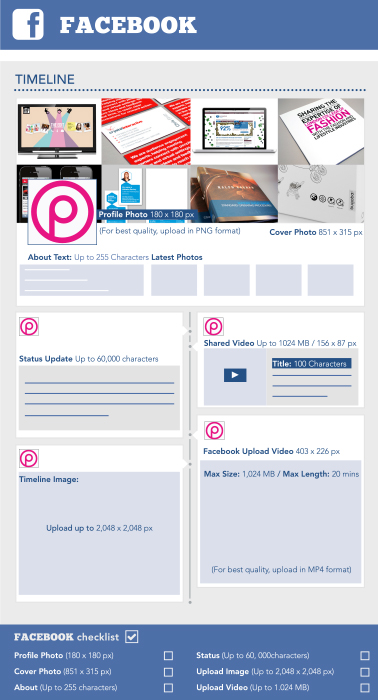
In 2026, Facebook’s key image sizes are 320 x 320 pixels for profile pictures, 851 x 315 pixels for cover photos, 1200 x 630 pixels for landscape posts, 1080 x 1080 pixels for square posts, and 1080 x 1920 pixels for Stories. The details and reasoning behind each size are below.
Nothing undercuts a brand’s Facebook page faster than a stretched logo or a cover photo that crops out the headline. It happens constantly, and usually for the same reason: Facebook has changed its image dimensions several times over the years, so whatever size worked in 2020 (or 2014) probably isn’t right anymore. Here’s exactly what to use in 2026, checked directly against Meta’s own Help Center.
Facebook profile picture size
Your profile picture shows up as a circle at 170 x 170 pixels on desktop and 128 x 128 pixels on mobile, but you shouldn’t upload it at that size. Facebook recommends starting with a square image at least 320 x 320 pixels so the crop still looks sharp everywhere it appears: in comments, in Messenger, next to every post you make. Keep your logo or headshot centered, since anything near the edges gets clipped off by the circular crop. JPG works fine for photos; use PNG if your logo has transparency or fine text that needs to stay crisp.
Facebook cover photo size
According to Meta’s official Help Center, Page cover photos display at 851 x 315 pixels, and that’s the number to design around. Upload something smaller and Facebook will simply stretch it to fit, which is where most of the blurriness comes from. The absolute minimum Facebook will accept is 399 x 150 pixels, but treat that as a floor, not a target.
For the sharpest result, upload an sRGB JPG at 851 x 315 pixels and keep the file under 100 KB for fast loading. If you’re starting from a larger source image, a free tool like ImageConvertix can resize, compress, and convert it to the right format right in the browser, no installation needed. If your cover includes a logo or text rather than a photo, switch to PNG, since it compresses flat graphics far more cleanly than JPG does.
One detail that trips people up: your profile picture overlaps the bottom-left corner of your cover photo on both desktop and mobile, so keep anything important (text, a face, your logo) away from that corner. Because the layout also shifts slightly between devices, it’s worth previewing your cover on a phone before you publish rather than only checking it on desktop.
Facebook post image sizes
Facebook supports three shapes for feed images now, and which one you pick genuinely changes how much room your post takes up. A landscape image works best at 1200 x 630 pixels (a 1.91:1 ratio), a square image at 1080 x 1080 pixels, and a portrait image at 1080 x 1350 pixels (4:5). Portrait and square posts tend to claim more vertical space in the mobile feed than landscape does, which is worth testing if landscape has been your default. A lot of brands see a real difference just from switching shape.
Facebook Story size
Stories are full-screen and vertical, so design at 1080 x 1920 pixels with a 9:16 ratio. Keep text and logos out of the top and bottom roughly 15% of the frame. That space gets covered by the profile name, reply bar, and navigation icons Facebook overlays automatically.
Facebook video specs
Video limits vary by where the video is going, and Meta has loosened several of these over the past year, so it’s worth double-checking your account before anything time-sensitive. As a safe working number, 4 GB is a reliable ceiling across Feed, Reels, and Stories. MP4 with H.264 video and AAC audio is the most dependable format; MOV also works. Feed videos can run up to roughly 240 minutes, Reels are vertical at 1080 x 1920 pixels, and Stories run around 60 seconds per segment. Whatever you upload, start with the highest-quality source file you have. Facebook re-encodes every video after upload, and a better original simply survives that compression better.
Quick reference table
| Element | Size | Format |
| Profile picture | 320 x 320 px minimum (displays at 170 x 170 px) | JPG/PNG |
| Cover photo | 851 x 315 px | JPG, or PNG for logos/text |
| Landscape post | 1200 x 630 px | JPG/PNG |
| Square post | 1080 x 1080 px | JPG/PNG |
| Portrait post | 1080 x 1350 px | JPG/PNG |
| Story | 1080 x 1920 px | JPG/PNG/MP4 |
| Video | Up to 4 GB | MP4/MOV |
Facebook image size FAQ
Why does my Facebook cover photo look cropped on mobile? Cover photos render slightly differently across devices, so content pushed toward the edges is more likely to get cut off. Centering your key elements avoids most cropping issues.
What file format should I use for a logo on Facebook? PNG. It handles flat colors, sharp edges, and text far more cleanly than JPG, which is built for photographs and compresses graphics poorly by comparison.
What’s the ideal Facebook cover photo size in 2026? 851 x 315 pixels, uploaded as an sRGB JPG under 100 KB, straight from Meta’s own specifications.
Keep the rest of your social presence sized right, too
Facebook is rarely the only platform in the mix. If Instagram is part of your strategy, our guide to optimizing Instagram images covers the current square, portrait, and Story dimensions there. Repurposing video across platforms is its own puzzle too, and our Vimeo sizing cheat sheet and SlideShare sizing cheat sheet walk through those specs, and the complete social media sizing cheat sheet rounds up every major network in one place if you’re managing several at once.
Getting the dimensions right is just the starting point, though. Once your visuals are properly sized, the real question is whether they’re doing their job. If you’re deciding where to focus your energy, our roundup of the top social media platforms for brands is a good place to prioritize from. B2B teams specifically can see how properly optimized profiles turn into pipeline through social media lead generation, and once your images are sized correctly, our breakdown of CTR tactics that consistently outperform covers what actually gets them clicked. For the bigger picture of where social strategy is headed next, our social media trends roundup is worth a read too.
Correctly sized, on-brand visuals are table stakes. If you’d rather hand the strategy and execution off entirely, that’s exactly what our team does. Get in touch to talk through your social media plan.
Source: http://thepinkgroup.co.uk/
About The Author