Artificial intelligence may feel like a modern invention, but the dream behind it is ancient.
Long before people used tools like ChatGPT, Midjourney, Siri, or self-driving technology, humans were already imagining machines that could think, speak, move, and make decisions. The history of artificial intelligence is not just a story about computers. It is a story about human curiosity.
For centuries, people have asked one big question:
Can we create something that thinks like us?
That question eventually led to one of the most important fields in technology today: artificial intelligence, or AI.
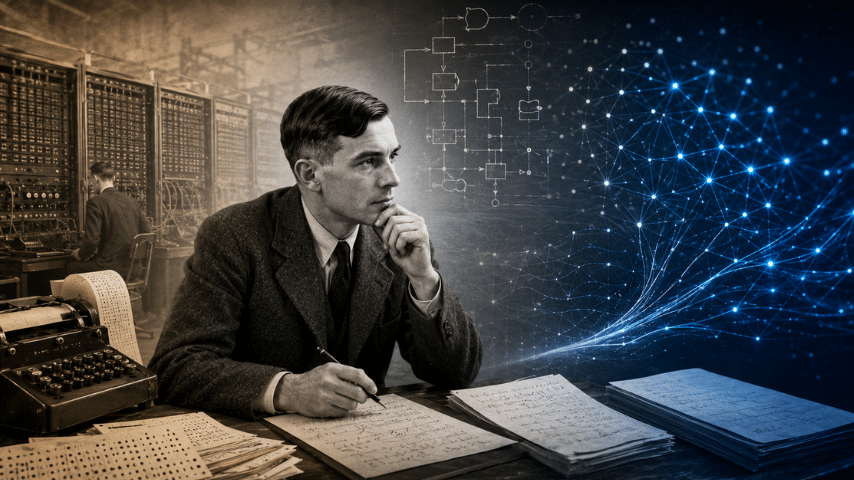
The Dream of Thinking Machines
The idea of artificial intelligence did not begin in a computer lab. It began in myths, stories, and imagination.
Ancient civilizations told stories about artificial beings made by humans or gods. These beings could move, obey commands, or act almost like living creatures. While these were not real machines, they showed that people had long been fascinated by the idea of creating life-like intelligence.
Over time, that dream moved from fantasy to engineering.
Inventors began building mechanical devices that could perform tasks automatically. These early machines were not “intelligent” in the way we define AI today, but they were important because they showed that human actions could be copied through mechanisms.
Eventually, the question changed.
Instead of asking, “Can we build a machine that moves?”
People began asking, “Can we build a machine that thinks?”
Alan Turing and the Question of Machine Intelligence
One of the most important figures in the history of AI was Alan Turing, a British mathematician and computer scientist.
In 1950, Turing published a famous paper called Computing Machinery and Intelligence. In it, he asked a bold question: Can machines think? His work helped shape the foundation of computer science and the early artificial intelligence movement.
Turing also introduced what later became known as the Turing Test.
The idea was simple but powerful. A human evaluator would have a text-based conversation with both a human and a machine, without knowing which was which. If the evaluator could not reliably tell the machine from the human, the machine could be considered to show intelligent behavior.
This did not mean the machine had feelings or consciousness. But it gave researchers a practical way to think about machine intelligence.
Instead of debating whether a machine had a “mind,” Turing focused on behavior.
Could a machine respond in a way that seemed intelligent?
That question became one of the starting points for AI research.
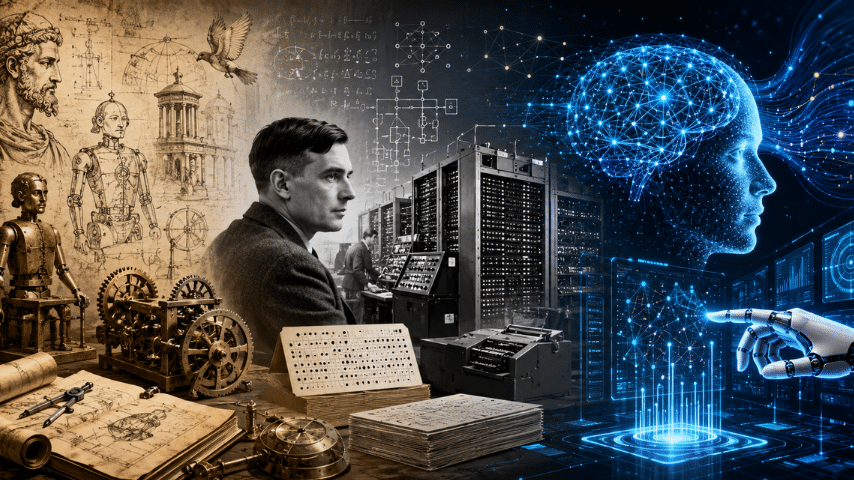
The Birth of Artificial Intelligence as a Field
The official birth of artificial intelligence as a research field is often linked to the Dartmouth Summer Research Project on Artificial Intelligence in 1956.
This workshop was organized by John McCarthy, who is widely credited with helping coin the term “artificial intelligence.” A small group of scientists gathered at Dartmouth College to explore whether human learning and intelligence could be described so precisely that machines could simulate them.
This was a major turning point.
Before this, many scientists had studied computing, logic, mathematics, and automation. But the Dartmouth workshop gave the field a name and a direction.
The researchers believed that machines might one day be able to use language, solve problems, improve themselves, and perform tasks that required intelligence.
At the time, this idea was extremely ambitious.
Computers were large, expensive, and limited. They did not have the speed, memory, or data that modern AI systems rely on today. But the vision was there.
The dream of AI had officially entered the scientific world.
Early AI: Rules, Logic, and Problem-Solving
In the early years, AI was mostly built around rules and logic.
Researchers believed that if human reasoning could be broken down into clear steps, then computers could follow those steps. This approach is often called symbolic AI.
For example, an early AI system might be given a set of rules like:
If this happens, do that.
If this condition is true, choose this answer.
If a problem matches this pattern, use this solution.
This worked well for certain tasks, especially games, puzzles, and structured problems. Computers could follow instructions quickly and accurately.
But there was a problem.
Human intelligence is not always neat or rule-based.
People understand context. We recognize tone. We make guesses. We learn from messy real-world experiences. We can understand an unclear sentence, identify a face in bad lighting, or know that someone is joking.
Early AI struggled with this.
It could perform well in controlled environments, but it had difficulty with the complexity of the real world.
The AI Winter: When the Hype Cooled Down
Because early AI researchers were optimistic, people expected fast progress.
Many believed that machines would soon be able to translate languages perfectly, hold conversations, solve complex problems, and perform human-level reasoning.
But the technology was not ready.
Computers were not powerful enough. There was not enough data. Many AI systems worked only in narrow situations. When they were taken outside those situations, they often failed.
As expectations grew too high and results fell short, funding and excitement dropped. These periods became known as AI winters.
An AI winter is a time when interest, investment, and confidence in artificial intelligence decline.
This is an important part of AI history because it shows that AI did not become powerful overnight. It went through cycles of excitement, disappointment, and rebuilding.
The Comeback: Machine Learning Changes Everything
AI began to grow again when researchers shifted from trying to program every rule manually to letting computers learn from data.
This approach is called machine learning.
Instead of telling a computer exactly what to do in every situation, researchers gave it examples. The system could then look for patterns and improve over time.
For example, instead of programming every possible rule for identifying a cat, researchers could show a machine thousands or millions of images labeled “cat” and “not cat.” Over time, the system could learn patterns that help it recognize cats in new images.
This was a major shift.
AI was no longer just about rules. It became about learning.
As computers became faster and more data became available, machine learning became more powerful. This opened the door to better speech recognition, image recognition, recommendation systems, fraud detection, and translation tools.
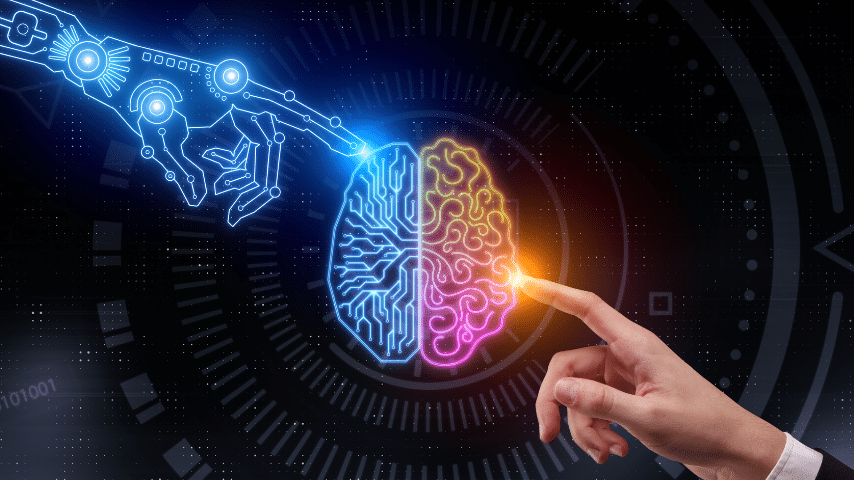
Neural Networks and Deep Learning
Another important breakthrough came from neural networks.
Neural networks are computer systems inspired by the way the human brain processes information. They are made of layers that help a machine recognize patterns.
Early neural networks existed for decades, but they were limited by computing power and available data. Once technology improved, neural networks became much more useful.
This led to deep learning, a type of machine learning that uses many layers to process information.
Deep learning helped AI make huge progress in areas like:
image recognition, voice assistants, language translation, medical imaging, self-driving technology, and content generation.
This is one of the reasons modern AI feels so advanced compared to older systems.
Instead of only following fixed instructions, modern AI systems can detect patterns in enormous amounts of data.
How Modern AI Became Possible
The AI tools we use today were made possible by several things coming together:
better computers, larger datasets, improved algorithms, cloud computing, and years of research.
Modern AI is not one invention. It is the result of many breakthroughs stacked on top of each other.
Alan Turing helped ask the right question.
The Dartmouth researchers helped define the field.
Early programmers built rule-based systems.
Machine learning researchers taught computers to learn from examples.
Deep learning researchers created systems that could process huge amounts of information.
Modern AI teams built models that can generate text, images, audio, code, and more.
This is why AI seems to have suddenly appeared everywhere, even though its history is much longer.
AI did not come from one moment.
It came from decades of experiments, failures, discoveries, and improvements.
Why the History of AI Matters Today
Understanding the history of AI helps us understand what AI really is.
AI is not magic. It is not human thinking copied perfectly into a machine. It is a technology built from mathematics, data, computing power, and human design.
It can do incredible things, but it also has limits.
AI can generate content, answer questions, recognize patterns, and automate tasks. But it can also make mistakes, reflect bias in data, misunderstand context, or produce answers that sound confident but are not accurate.
That is why the future of AI depends not only on better technology, but also on responsible use.
The same question that started AI is still important today:
What should machines be able to do, and how should humans guide them?
Final Thoughts
The history of artificial intelligence is the story of a dream becoming real.
It started with myths about artificial beings. It grew through mathematics, computing, and scientific research. It became a formal field in the 1950s. It struggled through disappointment and AI winters. Then it came back stronger through machine learning, neural networks, and deep learning.
Today, AI is part of everyday life.
It helps people write, search, shop, create, translate, analyze, design, and communicate. But behind every modern AI tool is a long history of human imagination and innovation.
Artificial intelligence was not built overnight.
It was made by people who believed that machines could do more than calculate.
They believed machines could learn.
And that belief changed the world.
About The Author