Copilot Checkout and Brand Agents: Ecommerce AI Conversion Playbook
What just happened (and why it matters)
Microsoft Advertising just announced two capabilities aimed straight at the biggest leak in ecommerce: the gap between “I’m interested” and “I’m buying.” The leak is getting smaller because the shopping journey is being compressed into a single chatbot conversation.
They unveiled:
- Copilot Checkout: an in-conversation checkout experience designed to remove redirects and friction while keeping the merchant as the merchant of record (so you own the transaction and customer relationship). You can apply to be a Copilot Checkout Merchant here.
- Brand Agents: AI-powered shopping assistants for your Shopify site that speak in your brand voice and guide shoppers from questions to purchase based on Microsoft Clarity data.
The real headline: conversions moved upstream
If you’re still thinking in terms of “rank > click > product page > cart,” you’re already late.
AI assistants are now doing the early-funnel work: clarifying intent, comparing options, and answering objections before a shopper ever hits your site. Microsoft describes this as the fight for conversions moving upstream: inside the same interaction where the shopper is researching and deciding.
That’s the point of Copilot Checkout: conversation-to-conversion in one place.
AI shopping isn’t one thing. It’s three overlapping things.
Microsoft’s AEO/GEO playbook breaks the AI shopping ecosystem into AI browsers, AI assistants, and AI agents and the key detail is that these capabilities overlap.
Translation: the “surface” changes, but the inputs stay similar. If the system can’t read your product facts, it can’t recommend you. If an agent can’t complete your checkout, your feed perfection doesn’t matter.
Discovery and Conversion are now both AI Driven
This announcement is basically a spotlight on our core belief: discovery and conversion are now one continuous AI-mediated flow. You win it with the same three levers we use in our SEO for AI framework:
- On-page visibility (make your site and catalog easy for AI to find, load, and understand)
- Off-page trust & authority (earn the mentions and sources AI systems trust)
- Monitoring (track citations, visibility shifts, and the conversion impact of AI-assisted sessions)
Copilot Checkout: what it is (and what it isn’t)
Copilot Checkout is positioned as a friction remover. The shopper stays inside Copilot, compares options, asks follow-ups, and checks out without being bounced through a dozen tabs.

What should make merchants pay attention is the merchant-forward positioning: you stay the merchant of record and keep customer data and the relationship.
Microsoft shared early performance signals from Copilot shopping journeys (internal data): more purchases within 30 minutes and a higher likelihood to purchase when shopping intent is present.
Brand Agents: your best in-store associate, now on your website
Brand Agents are the on-site counterpart: an assistant that speaks in your voice and helps customers explore, compare, and confidently click “buy.”
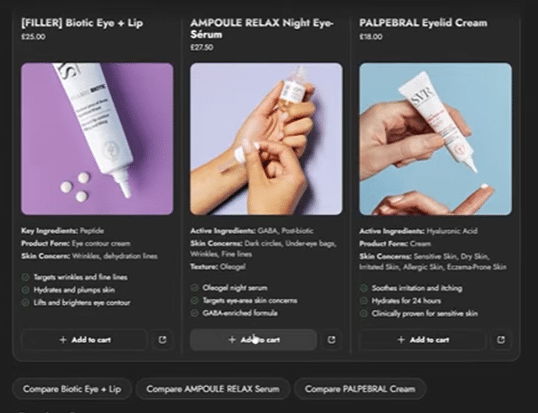
The pitch is speed: deployed in hours, not weeks. And the promise is measurable uplift: Microsoft highlights a Shopify merchant reporting over 3X higher conversion rates in agent-assisted sessions.
Brand Agents tie into Microsoft Clarity for dashboards showing engagement and conversion metrics, so teams can improve performance based on how shoppers actually interact.
The playbook: win AI discovery + AI conversions with our 3-part framework
Here’s the practical part. If you want Copilot (and other assistants/agents) to recommend you, you need to feed the machine and make your site “agent-ready.”
1) On-page visibility: make your catalog AI-readable
Our SEO for AI framework starts here: make pages easy to find, load, and understand for people and AI.
From Microsoft’s AEO/GEO guide, AEO is about clarity with enriched, real-time data, and GEO is about credibility with an authoritative voice. Your on-page work supports both.
Technical foundations (do these before you debate prompts)
If your product facts aren’t structured, fresh, and consistent, you’re asking an AI assistant to improvise. That’s not a strategy.
- Technical SEO basics: HTTPS, clean URLs, broken-link fixes, correct XML sitemaps and robots.txt.
- Performance: mobile-first with strong Core Web Vitals and fast media.
- Schema markup: Organization, Product, Offer, AggregateRating, Review, Brand, ItemList, FAQ.
- Dynamic fields: keep price, availability, variants (color/size), SKU/GTIN, and dateModified in sync across site and feeds.
Content that converts in an AI-first funnel
In AI shopping, assistants interpret queries as intents. Your content has to answer real questions directly, with citable blocks that match how people ask.
- Pillar page + supporting cluster (you’re reading the pillar).
- Short Q&A blocks for AI snippets (shipping, returns, sizing, compatibility, warranties).
- Comparison tables and “Model A vs Model B” sections that make trade-offs explicit.
- Alt text, captions, and transcripts so multi-modal systems can understand visuals and video.
2) Off-page trust & authority: become the brand AI feels safe recommending
AI systems prioritize trustworthy sources. So does every human with a credit card.
This is where your ability to get found in AI search really lives: authoritative mentions, credible citations, and consistent entity data across the web.
- Backlinks: publish link-worthy assets (original data, tools, checklists) and do targeted outreach.
- PR: earn coverage on high-crawl outlets so your claims are backed by third-party sources.
- Wikipedia/Wikidata/Knowledge Graphs: connect structured facts to citations so your entity is unambiguous.
- Directories: keep Name/Address/Phone consistent across major platforms.
3) Monitoring: measure the invisible early funnel
If discovery happens inside conversations, your analytics needs to catch up.
The GEO framework emphasizes monitoring AI citations/mentions and comparing AI-driven traffic vs organic.
- Track AI citations and mentions (who is quoting you, and for what).
- Watch Search Console for indexing and schema errors.
- Measure agent-assisted conversion uplift, AOV changes, and engagement time vs non-assisted sessions.
- Create an alerting routine for feed freshness and out-of-stock errors.
Implementation checklist: what to do this week
If you want a simple action plan, here it is.
- Audit your product feed and on-site schema for missing or inconsistent fields (price, availability, variants, ratings).
- Add or improve Product/Offer/Review/FAQ/ItemList schema on high-value categories and best sellers.
- Publish one “money” pillar page and 5-7 supporting articles focused on top converting intents (exactly what you’re building right now).
- Build a trust stack: verified reviews, clear policies, third-party mentions, and consistent entity profiles (Wikidata, directories).
- Set up monitoring: AI citation tracking + Search Console checks + a weekly feed freshness report.
We know it sounds like a lot…
If this feels like a lot, good news: it’s a system, not a mystery.
Our SEO for AI service is built for this exact moment: make your site AI-readable, build trust that AI systems can cite, and measure what’s happening as discovery shifts into assistants and agents.
If you want, we’ll map your current footprint, identify the fastest wins, and give you a clear sprint plan.
Sources
Microsoft Advertising. “Conversations that Convert: Copilot Checkout and Brand Agents.” January 8, 2026.
Microsoft Advertising. “From Discovery to Influence: A Guide to AEO and GEO.” Playbook referenced by Microsoft Advertising blog post.
AOK Marketing. “SEO for AI” service framework (On-page visibility, Off-page trust & authority, Monitoring).
Frequently asked questions (for AI snippets)
Q: Does Copilot Checkout replace my website checkout?
A: No. The point is to remove friction during discovery, but the merchant stays the merchant of record and still needs a functioning ecommerce site and accurate product data.
Q: Do I need Microsoft Merchant Center (MMC) to benefit?
A: Microsoft notes MMC is not required to sell through Copilot Checkout, but MMC product feeds help inform organic Copilot results.
Q: Are Brand Agents only for Shopify?
A: Brand Agents are currently presented as available for Shopify merchants, enabled through Microsoft Clarity.
Q: What’s the fastest way to improve AI recommendations for my products?
A: Start with structured product facts (feeds + on-site schema) and tighten trust signals (reviews, policies, third-party mentions).
Q: What’s AEO vs GEO in plain English?
A: AEO is clarity: accurate, structured, fresh product facts. GEO is credibility: authoritative sources and consistent brand signals that AI can trust.
Q: How do I measure “AI discovery”?
A: Track citations/mentions in AI answers, compare assisted vs unassisted sessions, and monitor feed/schema health so you can connect visibility to conversion.
About The Author