The new rules of traffic drops
An organic traffic drop used to mean one of two things: your rankings slid or your tracking broke.
Now it can mean that… and more! Here are four things that might be causing the drop in your dashboard:
1) A ranking issue (algorithm update, competitors, intent shift).
2) A click issue (AI Overviews and other SERP features answering the question before a click ever happens).
3) An indexing/crawl issue (Google can’t find, render, or trust the right version of the page).
4) A content issue (you have the right topic but the wrong page, the wrong intent, or too many pages fighting each other).
If you don’t separate those quickly, you’ll do what most teams do under pressure:
- rewrite content when the problem is technical
- blame a “core update” when the problem is your analytics or a bot-blocking deploy
- chase sessions when the real business goal is qualified demand and visibility
This framework is designed for the moment when someone Slacks you: “Traffic is down. What happened?” and you need an answer that’s fast, credible, and actionable.
See Also : AI Search Engine Optimization Strategies for Businesses 2026 Edition
What you’ll get from this framework
| Best for | SEO leads, embedded marketing owners, founders/GM, and web/engineering partners responding to a sudden organic drop. |
| Time to first diagnosis | 60–180 minutes for a confident “what changed” and initial root-cause hypothesis. |
| Time to initial recovery sprint | 2 weeks to ship the highest-impact fixes and stabilize visibility. |
| Primary outputs | Segmented impact report, root-cause shortlist, prioritized fix backlog, and an exec-ready narrative. |
| Success definition | Restored qualified demand and search visibility, not just “sessions back.” |
| Where this lives | Your incident playbook and a recurring monthly health check. |
Before you panic: what the data patterns usually mean
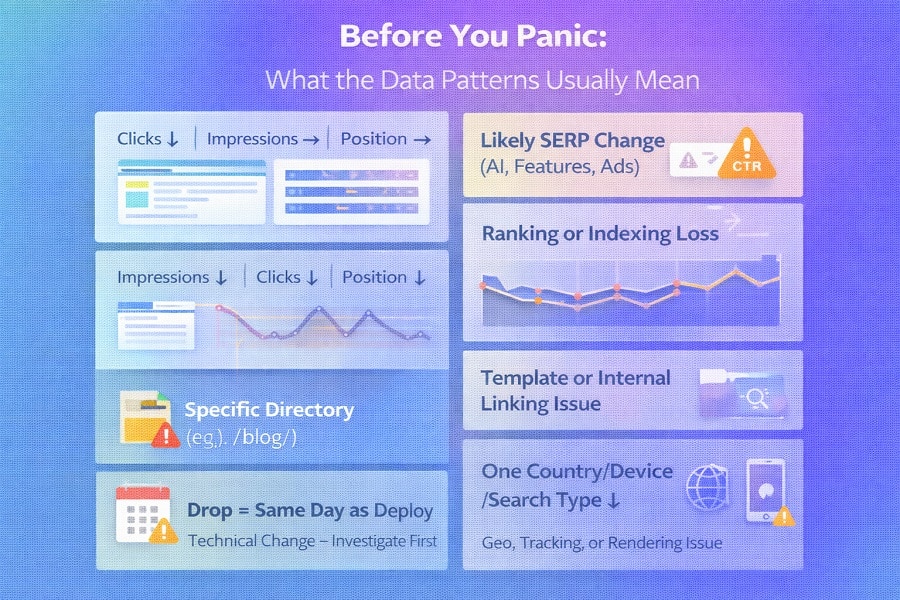
Most drops announce themselves with a pattern. Learn the patterns and you cut diagnosis time in half.
- Clicks down, impressions flat, average position roughly flat: typically CTR loss from SERP changes (AI Overviews, featured snippets, more ads, more local packs).
- Impressions down, clicks down, position worse: rankings or indexing (or both).
- Specific directory/template down (ex: /blog/ or /collections/): usually technical, internal linking, or template-level intent mismatch.
- Only non-brand down, brand stable: often competitive displacement or SERP feature expansion. Sometimes content quality/intent drift.
- Only one country/device/search type down: tracking, geo targeting, hreflang, mobile rendering, or localization issues.
- Drop starts the same day as a deploy: treat as technical until proven otherwise.
See also : Earned Authority for AI: PR, Co-Citations and GEO Strategy (2026)
The 7-step recovery framework
Run these steps in order. Each step either rules out a cause or narrows the suspect list.
The goal isn’t to build the perfect diagnosis deck. The goal is to stop guessing and start shipping.
Step 1: Confirm the drop (data sanity checks)
Validate the drop with multiple sources (Search Console, analytics, server logs) and normalize for data lag and seasonality.
Step 2: Segment impact (brand vs non-brand, query classes, page types)
Locate the damage. You can’t fix what you can’t localize.
Step 3: SERP changes (AI Overviews, feature shifts, competitor displacement)
Search didn’t just “rank pages” anymore. It assembles answers. Your job is to see what Google is now showing instead of you.
Step 4: Algorithm signals (core updates, manual actions, link trends)
Tie your drop date to known updates and alerts. Confirm whether this is an algorithmic shift, a policy issue, or a reputation/links problem.
Step 5: Technical triage (indexing, crawl, rendering, logs, sitemap, robots)
If Google can’t crawl or trust the correct version, your content doesn’t matter. Triage technical risks in the right order.
Step 6: Content triage (cannibalization, intent mismatch, thin/duplicative sections)
Most “content fixes” fail because teams edit the wrong page. This step ensures you have one best page per intent and it’s built for humans and machines.
Step 7: Authority triage (lost links/mentions, E-E-A-T gaps)
Sometimes the drop isn’t your page. It’s the trust and context around your brand and authors. You diagnose and shore that up here.
The 2-week recovery sprint plan

You can diagnose forever. Or you can ship. Here’s a sprint that gets you from “traffic is down” to “we have a fix in production” fast.
Days 1–2: Stabilize the story and localize the damage
- Run Step 1 (confirm the drop). Output: a single, trusted chart with the right date range and segments.
- Run Step 2 (segment impact). Output: top 3 segments driving 80% of the loss.
- Freeze the blame game: publish a simple internal update (template below).
Days 3–4: Determine if this is a click problem or a ranking/indexing problem
- Run Step 3 (SERP changes). Output: sample SERP captures and a CTR hypothesis (AI Overviews vs feature shift vs competitor).
- Run Step 4 (algorithm signals). Output: update/incident correlation and any Search Console alerts.
Days 5–7: Ship the highest-confidence technical fixes
- Run Step 5 (technical triage). Output: a prioritized list of “stop the bleeding” issues (robots/noindex/canonicals/redirects/5xx).
- Ship fixes with rollback plans. Output: production changes and verification checks in Search Console.
Week 2: Consolidate content, repair authority, and shift measurement
- Run Step 6 (content triage). Output: consolidate cannibalized pages, align intent, and upgrade thin sections.
- Run Step 7 (authority triage). Output: lost-link recovery list and E-E-A-T upgrades (authors, sources, evidence).
- Establish a new baseline: track visibility and demand, not just traffic. (More below.)
See also : AI-Readable SEO: Schema and Technical Signals
Stakeholder-friendly reporting template
The fastest way to lose confidence is to talk like an SEO tool. The fastest way to gain confidence is to communicate like an operator.
Use this structure for your internal update or exec brief:
- What happened (1 chart): organic clicks/sessions vs prior period, with the exact date the change started.
- Where it happened: the 2–3 segments responsible for most of the loss (brand vs non-brand, page type, country/device).
- Why we think it happened: the top 1–3 root-cause hypotheses with evidence (SERP changes, indexing, update timing, deploy).
- What we’re doing this week: the fix backlog with owners and ship dates.
- What success looks like: leading indicators (impressions, position, index coverage, AI visibility) and lagging indicators (qualified leads/revenue).
- Risks and unknowns: what could invalidate the hypothesis and how we’ll test it.
Copy/paste: internal update message
Subject: Organic traffic drop – incident update
We confirmed an organic drop starting on [DATE]. It is concentrated in [SEGMENT] and [SEGMENT].
Early evidence suggests the primary driver is [HYPOTHESIS], based on [EVIDENCE].
This week we are shipping: (1) [FIX], (2) [FIX], (3) [FIX]. Owners: [NAMES].
We’ll report back on [DATE] with updated metrics: impressions, clicks, index coverage, and lead quality.
When to run a GEO baseline and shift KPIs
If AI Overviews (and other “answer-first” features) are taking clicks, you can do everything right and still watch sessions fall.
That’s not failure. That’s the shape of the channel changing.
What you do in that world is shift the scoreboard:
- Visibility metrics: impressions, average position, share of SERP features, citation presence in AI answers (where measurable).
- Demand metrics: branded search trends, direct traffic lift, and lead quality from organic (not just volume).
- Coverage metrics: how many of your priority topics have a clear “best page” and how many are cannibalized.
- Entity/authority metrics: unlinked brand mentions, earned links, expert citations, and author trust signals.
Run a GEO baseline with a tool like LLMtel.com when:
- rankings look stable but clicks trend down for non-brand informational queries
- your category is heavy on AI Overviews (how-to, comparisons, definitions, troubleshooting)
- you’re seeing more “zero-click” behavior in analytics
A GEO baseline is simply your “visibility inventory” across: traditional blue links and SERP features and AI answer surfaces.
See also : AI Visibility: How to Show Up in AI Search & Answers
On-page modules and schema recommendations
Recommended modules:
- Above-the-fold: ‘What changed’ decision tree (click issue vs ranking/indexing issue).
- The 7-step framework overview (this page) and links to cluster articles.
- 2-week sprint plan and reporting template.
- FAQ section addressing common stakeholder questions.
Recommended schema:
- Article
- FAQPage
- HowTo (for the 7-step process or the 2-week sprint plan)
- BreadcrumbList
FAQ
We didn’t change anything. How can traffic drop overnight?
Because Search changed. Or your competitors changed. Or Google re-evaluated your pages. Or your tracking did change and nobody told marketing. Step 1 exists for a reason: verify the data before you rewrite the site.
Rankings look stable but clicks are down. What do we do?
Treat it like a SERP real-estate problem. Capture SERPs, identify what displaced you (AI Overviews, featured snippets, local packs), and adjust content and formatting so you can win visibility even when clicks shrink.
Should we pause publishing new content during a drop?
Pause only if you’re about to publish more pages that cannibalize the same topics. Otherwise, keep publishing – but focus on consolidating around best pages and improving evidence and authority.
How long does recovery take?
Technical fixes can show impact quickly once crawled and reprocessed. Algorithmic trust and authority fixes typically take longer. The sprint plan is about stabilizing the trend and restoring control, not promising overnight miracles.
References and useful docs
Keep these bookmarked for incident response:
- Google Search Console Help Center (performance reports, indexing, manual actions).
- Google Search Central documentation (crawling/indexing, sitemaps, canonicalization, redirects).
- Google Search Status Dashboard (for indexing/serving incidents).
About The Author