Social media has a funny way of feeling both completely obvious and totally confusing at the same time. Anyone can open an account and start posting. Very few brands actually get it right. Somewhere between “post more” and “post less,” between chasing followers and building a community, there’s a set of ground rules that separate the brands people genuinely want to follow from the ones people scroll straight past.
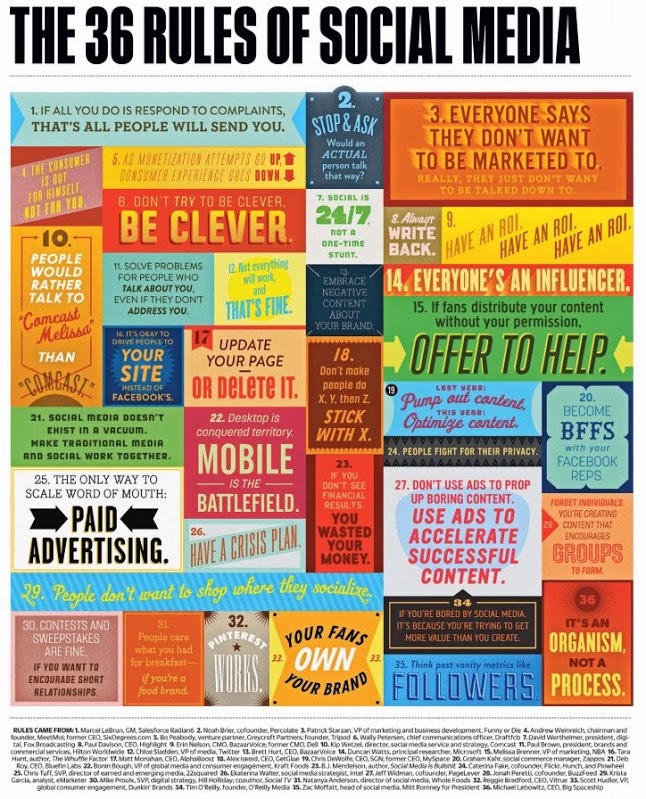
A widely shared marketing infographic once distilled decades of hard-won social media wisdom into 36 short, punchy rules, insights pulled from CEOs, CMOs, and social strategists who’ve actually been in the trenches running campaigns, fielding complaints, and watching what really moves the needle. Some of those rules are blunt. Some are almost philosophical. All of them still hold up, because the platforms change constantly, but human behavior really doesn’t.
This guide breaks those rules down into practical, usable groups so you can actually apply them to your own social media marketing strategy, whether you’re running a single Instagram account or managing a full multi-platform presence for a growing brand.
Rule Group 1: Stop Broadcasting, Start Listening
“If all you do is respond to complaints, that’s all people will send you.”
This is one of the more counterintuitive rules, and it’s exactly why so many brand social accounts feel lifeless. If your only activity is customer service, you train your audience to only reach out when something’s wrong. A healthy social presence needs a mix: celebrating wins, sharing behind-the-scenes moments, answering questions before they become complaints, and simply being present in the conversation, not just reacting to it.
“Always write back.”
Silence is the fastest way to lose trust on social media. Whether it’s a compliment, a question, or a complaint, a reply, even a short one, tells people there’s an actual human behind the account. Brands that respond quickly and consistently build a reputation for being reliable, which matters just as much as the product itself.
“Social is 24/7, not a one-time stunt.”
A single viral post or clever campaign doesn’t build a brand. Consistency does. Social media rewards brands that show up regularly, not the ones that disappear for months and then post a big splashy campaign hoping to make up for lost time.
Rule Group 2: Marketing Without Sounding Like Marketing
“Everyone says they don’t want to be marketed to. Really, they just don’t want to be talked down to.”
This might be the single most important rule on the entire list. People aren’t rejecting marketing itself, they’re rejecting condescending, tone-deaf, overly salesy marketing. Speak to your audience like they’re smart adults who can make their own decisions, and they’ll actually stick around to hear what you have to say.
“Don’t try to be clever. Be clever.”
Forced humor and try-hard wit are painfully obvious online. The brands that actually land a joke or a clever line do it because it comes naturally from their voice, not because a content calendar told them Tuesday needed something “fun.”
“Not everything will work, and that’s fine.”
Social media rewards experimentation. Some posts flop. Some formats don’t resonate. That’s not failure, that’s data. The brands who improve fastest are the ones who treat every post as a small test rather than a make-or-break moment.
Rule Group 3: Content That Actually Solves Problems
“Solve problems for people who talk about you, even if they don’t address you.”
Social listening isn’t just about monitoring your brand name. People complain, ask questions, and vent about problems your product or service could solve without ever tagging you directly. Brands that catch those conversations and step in with genuine help, not a sales pitch, build enormous goodwill.
“Update your page or delete it.”
An abandoned social account is worse than no account at all. It signals neglect, and in some cases, it makes a brand look like it’s gone out of business. If you can’t commit to keeping a channel active, it’s better to consolidate your energy into fewer platforms you can actually maintain well.
“Embrace negative content about your brand.”
Ignoring or deleting criticism rarely makes it disappear, it usually makes it worse. Brands that acknowledge negative feedback publicly, take ownership where it’s warranted, and show they’re listening tend to come out of a rough patch with more trust than they had before.
Rule Group 4: Prove It With Numbers
“Have an ROI. Have an ROI. Have an ROI.”
Repeated three times on the original list for a reason. Social media without measurable goals is just noise. Whether your objective is leads, sales, website traffic, or brand awareness, define it clearly and track it, or you’ll never know whether your efforts are actually working.
“If you don’t see financial results, you wasted your money.”
This is a hard truth many brands avoid facing. Vanity metrics like follower counts and likes feel good, but they don’t pay the bills. A strong social media ROI framework connects your social activity to actual business outcomes, not just engagement for engagement’s sake.
“Don’t use ads to prop up boring content. Use ads to accelerate successful content.”
Paid promotion works best as an amplifier, not a life-support machine. If a piece of content isn’t performing organically, throwing ad spend behind it rarely fixes the underlying problem. Instead, identify what’s already resonating and put your budget behind scaling that success further.
Rule Group 5: Mobile, Desktop, and Where Your Audience Actually Lives
“Mobile is the battlefield.”
The overwhelming majority of social media consumption happens on a phone, in short bursts, often while doing something else entirely. Content that doesn’t load fast, format cleanly, or grab attention within the first few seconds on a small screen simply won’t perform, no matter how good it looks on a desktop monitor.
“Desktop is conquered territory.”
This doesn’t mean desktop doesn’t matter, it means the competitive battle for attention has already moved elsewhere. Brands that over-invest in desktop-first design while under-investing in mobile experience are optimizing for a shrinking share of their actual audience.
Rule Group 6: Influence, Advocacy, and Word of Mouth
“Everyone’s an influencer.”
You don’t need a celebrity partnership to benefit from influence. Every single follower who shares, comments, or tags a friend is acting as a micro-influencer for your brand. Treating your everyday audience with the same care you’d give a paid partnership pays off in ways traditional influencer marketing can’t replicate.
“If fans distribute your content without permission, offer to help.”
When someone shares your content or talks about your brand unprompted, that’s free advocacy. Instead of worrying about control, lean in, reach out, thank them, and see if there’s a way to support what they’re already doing. Trying to clamp down on organic enthusiasm almost always backfires.
“The only way to scale word of mouth: paid advertising.”
Organic word of mouth is powerful but slow and unpredictable. If you want to consistently reach new audiences at scale, paid social remains one of the most effective tools for extending the reach of the stories your existing fans are already telling.
Rule Group 7: Content Strategy Over Content Volume
“Pump out content” was last year. This year: optimize content.
There was a time when sheer output was considered a winning social media strategy. That era is over. Audiences are more discerning, algorithms reward engagement over volume, and a smaller batch of genuinely useful, well-crafted posts consistently outperforms a flood of forgettable ones.
“People fight for their privacy.”
Data privacy concerns aren’t going away. Brands that are transparent about how they collect and use customer data, and that respect boundaries around targeting and personalization, build far more durable trust than those that push the limits of what’s technically allowed.
“Think past vanity metrics like followers.”
A large follower count means very little if those followers never engage, click, or convert. Focus on metrics that actually reflect business impact: click-through rates, conversion rates, share of voice, and repeat engagement from real, active accounts.
Rule Group 8: Building Real Relationships, Not Just Audiences
“Become BFFs with your Facebook reps.”
Platform representatives can offer insight into upcoming algorithm changes, ad product updates, and best practices you won’t find in a public help center. Building a relationship with your platform contacts, where available, can give your brand an edge most competitors never bother to pursue.
“Forget individuals, you’re creating content that encourages groups to form.”
The strongest social media communities aren’t built one follower at a time, they’re built around shared interests, identities, or causes that bring people together. Content that sparks a sense of belonging tends to outperform content aimed narrowly at individual transactions.
“People don’t want to shop where they socialize.”
There’s a meaningful difference between a platform people use to connect with friends and one they associate with shopping. Understand where your audience’s head is at on each platform, and tailor your tone accordingly instead of pushing hard sales messaging into spaces built for casual connection.
Rule Group 9: Crisis Management and Long-Term Thinking
“Have a crisis plan.”
Social media moves fast, and a single misstep can spiral into a full-blown reputation crisis within hours. Brands with a documented crisis response plan, who to notify, what to say, how quickly to respond, recover faster and with far less damage than those scrambling in real time.
“If you’re bored by social media, it’s because you’re trying to get more value than you create.”
Burnout on social media often comes from treating it purely as a broadcasting tool rather than a genuine channel for connection. Brands that focus on creating real value for their audience, not just extracting attention from them, tend to find the work far more sustainable over the long run.
“It’s an organism, not a process.”
Perhaps the most important rule to end on. Social media can’t be fully systemized, templated, and automated without losing what makes it work in the first place: genuine, responsive, human interaction. Treat your strategy as something that grows and adapts, not a rigid checklist to complete.
Turning These Rules Into a Real Strategy
Reading 36 rules is one thing. Actually applying them consistently is another. Here’s how to translate these principles into a working social media marketing strategy:
- Start with clear goals and measurable ROI. Before creating a single post, define what success actually looks like for your brand, leads, sales, retention, or brand awareness, and choose metrics that reflect that goal.
- Prioritize response time and engagement. Build a workflow that ensures comments, messages, and mentions get a timely, human reply. Speed and tone matter as much as the message itself.
- Audit your content quality over quantity. Review your recent posts honestly. Are they solving problems, sparking conversation, and reflecting your actual brand voice, or are they filling a calendar for the sake of consistency?
- Build a lightweight crisis plan. Even a simple one-page document outlining who responds to what, and how quickly, can save enormous stress and reputational damage if something goes wrong.
- Invest in paid social strategically. Use advertising to amplify content that’s already proving itself organically, rather than propping up posts that aren’t resonating on their own.
- Treat your audience like a community, not a number. Shift your internal reporting and mindset away from raw follower counts and toward real engagement, advocacy, and conversion metrics.
Why These Social Media Rules Matter More in the Age of AI Search
As more people research brands and products through AI tools and generative search assistants rather than scrolling social feeds directly, the fundamentals behind these 36 rules matter even more, not less. AI systems summarizing brand reputation, customer sentiment, and social proof pull heavily from how a brand actually behaves online: how it responds to complaints, how consistently it shows up, and whether its content reflects genuine expertise rather than generic marketing filler.
In other words, the same qualities that make a brand trustworthy to a human scrolling their feed, responsiveness, authenticity, consistency, and real value, are increasingly the same signals AI-driven search and recommendation tools use to decide which brands are worth surfacing. Rules built around human trust turn out to be remarkably future-proof, even as the technology around them keeps shifting.
Putting It All Together
The 36 rules of social media marketing aren’t really about social media at all, not at their core. They’re about trust, consistency, and treating your audience like people rather than a metric to optimize. Respond quickly. Solve real problems. Measure what actually matters. Build community instead of just chasing followers. Have a plan for when things go wrong, and stay genuinely engaged rather than running social media purely on autopilot.
Brands that internalize these principles don’t just perform better in the short term, they build the kind of long-term trust and loyalty that no algorithm change can take away. If you’re looking to sharpen your own approach, a social media marketing plan built around real business goals is the natural next step after internalizing these fundamentals. And if managing that consistency in-house feels like a lot to take on, exploring professional social media management support can help ensure these rules are actually applied day in and day out, not just understood in theory.
Frequently Asked Questions
Are these social media rules still relevant with AI changing how content is created?
Yes, if anything they’re more relevant. AI tools have made content production faster, but the underlying human behaviors these rules address, wanting to be heard, disliking condescension, trusting responsive brands, haven’t changed. AI can help execute a strategy faster, but it can’t replace genuine listening and community-building.
Do small businesses need to follow all 36 rules?
Not all 36 apply equally to every brand. A small local business may not need a formal crisis communications team, but the core principles, respond quickly, be genuine, measure your ROI, and prioritize engagement over vanity metrics, apply regardless of company size.
What’s the biggest mistake brands make on social media?
Treating it purely as a broadcasting channel instead of a two-way conversation. Brands that only post promotional content without engaging, responding, or listening tend to see declining reach and engagement over time, regardless of how much content they publish.
How do I know if my social media ROI is actually good?
Start by defining what success means for your specific goals, whether that’s leads, sales, or brand awareness, and compare your results against your own historical performance and realistic industry benchmarks, rather than chasing arbitrary follower or engagement numbers that don’t tie back to business outcomes.
Happy Marketing!
Dave Burnett
Click Here to Connect with Dave on Google+: www.google.com/+DaveBurnett
About The Author